


















Lesson 41 of 44 · Projects and Practice
Project 2: Weigh a Famous Science Story
A guided project: test a famous science story such as Newton's apple or Franklin's kite by asking about source, evidence and motive, then rate your confidence.
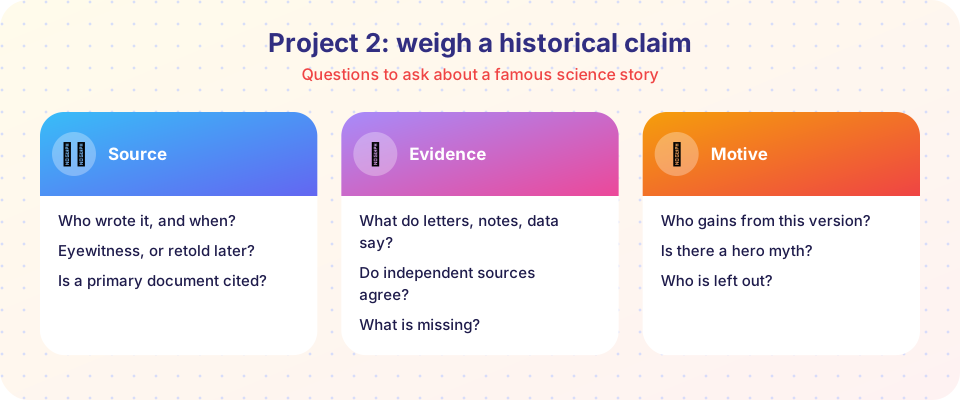
Many science stories are too good to be true: the apple that fell on Newton's head, Archimedes shouting "Eureka" in the bath, Galileo dropping weights from a tower, Franklin's kite proving that lightning is electric. Some are partly true, some are legends and some are true but misleading. In this project you will use three questions to weigh a story and report your confidence honestly. It is the core skill of a historian.
What you will learn
- How to trace a story back to its earliest source.
- How to look for independent evidence and what counts.
- How to consider motive and hero myths.
- How to state a confidence level with reasons.
Key terms
Provenance: the origin and chain of custody of a source or story.
Eyewitness: someone who saw the events; their report can still be mistaken or biased.
Hagiography: a flattering biography that treats a person like a saint.
Corroboration: support from an independent source.
Question 1: where does the story come from?
Find the earliest written source. For Newton's apple, the main source is Newton's friend William Stukeley, who in 1752 wrote down a conversation from 1726 in which an elderly Newton told him that the notion of gravitation came into his mind while sitting in a garden when an apple fell. John Conduitt, Newton's relative, recorded a similar story. Nothing in Newton's own papers from the 1660s says so, and the story that the apple hit his head appears much later. A late source, a retelling and a story told by an old man about his youth: these lower confidence, though they do not disprove it.
Question 2: what other evidence exists?
Look for documents from the time: letters, notebooks, instrument records and datasets. For the claim that Galileo dropped weights from the Tower of Pisa, the first source is his student Vincenzo Viviani writing more than a decade after Galileo's death; Galileo's own writings discuss inclined planes and thought experiments, and no record of a tower demonstration survives from his time. Franklin's own 1752 proposal for a lightning experiment used a sentry box with an iron rod; the experiment was first carried out in France (Dalibard, May 1752); Franklin's kite account, in a newspaper (Pennsylvania Gazette, October 1752), is brief and does not name him doing it, and later accounts add details. Independent evidence strengthens a claim; a missing piece weakens it, but absence of evidence is not proof of absence.
Question 3: who benefits, and what myths are at play?
Stories survive when they are memorable and when they serve someone's interests: a nation's pride, a university's founder, a profession's image. The "lone genius" story erases collaborators and predecessors. A story that explains a deep idea with a simple event (an apple, a bath) is easy to teach, which is both a virtue and a risk. Ask: What does this story want me to believe? Who is missing from it?
Rate your confidence
Use a simple scale:
| Level | Meaning |
|---|---|
| High | Several independent early sources agree; consistent with documents from the time |
| Medium | One early source plus later retellings; plausible but not confirmed |
| Low | Late sources only, conflicts with documents, or reads like a legend |
State the level and the reasons, and note what evidence would change your mind.
Common misconceptions
"If a story is false, the science is wrong." Gravity does not depend on the apple story. A story can be a legend while the science behind it is sound.
"Old sources are reliable because they are close to the events." Closeness helps, but memory, bias and purpose matter.
"Debunking is the goal." The goal is a more accurate and more interesting account, including how and why the legend arose.
Try it
A scoring script for your project. Give each source a score for how early it is, how independent and how detailed, then print a confidence level. This is a thinking aid with arbitrary weights, not a scientific measurement.
Press Run (or Ctrl + Enter) to see the result here.
Program input · what you'd type while the program runs
Type the answers before you press Run, one per line. Each time the program reads a line (with input()), it gets the next line from this box.
Second, a flip-card trainer with famous stories and the main reason to doubt each.
Check your understanding
Quick check · 5 questions
of 5 answered You scored / 5 · perfect!
-
1. What is the earliest source for the apple story?
The accounts come from friends and relatives writing down what an older Newton said. -
2. What is corroboration?
Independent sources raise confidence. -
3. What does a late source with no contemporary documents typically give?
Lower confidence, but not proof that the story is false. -
4. Why might a lone-genius story be misleading?
Most discoveries involve many people. -
5. If the Newton apple story is a legend, what follows for the theory of gravity?
Science stands on evidence; the story is a separate historical question.
Summary
- Ask where a story comes from, what other evidence exists and who benefits.
- Late, uncorroborated, hero-friendly stories deserve lower confidence.
- State your confidence and what would change it.
- A debunked story does not debunk the science.
Track your progress
Create a free account to tick off lessons and pick up where you left off on any device.
of History of Science lessons completed