


















Lesson 12 of 44 · Greek and Islamic Science
Greek natural philosophy: from Thales to Aristotle
How early Greek thinkers explained nature with reasons: Thales, Anaximander, Pythagoras, Democritus, Hippocrates and Aristotle, with their strengths and mistakes.
The Greeks did not have telescopes, microscopes or clocks. What they had was an unusual habit: they argued in public about the nature of the world and expected reasons. Cities such as Miletus, Athens and Syracuse were busy, literate trading places with little central religious authority, and thinkers could challenge one another. The result was a sequence of bold, competing theories.
What you will learn
- What Thales, Anaximander, Pythagoras and Democritus proposed
- How Hippocratic medicine looked for natural causes
- How Aristotle combined logic, observation and theory
- Where Aristotle was right, where he was wrong, and why both matter
Key terms
Arche: the original or underlying principle of things, a central Greek question.
Atom: from Greek atomos, uncuttable: Democritus's tiny indivisible particles.
Four causes: Aristotle's explanation of a thing by its matter, form, source of change and purpose.
Deduction: reasoning from general premises to a certain conclusion.
The Milesians
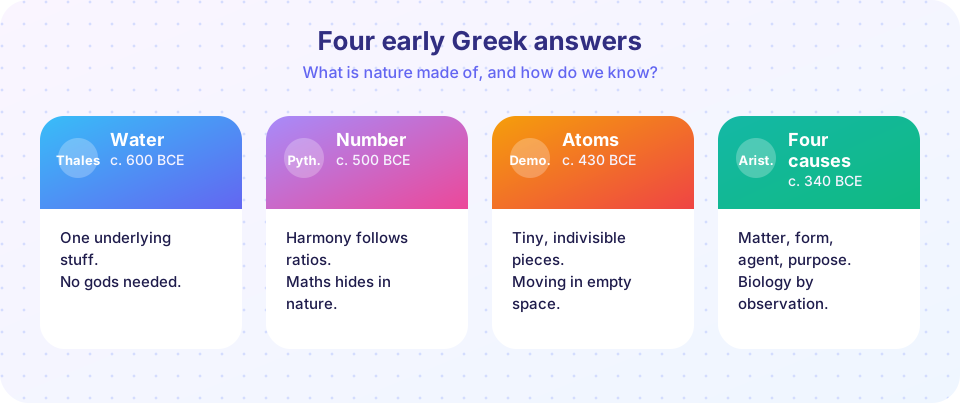
Thales (about 624 to 546 BCE) is called the first philosopher because he proposed that everything comes from water, and he did not need a god to explain why. Whether or not the claim was right, it was a general natural explanation. Tradition says he predicted a solar eclipse in 585 BCE, but historians doubt he had the knowledge to do so; he may have used Babylonian cycle knowledge.
Anaximander, a younger Milesian, said the source of things was the apeiron, the boundless. He drew a map of the known world and proposed that Earth floats unsupported at the centre. His idea that humans descended from other animals is a speculation, not an evolutionary theory in any modern sense.
Pythagoras and number
Pythagoras (about 570 to 495 BCE) is surrounded by legend, and many of the results credited to him came from his followers. The Pythagoreans believed that number underlies nature. Their best evidence was music: plucked strings whose lengths are in simple ratios give pleasing intervals. A string half as long sounds an octave higher (2:1), two-thirds as long gives a fifth (3:2), three-quarters gives a fourth (4:3). This is arguably the first quantitative law of physics. They also discovered that the diagonal of a square is incommensurable with its side, so that the square root of 2 is not a ratio of whole numbers, a result that disturbed their belief that everything is number.
Atoms and the void
Leucippus and Democritus (about 460 to 370 BCE) proposed that the world is made of indivisible atoms moving in empty space. Different shapes and arrangements make different materials. They had no experiments to support it, but the idea was a model of explanation: the visible world from invisible parts. Their rivals, such as Parmenides and Aristotle, argued that a void was impossible. The atomic idea survived in writings of Epicurus and Lucretius and was revived in the 1600s.
Hippocrates and the natural body
The Hippocratic writers (5th and 4th centuries BCE) argued that diseases have natural causes. The essay On the Sacred Disease, about epilepsy, says it is no more sacred than any other illness, and that calling it divine is a way of hiding ignorance. They emphasised careful observation, case histories, diet and prognosis. Their theory of four humours (blood, phlegm, yellow bile, black bile) was wrong, but their attitude, look first and use natural causes, was an important step.
Aristotle
Aristotle (384 to 322 BCE), a student of Plato and tutor of Alexander the Great, founded the Lyceum in Athens. He wrote on logic, physics, biology, ethics and politics. He created the first formal system of logic (the syllogism) and explained a thing by four causes: its matter, its form, what makes it, and its purpose.
In biology he was an outstanding observer. He dissected animals, described the development of the chick embryo, classified hundreds of species, and noted that dolphins breathe air and bear live young, unlike fish, and he often explained animal parts by their purpose.
In physics and cosmology he was less fortunate. He taught that heavier objects fall faster in proportion to weight, that there are four elements plus a fifth, the heavenly aether, that Earth sits motionless at the centre, and that the heavens are perfect and unchanging. This system was coherent, matched everyday experience, and was taught for nearly two thousand years. Its overthrow in the 1500s and 1600s is the story of chapter 4.
Common misconceptions
"Greek thinkers never tested anything." Hippocratic physicians, Aristotle's biology and later Archimedes and Ptolemy all used observation and measurement. They did not usually design experiments to isolate variables.
"Aristotle was simply wrong about everything." He was often right in biology and logic, and his errors in physics were reasonable given what could be seen.
"Pythagoras proved his theorem." The relation was known earlier in Babylon and India; the earliest surviving Greek proof is in Euclid, later than Pythagoras.
Try it
First, compute the Pythagorean string ratios and plot an octave and a fifth. Second, compare Aristotle's fall-speed rule with the physics of a short drop.
Press Run (or Ctrl + Enter) to see the result here.
Program input · what you'd type while the program runs
Type the answers before you press Run, one per line. Each time the program reads a line (with input()), it gets the next line from this box.
Press Run (or Ctrl + Enter) to see the result here.
Program input · what you'd type while the program runs
Type the answers before you press Run, one per line. Each time the program reads a line (with input()), it gets the next line from this box.
Check your understanding
Quick check · 5 questions
of 5 answered You scored / 5 · perfect!
-
1. Which ratio gives an octave on a string?
A string half as long gives a pitch an octave higher. -
2. What was the Hippocratic claim about epilepsy?
On the Sacred Disease argued for natural causes. -
3. Who proposed that the world is made of atoms and void?
Leucippus and Democritus, around 460 to 370 BCE. -
4. Where was Aristotle most reliable?
He observed and dissected animals carefully but was wrong about falling bodies and the heavens. -
5. Why did the Pythagoreans find the square root of 2 troubling?
Incommensurable lengths challenged the belief that number explains everything.
Summary
- Greek thinkers offered natural explanations and argued for them: water, number, atoms, four causes.
- Pythagorean string ratios are an early quantitative law.
- Hippocratic medicine sought natural causes and careful observation, even with a wrong humour theory.
- Aristotle was an outstanding observer in biology and a founder of logic, but his physics and cosmology were wrong in ways that later had to be overturned.
Next: Hellenistic science
Track your progress
Create a free account to tick off lessons and pick up where you left off on any device.
of History of Science lessons completed