


















Lesson 28 of 44 · Physics and Chemistry Transformed
Energy and Thermodynamics: Carnot, Joule and Clausius
How steam engines led to Carnot's efficiency limit, Joule's measurement of the mechanical equivalent of heat, energy conservation and Clausius's entropy.
Why can a steam engine never turn all of its heat into work? Why does a hot cup of tea cool down but never heat itself back up? The answers belong to thermodynamics, a science that grew out of the practical problem of running engines. In this lesson you will see how a French engineer, an English brewer's son and a German professor built the concepts of energy and entropy, and why the story involves priority disputes.
What you will learn
- What Carnot proved about heat engines in 1824, even with a mistaken theory of heat.
- How Joule's careful measurements showed heat and work are equivalent.
- How conservation of energy emerged from several people at once.
- What entropy and the second law mean, in plain words.
Key terms
Caloric theory: the older view that heat is a weightless fluid that flows from hot to cold.
Mechanical equivalent of heat: the number of joules of work that produce one calorie of heat (about 4.186 J per calorie).
First law: energy is conserved; it changes form but is neither created nor destroyed.
Entropy: a measure that, for an isolated system, never decreases in natural processes.
Carnot: the limit of engines
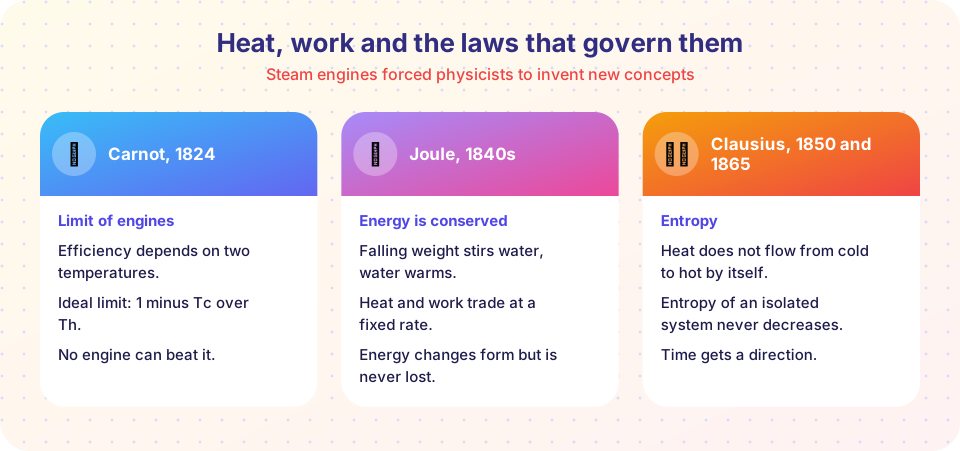
James Watt's improved steam engines of the 1770s and 1780s made Britain's industry run, and French engineers wanted to know how much better engines could become. In 1824 Sadi Carnot, a young French military engineer, published Reflections on the Motive Power of Fire. He imagined an ideal engine that takes heat from a hot source, converts some to work, and discards the rest to a cold sink. His great insight: the maximum efficiency depends only on the temperatures of the source and sink, not on the working fluid. He compared the engine to a waterwheel, where output depends on the height the water falls.
In modern notation, with absolute temperatures in kelvin, the ideal efficiency is 1 - Tc/Th. Carnot reasoned with the caloric theory and thought heat was conserved, which is wrong, but his result survived because the heart of it was the reasoning about reversible cycles. He died of cholera in 1832 aged 36, and his work was nearly forgotten until Émile Clapeyron and William Thomson (Kelvin) rediscovered it.
Joule: heat is motion, measured
James Prescott Joule, who managed his family's brewery in Manchester, had a precise sense of temperature thanks to his trade. From 1843 he measured how much temperature rise a given amount of mechanical work produced. In the best-known version of his experiment a falling weight turned paddles in a container of water, and Joule measured the water's temperature rise with a thermometer that could read to a fraction of a degree. His 1850 value was equivalent to about 4.16 J per calorie, remarkably close to the modern 4.186.
Joule's results were not at first welcomed by the Royal Society, and he presented them at a meeting in Oxford in 1847, where William Thomson heard him and became interested. The two later worked together on the Joule-Thomson effect and on the absolute temperature scale.
Energy conservation: many hands
By the 1840s several scientists reached the principle of energy conservation: the physician Julius Robert Mayer in 1842 from observations of blood color and a calculation of the heat equivalent of work; Joule from experiments; Hermann von Helmholtz in 1847 from physics and physiology, with a mathematical statement. Historians call this a case of "simultaneous discovery" and note that it grew from a shared set of problems: engines, electrochemical cells, animal heat and Romantic ideas about the unity of natural forces. Priority arguments followed, and Mayer suffered a breakdown.
The first law says energy is conserved. Machines cannot create energy from nothing, which ended many "perpetual motion" schemes.
Clausius, Kelvin and entropy
Carnot's efficiency rule and Joule's equivalence conflicted until Rudolf Clausius (1850) and Kelvin (1851) reconciled them: heat is not conserved by itself, but energy overall is; and heat does not flow by itself from a colder to a hotter body. This is the second law. In 1865 Clausius introduced entropy, which for reversible heat transfer changes by dS = dQ/T, and summarized the laws: the energy of the universe is constant; the entropy of the universe tends to a maximum. Ludwig Boltzmann in the 1870s explained entropy statistically, as a measure of the number of microscopic arrangements that look the same; this connected thermodynamics to atoms (see the next chapter).
The second law gives time a direction. Mixing cream into coffee is easy, unmixing it is not. It also fixed the practical limit: a power station burning fuel at about 800 K with a sink at 300 K can at best reach about 62% efficiency, and real plants fall short.
Common misconceptions
"Entropy is just disorder." Disorder is a rough picture. Entropy is a precise quantity, and local decreases are allowed when entropy is exported elsewhere, as in refrigerators and living things.
"Energy is used up." Energy is conserved; it spreads into forms (like low-grade heat) that are less useful.
"Carnot's theory was a mistake because caloric is false." His main result was valid; only the explanation was off.
Try it
First, compute Joule's experiment with numbers. A 10 kg weight falls 2 m, driving paddles in 1 kg of water. Water's specific heat is about 4184 J per kg per K.
Press Run (or Ctrl + Enter) to see the result here.
Program input · what you'd type while the program runs
Type the answers before you press Run, one per line. Each time the program reads a line (with input()), it gets the next line from this box.
Second, a plot of the Carnot limit as the cold temperature changes, with the hot reservoir fixed at 800 K.
Press Run (or Ctrl + Enter) to see the result here.
Program input · what you'd type while the program runs
Type the answers before you press Run, one per line. Each time the program reads a line (with input()), it gets the next line from this box.
Check your understanding
Quick check · 5 questions
of 5 answered You scored / 5 · perfect!
-
1. What does Carnot's limit depend on?
The ideal efficiency is 1 minus Tc over Th, regardless of working fluid. -
2. What did Joule's paddle experiment show?
Work done on water raised its temperature in proportion, giving about 4.2 J per calorie. -
3. Who developed the idea of energy conservation?
It is a standard example of near-simultaneous discovery. -
4. What does the second law say in plain terms?
That is Clausius's statement: it fixes the direction of natural processes. -
5. Who explained entropy statistically in the 1870s?
Ludwig Boltzmann linked entropy to the count of microscopic arrangements.
Summary
- Carnot (1824) showed that engine efficiency is limited by two temperatures.
- Joule (from 1843) measured that heat and work are equivalent, about 4.2 J per calorie.
- Mayer, Joule and Helmholtz independently reached energy conservation.
- Clausius and Kelvin stated the second law; Clausius named entropy in 1865.
- Boltzmann linked entropy to atoms and probability.
Track your progress
Create a free account to tick off lessons and pick up where you left off on any device.
of History of Science lessons completed