


















Lesson 16 of 44 · The Scientific Revolution
Chapter overview: The Scientific Revolution
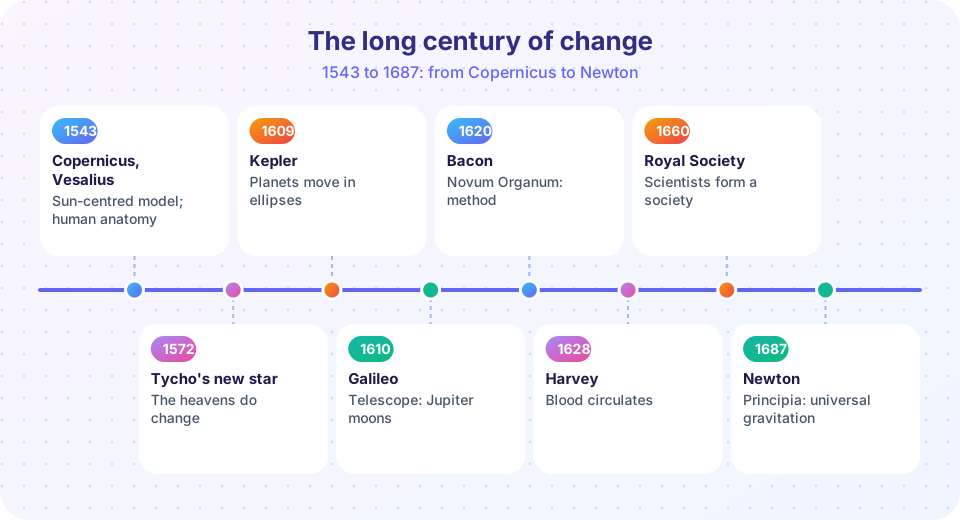
A map of the Scientific Revolution from Copernicus and Vesalius in 1543 to Newton's Principia in 1687: causes, key people, new instruments and the debate over the label.
In 1543 two books appeared that challenged ancient authorities. Nicolaus Copernicus argued that Earth moves around the Sun. Andreas Vesalius, in a lavishly illustrated volume based on his own dissections, corrected hundreds of errors in Galen's anatomy. In 1687 Isaac Newton published a book that explained the motion of falling stones and orbiting planets by the same mathematical laws. Between those dates, astronomy, physics, anatomy and method were remade.
Historians call this the Scientific Revolution. This chapter follows it through the people, instruments and ideas that drove it, and asks whether "revolution" is the right word.
What you will learn
- The causes behind the burst of change after 1500
- The main people and the order of their work
- Why historians debate the label "Scientific Revolution"
- What each lesson in the chapter covers
Key terms
Heliocentric: sun-centred. Geocentric: Earth-centred.
Mathematical law: a precise, quantitative relation between measurable quantities.
Experiment: a deliberately arranged test to see what happens.
Learned society: an organisation such as the Royal Society where members share results.
Why then?
No single cause explains the timing, but several conditions came together.
- Printing. Movable type reached Europe around 1450. Books and diagrams could be copied exactly and distributed widely, so a result in Poland could be checked in Italy within years.
- Recovered texts. Humanist scholars brought back Greek works, including Archimedes, which showed what mathematics could do.
- Instruments and craft. Lens grinders, instrument makers, surveyors, navigators and artillerymen developed skills that scholars began to value.
- Patronage and trade. Princes and merchants paid for observatories, voyages and collections, and ocean navigation created a demand for accurate astronomy.
- Religious upheaval. The Reformation and Catholic reform made authority a live question and led to new institutions.
Causes
Ideas
Institutions
Was it a revolution?
The label was popularised in the 20th century, notably by Herbert Butterfield and Alexandre Koyré. Some scholars have questioned it. Steven Shapin began a book on the period with the line that there was no such thing as the Scientific Revolution, and this is a book about it, making the point that "science" was not a single unified activity at the time. Alchemy, astrology, natural magic and theology were part of many thinkers' work, including Newton's. Other historians stress long-term continuity from medieval natural philosophy, and from the Islamic and Greek traditions.
The practical view: whatever we call it, between 1543 and 1687 several fields changed their basic framework, and a new combination of mathematics, measurement and experiment became widely admired.
What this chapter covers
| Lesson | Focus |
|---|---|
| Heliocentrism: Copernicus to Kepler | A moving Earth, precise data and laws of planetary motion |
| Galileo and the new instruments | Telescope, microscope, falling bodies, the trial |
| Newton and the method of science | Bacon, Descartes, the Royal Society and the Principia |
| Chapter 4 review | Recap and quiz |
Common misconceptions
"Science and religion were simply at war." Many leading figures were devout, and Church institutions funded much astronomy; conflicts such as Galileo's trial were tied to politics, personalities and theology.
"Copernicus's model was obviously simpler and better." It explained retrograde motion neatly, but it still used circles and epicycles and lacked a physics for a moving Earth, so it was no more accurate than Ptolemy's at first.
"Everyone adopted the new ideas quickly." Acceptance took generations; Newtonian physics reached some European universities decades after 1687.
Try it
First, plot who was alive when, and see how the main figures overlap. Second, a small tool asks whether two people could have met.
Press Run (or Ctrl + Enter) to see the result here.
Program input · what you'd type while the program runs
Type the answers before you press Run, one per line. Each time the program reads a line (with input()), it gets the next line from this box.
Press Run (or Ctrl + Enter) to see the console output here.
No output.
Check your understanding
Quick check · 4 questions
of 4 answered You scored / 4 · perfect!
-
1. Which two books appeared in 1543?
Both works challenged ancient authorities. -
2. Which development helped results spread quickly?
Printing made exact copies of texts and diagrams possible. -
3. Why do some historians question the label Scientific Revolution?
Alchemy, theology and medieval traditions were mixed in, and continuity matters. -
4. Which statement about Copernicus's model is accurate?
Ellipses came with Kepler.
Summary
- The Scientific Revolution (1543 to 1687) reshaped astronomy, physics and anatomy.
- Printing, instruments, patronage, voyages and religious change set the stage.
- The label is debated; science was not yet one unified activity and continuity was strong.
- The next lessons follow Copernicus to Kepler, Galileo, and Newton and the method.
Track your progress
Create a free account to tick off lessons and pick up where you left off on any device.
of History of Science lessons completed