


















Lesson 19 of 44 · The Scientific Revolution
Newton and the method of science
How Bacon and Descartes proposed methods, the Royal Society organised science, and Newton's Principia explained falling apples and orbiting planets with one law.
By the mid-1600s, Europe had new observations (Galileo, Tycho, Harvey), new laws (Kepler's three), and a puzzle: why do planets obey Kepler's laws? Two kinds of answers were needed. One was about method: how should one investigate nature? The other was about physics: what single set of laws governs both earthly and heavenly motion? Francis Bacon and René Descartes proposed methods. Isaac Newton's Principia answered the physics.
What you will learn
- What Bacon and Descartes each proposed about method
- How the Royal Society changed how science was organised
- What Newton's laws of motion and gravitation say
- How Newton explained Kepler's laws and tested gravity on the Moon
Key terms
Induction: reasoning from many observations to a general rule.
Deduction: reasoning from general principles to specific conclusions.
Inertia: the tendency of a body to keep its state of motion unless acted on by a force.
Universal gravitation: every mass attracts every other with a force proportional to the product of the masses and inversely proportional to the square of their distance.
Two methods
Francis Bacon (1561 to 1626), an English lawyer and statesman, wrote Novum Organum (1620). He argued that natural philosophy must be rebuilt on collecting facts carefully, tabulating cases and then moving cautiously to general rules (induction), and he warned against "idols", habits of mind such as prejudice and reliance on authority that mislead us. He also imagined a collaborative research institution, which later inspired the Royal Society. Bacon did not do much science himself, and his insistence on pure induction was too simple, but his picture of organised, shared investigation was influential.
René Descartes (1596 to 1650), a French mathematician and philosopher, took the opposite emphasis in Discourse on Method (1637). He began by doubting everything he could and rebuilt knowledge from certain foundations, using reason and mathematics (deduction). He invented coordinate geometry, linking algebra and geometry, and pictured nature as a vast machine whose parts push on one another, the "mechanical philosophy". His specific physical theories, such as vortices of matter carrying the planets, turned out wrong, but his insistence that nature should be explained by mathematics and mechanism shaped later work.
Real science needed both: observation and experiment and mathematical reasoning. Galileo and Newton showed how they combine.
The Royal Society
In 1660 a group of scholars in London formed a society to promote experimental knowledge; Charles II chartered it in 1662 as the Royal Society. Its motto, Nullius in verba ("on no one's word"), expressed the idea that claims should be tested, not accepted on authority. It published the Philosophical Transactions from 1665, one of the first scientific journals, so results could be reported, criticised and dated. France's Académie des sciences (1666) did similar work. These institutions made science a public, cumulative activity.
Newton (1643 to 1727)
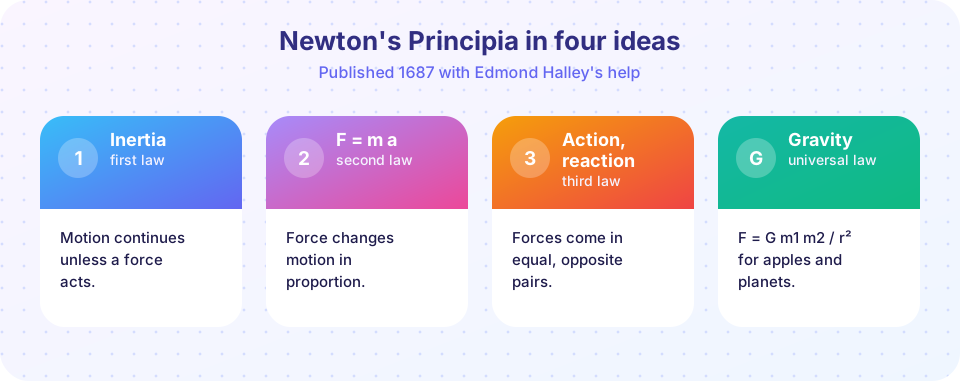
Isaac Newton, professor at Cambridge, worked on mathematics (calculus, developed around 1665 to 1666, and a bitter priority dispute with Gottfried Leibniz followed), optics (white light is a mixture of colours, shown with prisms; Opticks, 1704) and mechanics. Prompted by the astronomer Edmond Halley, who paid for printing, he published the Mathematical Principles of Natural Philosophy (Principia) in 1687.
The book states three laws of motion:
- Inertia. A body stays at rest or moves in a straight line at constant speed unless a force acts on it.
- F = ma. The acceleration of a body is proportional to the net force and inversely proportional to its mass.
- Action and reaction. When one body exerts a force on another, the second exerts an equal and opposite force on the first.
And a law of universal gravitation: the force between two masses is F = G m₁m₂ / r², where G is a constant. The value of G was first measured in the laboratory by Henry Cavendish in 1798; today it is about 6.674 × 10⁻¹¹ N m² kg⁻².
Newton showed that an inverse-square force toward the Sun gives elliptical orbits with the Sun at a focus, equal areas in equal times, and T² proportional to a³: Kepler's three laws as consequences. He also explained tides, the flattening of Earth and the paths of comets. The same law governs apples and planets.
A famous check, the Moon test: at the Moon's distance of about 60 Earth radii, gravity should be 1/60² = 1/3600 as strong as at Earth's surface: 9.8/3600 ≈ 0.0027 m/s². The Moon's actual centripetal acceleration, from its orbital period and distance, matches.
Newton also spent enormous effort on alchemy and theology, and his private views did not match the later image of a pure rationalist. Context matters (lesson 1.3). He wrote to Robert Hooke in 1675 that "if I have seen further it is by standing on the shoulders of giants," a phrase older than him, and a fair summary of the chain in this chapter.
Common misconceptions
"Newton discovered gravity." People knew things fall. Newton's achievement was a mathematical law that explains falls, tides and orbits, and he tested it quantitatively.
"Bacon's method is how science works." Real science uses theory to guide observation. Pure data collection without ideas goes nowhere.
"Newtonian physics is wrong." It is an excellent approximation at everyday speeds and masses; Einstein's relativity refines it at high speeds and strong gravity (chapter 7).
Try it
First, run the Moon test. Second, simulate a planet under an inverse-square force and check Kepler's second law numerically.
Press Run (or Ctrl + Enter) to see the result here.
Program input · what you'd type while the program runs
Type the answers before you press Run, one per line. Each time the program reads a line (with input()), it gets the next line from this box.
Press Run (or Ctrl + Enter) to see the result here.
Program input · what you'd type while the program runs
Type the answers before you press Run, one per line. Each time the program reads a line (with input()), it gets the next line from this box.
Check your understanding
Quick check · 5 questions
of 5 answered You scored / 5 · perfect!
-
1. What did Bacon emphasise?
Induction and collaboration were his themes; Descartes stressed deduction. -
2. What is the Royal Society's motto Nullius in verba about?
It means on no one's word. -
3. Which statement is Newton's second law?
F = ma; the other two are the third and first laws. -
4. How did Newton explain Kepler's laws?
He derived them from his law of gravitation. -
5. Who first measured G in a laboratory, and when?
Cavendish's torsion balance experiment.
Summary
- Bacon urged induction and shared research; Descartes urged deduction, mathematics and mechanism; real science uses both.
- The Royal Society and its journal made science public and cumulative.
- Newton's three laws and law of gravitation unified earthly and heavenly motion and explained Kepler's laws.
- The Moon test checks the inverse-square law.
- Newtonian physics remains an excellent approximation, later refined by relativity.
Next: Chapter 4 review
Track your progress
Create a free account to tick off lessons and pick up where you left off on any device.
of History of Science lessons completed