


















Lesson 9 of 44 · Science Before Science
The Americas and the Pacific: cycles, cords and wayfinding
Discover Maya astronomy and base-20 numbers, Inca quipu record keeping and Polynesian wayfinding, and why oral and non-written knowledge is hard for historians.
Some of the most impressive ancient knowledge was not written on clay or paper. The Maya tracked Venus for centuries and wrote numbers with a true zero. The Inca ran a vast empire with a record system made of knotted cords. Polynesian navigators crossed thousands of kilometres of open ocean using stars, swells and birds, and settled islands from Hawai'i to New Zealand. These systems show that organised, accurate knowledge takes many forms.
What you will learn
- How Maya astronomers tracked Venus and combined calendars
- How base-20 Maya numbers and the quipu worked
- What Polynesian wayfinding involved and how it was demonstrated in modern times
- Why historians have to read non-written systems differently
Key terms
Synodic period: the time a planet takes to return to the same position relative to the Sun as seen from Earth (about 584 days for Venus).
Calendar round: the 52-year cycle after which the Maya 260-day and 365-day counts repeat their combination.
Quipu (khipu): an Andean record of knotted cords.
Wayfinding: navigation by natural signs, without instruments.
Maya sky and calendars
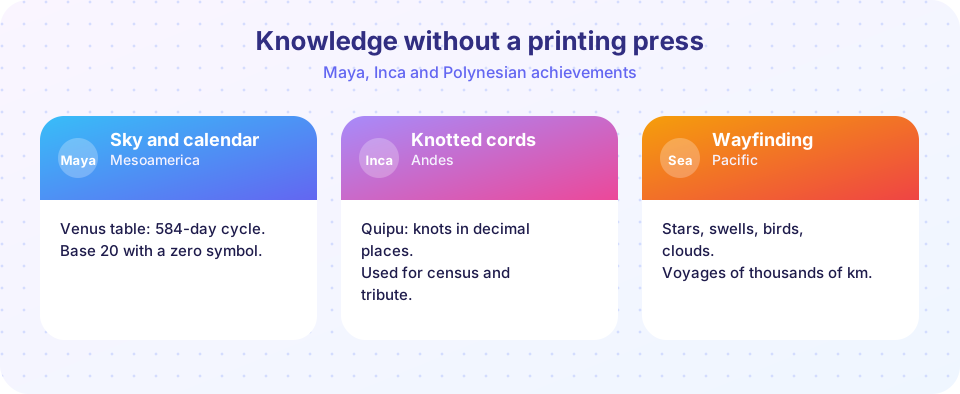
The Maya of Mesoamerica built observatories aligned to the Sun and planets, and recorded observations in bark-paper books, of which only four survive in full. The Dresden Codex (a surviving copy, probably from the 11th or 12th century CE, of older material) contains a table on Venus. It lists the planet's cycle as 584 days; the modern value of the synodic period is 583.92 days. The table groups five Venus cycles into 2,920 days, which equals exactly eight 365-day years, and it includes corrections to keep long runs aligned. Venus mattered in religion and in timing of events, which gave strong reasons to watch it carefully.
The Maya used interlocking calendars: a 260-day count (the tzolk'in), a 365-day year (the haab') and a continuous Long Count of days from a mythical starting date in 3114 BCE. A given combination of the first two repeats every 18,980 days, which is 52 years.
Their numbers were base 20: a dot for 1, a bar for 5, and a shell-shaped glyph for zero, with digits stacked vertically. Zero as a true placeholder appears in Maya inscriptions long before it reached Europe, although there is no evidence that the two traditions influenced each other.
Inca quipu
The Inca Empire (about 1400 to 1532 CE) had no known writing of the usual kind. Administrators kept records on quipus: a main cord with hanging cords that carry knots. Knot type and position show numbers, in a decimal positional system, with clusters for units, tens, hundreds. Colour and cord arrangement presumably recorded categories such as goods or districts. Specialists called quipucamayocs maintained and read them. Quipu records were used for census, tribute and storehouses. Some scholars think certain quipus encode narrative or other non-numeric information, but this is not deciphered.
Polynesian wayfinding
Polynesian voyagers settled the Pacific over about three thousand years, reaching Hawai'i by around the 11th to 13th centuries and Aotearoa (New Zealand) by about 1300 CE. They sailed in double-hulled canoes and navigated without compasses or charts. Wayfinders memorised the rising and setting points of dozens of stars, read the direction of ocean swells (which persist across long distances), noted cloud formations over islands, the flight paths of land-based birds at dawn and dusk, and the colour of water. Knowledge passed from master to apprentice through chants and practice.
In 1976 the canoe Hōkūle'a sailed from Hawai'i to Tahiti, guided by Mau Piailug, a navigator from Satawal in Micronesia, using traditional methods. This voyage showed such navigation is workable and renewed a tradition that colonial history had suppressed.
Reading non-written systems
For written records, historians can read the text. For quipus, wayfinding and oral traditions they use archaeology, linguistics, descendants' testimony and experiment. This does not make the knowledge lesser. It means the historian must be humble about gaps and respectful of living communities that hold the knowledge.
Common misconceptions
"The Maya predicted the end of the world in 2012." The Long Count simply rolled over a large unit (the 13th b'ak'tun) on 21 December 2012. Maya sources describe the date as a cycle completion, not an apocalypse.
"Polynesians reached islands by accident." Analysis of settlement patterns, tradition and the 1976 voyage point to deliberate, skilled navigation, including return voyages.
"Without writing there is no mathematics." The quipu stores decimal numbers and the Maya had zero; both are mathematical systems.
Try it
First, a Maya number converter that prints dots, bars and shells. Second, a quipu decoder for a cord with knot clusters.
Press Run (or Ctrl + Enter) to see the result here.
Program input · what you'd type while the program runs
Type the answers before you press Run, one per line. Each time the program reads a line (with input()), it gets the next line from this box.
Press Run (or Ctrl + Enter) to see the console output here.
No output.
Check your understanding
Quick check · 5 questions
of 5 answered You scored / 5 · perfect!
-
1. What was the Maya Venus cycle in the Dresden Codex?
Venus's synodic period is about 584 days (modern value 583.92). -
2. How many days until the 260-day and 365-day Maya counts realign?
18,980 days is 52 years, the calendar round. -
3. What did the Inca quipu mainly record?
Knot position and type encode decimal digits; narrative use is debated. -
4. How did Polynesian navigators find their way?
They used natural signs learned through apprenticeship. -
5. What is true of Maya numerals?
Dots, bars and a zero glyph were used in base 20.
Summary
- Maya astronomers tracked Venus at about 584 days and combined calendars into a 52-year round.
- Maya numbers were base 20 with a zero glyph; Inca quipus stored decimal numbers in knots.
- Polynesian wayfinding used stars, swells and birds; the 1976 Hōkūle'a voyage demonstrated it.
- Non-written systems demand different tools from historians and respect for living knowledge.
Next: Chapter 2 review
Track your progress
Create a free account to tick off lessons and pick up where you left off on any device.
of History of Science lessons completed