


















Lesson 33 of 44 · Twentieth-Century Revolutions
Genes and the Double Helix: Mendel to Watson and Crick
How Mendel's peas, Morgan's flies and the DNA experiments of Avery, Franklin, Watson and Crick built the science of heredity, with the controversies.
Darwin's theory needed heredity but could not explain it. The answer came in steps over ninety years: counting pea plants, finding genes on chromosomes, proving that DNA carries the information, and finally seeing the molecule's shape. The last step, in 1953, produced one of the most famous and most disputed stories in science. This lesson follows the whole path and asks who got credit.
What you will learn
- What Mendel found and why his work was ignored for 34 years.
- How Morgan's group showed that genes sit on chromosomes.
- Which experiments proved that DNA is the genetic material.
- How the double helix was found and why Rosalind Franklin's role is debated.
Key terms
Gene: a unit of heredity; molecularly, a stretch of DNA that encodes a product.
Allele: one version of a gene.
Dominant and recessive: an allele that shows in the heterozygote is dominant; one that is masked is recessive.
Base pairing: in DNA, A pairs with T and G with C through hydrogen bonds.
Mendel's peas
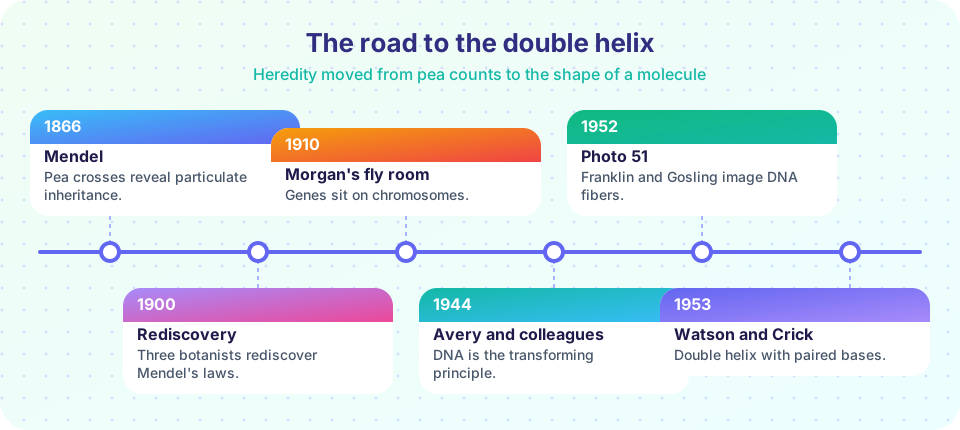
Gregor Mendel, an Augustinian friar in Brno, grew and crossed garden peas between about 1856 and 1863. He chose seven clear traits, such as round or wrinkled seed. Crossing pure round and pure wrinkled lines gave all round offspring in the first generation; crossing those among themselves gave about three round to one wrinkled in the second. He interpreted this as discrete "factors" in pairs, one from each parent, with one dominant. His published counts for seed shape were 5,474 round and 1,850 wrinkled, close to 3:1. He reported his work in 1865 and published it in 1866 in a local natural history society's journal. Few read it, and a letter to Carl Nägeli did not lead to follow-up.
In 1900 Hugo de Vries, Carl Correns and Erich von Tschermak each reported similar patterns and found Mendel's paper. In 1936 the statistician Ronald Fisher argued that Mendel's data fit expectations too well, which led to a long debate; most historians now suspect unconscious bias in counting or stopping rules rather than deliberate fraud, while Mendel's basic results have been repeatedly replicated.
Genes on chromosomes
Walter Sutton and Theodor Boveri observed in 1902 to 1903 that chromosomes behave like Mendel's factors. Thomas Hunt Morgan's "fly room" at Columbia University, starting in 1910 with Drosophila fruit flies, tested this. A white-eyed male fly showed that the trait tracks sex, linking a gene to the X chromosome. Alfred Sturtevant, an undergraduate, in 1913 drew the first genetic map by ordering genes along a chromosome from the frequency of recombination between them. By the 1920s heredity had a physical address. The modern synthesis (previous lessons) then joined genes to evolution.
Is it protein or DNA?
Chromosomes contain both DNA and proteins. Many biochemists, thinking DNA too simple, favored protein. In 1928 Frederick Griffith found that harmless pneumococcus bacteria could be transformed into virulent ones by a "transforming principle" from dead cells. In 1944 Oswald Avery, Colin MacLeod and Maclyn McCarty showed that the principle is DNA. In 1952 Alfred Hershey and Martha Chase labeled phage viruses with radioactive phosphorus (DNA) or sulfur (protein) and showed that DNA enters the host bacterium. Meanwhile, Erwin Chargaff showed that the amounts of A and T, and of G and C, are equal in each organism's DNA, while the overall ratio varies between species.
The double helix
By 1951 several teams tried to find DNA's structure. At King's College London, Maurice Wilkins and Rosalind Franklin used X-ray diffraction; Franklin, with her student Raymond Gosling, took very sharp images of the "B form" of DNA, including the one known as Photo 51 in May 1952. At Cambridge, James Watson and Francis Crick built physical models. In January 1953 Wilkins showed Watson Photo 51 without Franklin's knowledge; Crick also saw a King's College report with measurements. Watson and Crick put together a model with two chains running in opposite directions, with bases paired A to T and G to C inside, and published it in Nature on 25 April 1953, alongside papers by Wilkins's group and by Franklin and Gosling.
The structure immediately suggested how DNA is copied: unzip the strands and add matching bases to each. Matthew Meselson and Franklin Stahl confirmed semi-conservative copying in 1958. In the early 1960s Marshall Nirenberg, Har Gobind Khorana and others cracked the genetic code of three-letter words.
Watson, Crick and Wilkins received the 1962 Nobel Prize in Physiology or Medicine. Franklin had died of ovarian cancer in 1958 and Nobel prizes are not awarded posthumously. Historians now emphasize that she was a major contributor to the data and analysis, that credit was handled badly, and that Watson's 1968 memoir The Double Helix portrayed her unfairly. The balanced picture: the structure needed both the model builders and the crystallographers.
Common misconceptions
"Mendel was ignored because he was a monk." His journal was obscure, his statistical style was unusual for biology, and his ideas needed the later discovery of chromosomes to make sense.
"Franklin was robbed." She was not given the credit she deserved during the time, but the full story involves shared data, rivalry, communication failures and the rules of the Nobel Prize.
"One gene, one trait." Most traits involve many genes and the environment.
Try it
A Mendel simulator. Each offspring of two hybrid (Rr) parents gets one allele from each parent at random. Dominant R gives a round seed.
Press Run (or Ctrl + Enter) to see the result here.
Program input · what you'd type while the program runs
Type the answers before you press Run, one per line. Each time the program reads a line (with input()), it gets the next line from this box.
And a quick base-pairing tool: type a strand and see its complement.
Check your understanding
Quick check · 5 questions
of 5 answered You scored / 5 · perfect!
-
1. What ratio did Mendel observe in the second generation of a monohybrid cross?
Hybrid parents give offspring with a 3:1 ratio of dominant to recessive traits. -
2. Which experiment showed that DNA, not protein, enters bacteria from a virus?
They labeled DNA with phosphorus-32 and protein with sulfur-35 in bacteriophage. -
3. What did Alfred Sturtevant build in 1913?
He ordered genes by recombination frequency in Morgan's fruit flies. -
4. What is the base-pairing rule in DNA?
This pairing underlies Chargaff's rules and copying of DNA. -
5. Which statement about Rosalind Franklin is best supported?
Photo 51 and her measurements were essential; credit was handled badly, and she died before the 1962 prize.
Summary
- Mendel's pea crosses (1866) showed discrete inheritance; his work was rediscovered in 1900.
- Morgan's group placed genes on chromosomes and mapped them.
- Avery, MacLeod, McCarty and Hershey and Chase showed DNA is the genetic material.
- Franklin, Gosling, Wilkins, Watson and Crick together produced the double helix in 1953.
- Credit in this story is still discussed, which is itself a lesson about science as a human activity.
Track your progress
Create a free account to tick off lessons and pick up where you left off on any device.
of History of Science lessons completed