


















Lesson 5 of 44 · Getting Started
Chapter 1 review: Getting started
Recap the first chapter of the History of Science course: why history matters, how historians use sources, and the six eras, then test yourself with a ten-question quiz.
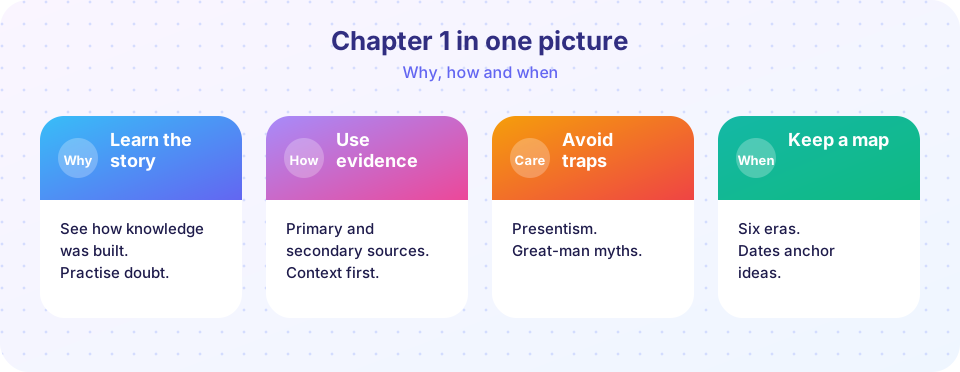
You have met the aims of the course, the toolkit historians use, and the big timeline. This review pulls them together in one picture and one table, and then tests you with ten questions that mix the whole chapter.
What you will learn
- A compact recap of the chapter's ideas
- How the toolkit applies to one new example
- Where you stand: ten questions across all four lessons
Key terms
Primary source: made at the time of the events.
Presentism: judging the past only by today's knowledge.
Context: the setting that gives an idea its meaning.
Anchor date: a date you use to place other events.
Recap table
| Lesson | Big idea | Example |
|---|---|---|
| Course map | Science grew slowly, in many places | Six eras from clay tablets to DNA |
| Why study it | History shows process, builds doubt, reveals people | Rømer and the speed of light |
| How historians work | Sources, context, avoiding presentism | The Pisa tower legend |
| Big timeline | Six eras and ten anchor dates | 1543 to 1687 |
A worked application
Suppose a website says: "In 1491 the Church burned a scientist for claiming Earth orbits the Sun." Run the toolkit.
- Source. Does the page cite a primary source? If not, be cautious.
- Date and context. Copernicus published in 1543, so no 1491 claim can be about his model. Galileo's trial was in 1633 and ended with house arrest, not burning. Giordano Bruno was burned in 1600, but for a mix of theological charges; his cosmic ideas were part of the case, so the story is real but complicated.
- Presentism check. Are we judging 1600 by 2020s values? We can condemn the punishment while still describing the situation accurately.
The lesson is not that the claim is false; it is that the exact version is probably wrong and the real story has more layers.
Try it
The first block lets you rehearse the anchor dates by shuffling them. The second plots the length of each era again so you remember how unequal they are.
Press Run (or Ctrl + Enter) to see the result here.
Program input · what you'd type while the program runs
Type the answers before you press Run, one per line. Each time the program reads a line (with input()), it gets the next line from this box.
Press Run (or Ctrl + Enter) to see the result here.
Program input · what you'd type while the program runs
Type the answers before you press Run, one per line. Each time the program reads a line (with input()), it gets the next line from this box.
Check your understanding
Quick check · 10 questions
of 10 answered You scored / 10 · perfect!
-
1. Who first showed that light takes measurable time to travel, using Jupiter's moon Io?
Rømer, working in Paris in 1676, interpreted the shifting eclipse times that way. -
2. A diary written the same week and a memoir written fifty years later disagree. Usually which is stronger evidence?
The diary is closer in time to the events and less affected by faded memory. -
3. What is Whig history?
Herbert Butterfield criticised this style in 1931. -
4. Which is NOT a reason the course gives for studying history of science?
History complements science; it does not replace experiments. -
5. In which era does Euclid's Elements belong in this course?
Euclid wrote about 300 BCE in Alexandria, part of the Greek tradition. -
6. Which date is an anchor for Newton's Principia?
The Principia was published in 1687. -
7. How many independent confirmations do three books that copy one source give?
They share one origin. -
8. What did most educated medieval Europeans think of Earth's shape?
The flat-Earth story spread in the nineteenth century. -
9. Why is the Scientific Revolution era so short in this course?
It spans about 144 years of intense change in physics and astronomy. -
10. Which statement shows context rather than presentism?
It asks why the model worked for people then.
Summary
- History of science builds understanding of process, practises doubt and reveals the human side.
- Check sources for date, authorship and independence; separate legend from evidence.
- Avoid presentism and great-man stories.
- Six eras and ten anchor dates give you a mental map for the next chapters.
Track your progress
Create a free account to tick off lessons and pick up where you left off on any device.
of History of Science lessons completed