


















Lesson 36 of 44 · Science, Society and Method
Chapter 8 Overview: Science, Society and Method
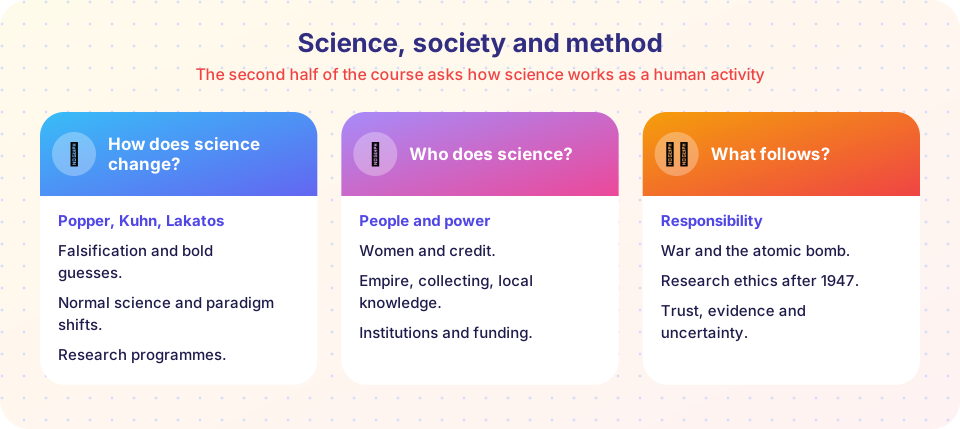
A guide to chapter 8: how science changes (Popper, Kuhn, Lakatos), who does science and gets credit, and what responsibilities come with scientific power.
So far this course has told stories of discoveries. This chapter steps back and asks three questions about science as a whole. How does scientific knowledge change, and is there a single scientific method? Who does science, and whose contributions are remembered? What happens when science meets war, empire, money and ethics? Historians, philosophers and sociologists of science have given partial answers, and you will see where they agree and where they do not.
What you will learn
- Why historians doubt that there is one fixed "scientific method".
- A preview of the ideas of Popper, Kuhn and Lakatos.
- Why asking "who?" and "for whom?" improves historical accounts.
- A map to the lessons of this chapter.
Key terms
Philosophy of science: the study of what scientific knowledge is and how it is justified.
Sociology of science: the study of scientists as a social group, including norms, institutions and incentives.
Presentism: judging the past only by present standards, or telling history as a march toward today.
Whig history: a story of inevitable progress with heroes and villains; a form of presentism.
Three lenses
Method. Textbooks often describe one "scientific method": observe, hypothesize, test, conclude. Real science is messier. Galileo used thought experiments, Darwin collected facts for decades before a hypothesis, and Maxwell worked from analogies. Philosophers have proposed rules, such as Karl Popper's demand that scientific claims be falsifiable, but each rule has exceptions, and practicing scientists use many styles of reasoning.
People. Science is done by people in institutions: universities, observatories, companies, armies and museums. Who is allowed to study, publish and be cited affects what is known. Historians therefore look at assistants, instrument makers, translators, collectors and local informants as well as the famous names.
Context. Ideas arise in a particular time. The Industrial Revolution shaped thermodynamics; empire shaped natural history; world wars shaped physics, chemistry and medicine. Context does not mean that scientific results are merely opinions. It means that the questions asked, the resources provided and the stories told are shaped by society.
Chapter 8 at a glance
Questions to carry
Warning signs
A guide to the chapter
- How science changes: Popper, Kuhn and after compares philosophies of method and shows what each explains.
- Science, war, empire and who gets heard examines credit, collecting, weapons and research ethics through case studies.
- The chapter review summarizes both with a quiz.
Common misconceptions
"If science has social context, it is not objective." Objectivity in practice comes from shared methods, open criticism and replication by different people. Social analysis helps explain why those safeguards are needed.
"History of science is just a list of discoveries." Good history explains how and why knowledge was made, including the mistakes and dead ends.
Try it
A short "claim checker": for each famous story, list who benefits from the simple version. It is a thinking aid, not a verdict.
Press Run (or Ctrl + Enter) to see the result here.
Program input · what you'd type while the program runs
Type the answers before you press Run, one per line. Each time the program reads a line (with input()), it gets the next line from this box.
And an interactive slider: how much does credit shrink as the story gets shorter? A toy illustration with made-up weights, only to show the idea.
Check your understanding
Quick check · 4 questions
of 4 answered You scored / 4 · perfect!
-
1. What is a major problem with the textbook 'one scientific method'?
Historians find different methods in different fields and times. -
2. What is Whig history?
It reads the past only as a path to the present. -
3. Why look at assistants and instrument makers?
Science is a collective activity. -
4. Does social context mean results are mere opinion?
Context and objectivity can coexist.
Summary
- Chapter 8 asks how science changes, who does it and what follows from its power.
- There is no single method that fits all science.
- Credit and context are part of the history.
- Good history avoids hero myths and inevitable-progress stories.
Track your progress
Create a free account to tick off lessons and pick up where you left off on any device.
of History of Science lessons completed