


















Lesson 4 of 44 · Getting Started
A big timeline of science
A map of the whole story: six eras of science from ancient knowledge to modern physics and biology, with anchor dates, and how to read BCE/CE dates.
Before diving into details it helps to see the whole shape. If you know only ten dates, you can place almost any discovery. This lesson gives you six eras, a set of anchor dates, and a few habits for reading history on a time axis.
What you will learn
- The six eras this course uses and the main idea of each
- Ten anchor dates that make the rest easier to place
- How to read dates written as BCE and CE
- Why dividing history into eras is a useful, imperfect tool
Key terms
BCE / CE: "before the Common Era" and "Common Era", the neutral labels for dates before and after year 1. There is no year 0.
Periodisation: dividing history into named periods for convenience.
Century: the 1600s are the 17th century (1601 to 1700); counting is off by one from the digits.
Anchor date: a date you remember well and use to place other events.
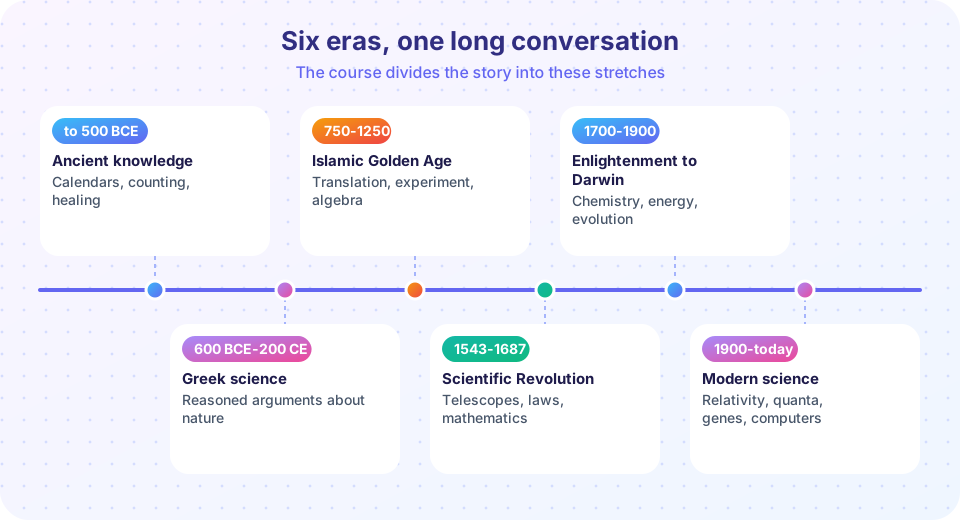
Six eras
- Ancient knowledge (to about 500 BCE). Farming, building and trade need calendars, counting and healing. Mesopotamia, Egypt, China, India and the Americas keep records of the sky and develop arithmetic.
- Greek science (about 600 BCE to 200 CE). Thinkers such as Thales and Aristotle argue that nature follows its own rules, and mathematicians such as Euclid and Archimedes organise proofs.
- The Islamic Golden Age (about 750 to 1250). Scholars in Baghdad, Cairo, Cordoba and Persia translate, test, extend and correct earlier work, inventing algebra and advancing optics, medicine and astronomy.
- The Scientific Revolution (1543 to 1687). New instruments, careful measurement and mathematical laws replace much of ancient physics and cosmology.
- Enlightenment to Darwin (about 1700 to 1900). Chemistry, geology, energy and life sciences develop quickly, and the idea of evolution arrives.
- Modern science (1900 to today). Relativity, quantum theory, genetics, plate tectonics, the Big Bang and computing.
The eras are uneven: the first lasts about 2,700 years in this course, the fourth only 144. That unevenness is itself a finding. Knowledge accumulated slowly for millennia and then sped up as communication, printing and institutions improved.
Ten anchor dates
| Date | Event |
|---|---|
| c. 1800 BCE | Babylonian scribes use base-60 place value |
| c. 240 BCE | Eratosthenes estimates Earth's size |
| c. 150 CE | Ptolemy writes the Almagest |
| c. 820 | al-Khwarizmi's book on al-jabr |
| c. 1015 | Ibn al-Haytham's Book of Optics |
| 1543 | Copernicus and Vesalius publish |
| 1687 | Newton's Principia |
| 1859 | Darwin's On the Origin of Species |
| 1905 | Einstein's "miracle year" papers |
| 1953 | Watson, Crick, Franklin, Wilkins: DNA structure |
Two of these are easy to mix up: the Scientific Revolution is 1543 to 1687 (143 or 144 years), and the nineteenth century belongs to the 1800s. Spend a minute tying each era to one date and one person.
Reading dates
BCE years count backward: 300 BCE is earlier than 200 BCE. The difference between 300 BCE and 200 CE is 500 years (there is no year 0, so strictly 499, but historians usually round). Words such as "c." or "circa" mean about; if a date is uncertain, treat it as a range.
Centuries are named by the next hundred: the 17th century is 1601 to 1700. Many history books also use "early modern" for roughly 1500 to 1800.
Why eras are imperfect
Eras are labels made later. Science in China did not stop when "the Greek era" ended; Indian mathematics flourished in the same centuries as Greek geometry; medieval Europe was not idle. The map is Eurocentric if you draw it too neatly. This course keeps the six labels as a skeleton, then deliberately visits many places inside them.
Common misconceptions
"The Scientific Revolution started science." It transformed physics and astronomy, but earlier eras supplied observations, mathematics, instruments, universities and many of the questions.
"Nothing happened between the Greeks and 1543." In that gap, algebra, optics, medicine, observatories, hospitals and universities developed. Chapter 3 covers part of it.
"Dates tell the whole story." A date marks publication, not the long work before. Copernicus worked on his model for decades before 1543.
Try it
First, plot ten milestones on one axis. Second, a small calculator tells you how many years separate any two events, handling BCE.
Press Run (or Ctrl + Enter) to see the result here.
Program input · what you'd type while the program runs
Type the answers before you press Run, one per line. Each time the program reads a line (with input()), it gets the next line from this box.
Press Run (or Ctrl + Enter) to see the console output here.
No output.
Check your understanding
Quick check · 5 questions
of 5 answered You scored / 5 · perfect!
-
1. Which pair is in the correct time order?
Ptolemy wrote around 150 CE and al-Khwarizmi around 820. -
2. Which century is the 1600s?
The 17th century runs from 1601 to 1700. -
3. How long is the Scientific Revolution as defined in this course?
From 1543 to 1687. -
4. Why are eras imperfect?
Different regions had different rhythms, and developments overlapped. -
5. Which year has no label in the BCE/CE system?
The calendar goes from 1 BCE to 1 CE with no year 0.
Summary
- The course uses six eras: ancient knowledge, Greek, Islamic Golden Age, Scientific Revolution, Enlightenment to Darwin and modern science.
- Learn ten anchor dates and tie each to a person and an idea.
- BCE counts backward and there is no year 0; centuries are named by the next hundred.
- Eras are conveniences with blurry edges and overlapping places.
Next: Chapter 1 review
Track your progress
Create a free account to tick off lessons and pick up where you left off on any device.
of History of Science lessons completed