


















Lesson 23 of 44 · Enlightenment to Darwin
Deep Time: Hutton, Lyell and the Age of the Earth
How geologists from Hutton to Lyell found that the Earth is vastly old, why Kelvin disagreed, and how radioactive dating finally measured billions of years.
Imagine standing at a cliff where flat-lying red sandstone rests on tilted gray layers. How long did it take to make each layer, tilt the lower ones and wear the surface flat in between? If you believe the Earth is a few thousand years old, the answer must be "very fast and violent." If you believe it is millions of years old, the answer can be "the same slow processes we see today." This lesson tells how scientists came to the second view and how they later put a number on it.
What you will learn
- Why many scholars in 1700 expected a young Earth and how that was calculated.
- How James Hutton and Charles Lyell argued from present processes to deep time.
- Why Lord Kelvin's physics produced a much shorter age and what was wrong with it.
- How radioactivity provided the first reliable clock.
Key terms
Deep time: the idea that Earth's history spans millions to billions of years.
Uniformitarianism: the principle that the processes we see now (erosion, deposition, volcanism) explain the geological past. The word was coined by William Whewell.
Catastrophism: the view that sudden, large events, such as floods, shaped much of the record.
Half-life: the time for half of a sample of radioactive atoms to decay.
A young Earth from texts
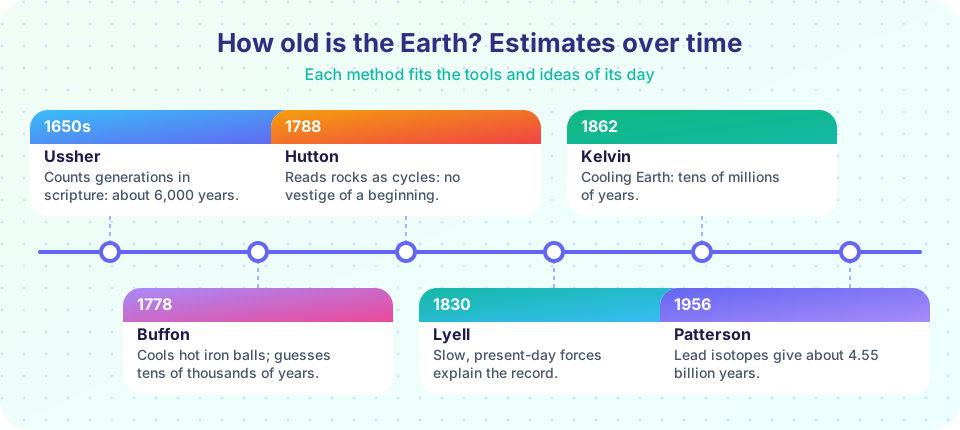
In the 1650s James Ussher, Archbishop of Armagh, added up genealogies and dates in the Bible and other histories to place creation at around 4004 BCE. This was a serious scholarly work of chronology, not a fringe guess, and it was printed in margins of English Bibles for generations. The French naturalist Georges-Louis Leclerc, Comte de Buffon, tried something different in 1778: he heated iron spheres of different sizes, measured how fast they cooled, and scaled the result up to a ball the size of the Earth. His published figure was about 75,000 years, and private notes ran into millions. It was the first attempt to date the Earth by physics rather than scripture.
Hutton: no vestige of a beginning
James Hutton, an Edinburgh farmer and physician, argued that rocks record a cycle. Rivers wear down mountains, sediment settles in the sea, heat and pressure harden it into rock, and uplift raises it again. He presented Theory of the Earth in 1785 and published it in 1788, closing with a famous line: "no vestige of a beginning, no prospect of an end."
A key piece of evidence is an unconformity, a surface where younger layers lie on older eroded ones. In 1788 Hutton sailed along the Berwickshire coast with John Playfair and James Hall and saw Siccar Point, where nearly horizontal red sandstone rests on near-vertical grey greywacke. Playfair later wrote that the mind seemed to grow giddy by looking so far into the abyss of time. The sequence needs: deposit, tilt, erode, deposit again. None of those steps is fast.
Lyell: the present is the key
Charles Lyell's Principles of Geology (three volumes, 1830 to 1833) made the argument systematic. He pointed to measurable present-day processes: erosion of river banks, delta growth, earthquakes that raise coastlines, and layers of ash from volcanoes. Given enough time, small steady changes add up to mountains. Lyell's book strongly influenced Darwin, who took volume one on the Beagle.
Not everyone agreed. Georges Cuvier, a brilliant anatomist, had shown in 1796 that fossil elephants were distinct from living species, proving extinction. He read the fossil record as a series of abrupt faunal turnovers and favored catastrophes, including floods. Modern geology keeps both ideas: slow processes dominate, but rare big events (asteroid impact, giant volcanic eruptions, megafloods) are real.
Behind the books, many fossil finders were working-class collectors. Mary Anning (1799 to 1847) of Lyme Regis found remarkable marine reptiles, including the first correctly identified ichthyosaur skeleton (found with her brother in 1811 to 1812) and, in 1823, a nearly complete plesiosaur. Anning supplied scientists with specimens but was rarely credited in publications.
Kelvin's cooling Earth
In the 1860s William Thomson (Lord Kelvin), the leading physicist of his day, calculated how long the Earth would need to cool from a molten ball to its present thermal state. His 1862 estimate was wide (about 20 to 400 million years), and he later narrowed it to roughly 20 to 40 million. Either way it clashed with geologists and with Darwin, who needed far longer. Kelvin's mathematics was correct for the assumptions he made. The missing piece was a source of heat he did not know: radioactive decay inside the Earth, and convection in the mantle that carries heat to the surface.
Radioactive clocks
After 1896 (Becquerel) and 1898 (the Curies), physicists learned that certain atoms decay at fixed statistical rates. Ernest Rutherford suggested in 1905 that this could date rocks. Bertram Boltwood in 1907 estimated ages up to over 2 billion years by comparing uranium and lead in minerals. Arthur Holmes championed the method in The Age of the Earth (1913). The modern figure, about 4.54 billion years, came from Clair Patterson in 1956, who measured lead isotopes in meteorites and the Earth. His same lab work led him to discover and fight against lead pollution from leaded gasoline, a rare case where careful measurements changed both history and public policy.
Common misconceptions
"Geologists once believed everything was gradual." Even Lyell allowed for local violent events. Modern geology accepts both gradual change and rare catastrophes.
"Kelvin was simply wrong." His reasoning was sound given what was known. The discovery of radioactivity changed the premises, an example of how new evidence overturns correct arguments built on missing facts.
"Radiometric dating relies on one assumption." Different isotope systems (uranium-lead, potassium-argon, rubidium-strontium) are cross-checked against each other and against layered records such as tree rings and ice cores.
Try it
A radioactive decay calculator and plot. After n half-lives the fraction left is 0.5**n. Uranium-238 has a half-life of about 4.468 billion years, so a mineral that is 4.468 billion years old has half of its original uranium.
Press Run (or Ctrl + Enter) to see the result here.
Program input · what you'd type while the program runs
Type the answers before you press Run, one per line. Each time the program reads a line (with input()), it gets the next line from this box.
Now compare estimates on a log scale. The values are rounded to the figures used in this lesson.
Press Run (or Ctrl + Enter) to see the result here.
Program input · what you'd type while the program runs
Type the answers before you press Run, one per line. Each time the program reads a line (with input()), it gets the next line from this box.
Check your understanding
Quick check · 5 questions
of 5 answered You scored / 5 · perfect!
-
1. What was James Hutton's key claim in 1788?
Hutton read rock cycles of erosion, deposition and uplift as processes without a visible start. -
2. What does uniformitarianism state?
Present-day processes, acting over long times, account for the record. The name was coined by Whewell. -
3. Why did Kelvin's age for the Earth come out too small?
His calculation was valid for his assumptions, but extra internal heat from radioactivity and convection extended the cooling time. -
4. Who is credited with the 1956 measurement of about 4.55 billion years?
Patterson used lead isotopes in meteorites and Earth rocks to find the age. -
5. What did Cuvier show in 1796?
Comparing anatomy of fossil and living elephants, he showed that some species had vanished.
Summary
- Early estimates of Earth's age came from texts and, with Buffon, from cooling experiments.
- Hutton and Lyell used rock cycles and present-day processes to argue for deep time.
- Kelvin's cooling calculations gave tens of millions of years, because radioactive heat was unknown.
- Radiometric dating, refined by Boltwood, Holmes and Patterson, gives about 4.54 billion years.
- Fossil collectors such as Mary Anning supplied key evidence but were rarely credited.
Track your progress
Create a free account to tick off lessons and pick up where you left off on any device.
of History of Science lessons completed