


















Lesson 20 of 44 · The Scientific Revolution
Chapter 4 review: The Scientific Revolution
Review chapter 4 of the History of Science course: Copernicus, Tycho, Kepler, Galileo, Bacon, Descartes and Newton, with a recap table and a ten-question quiz.
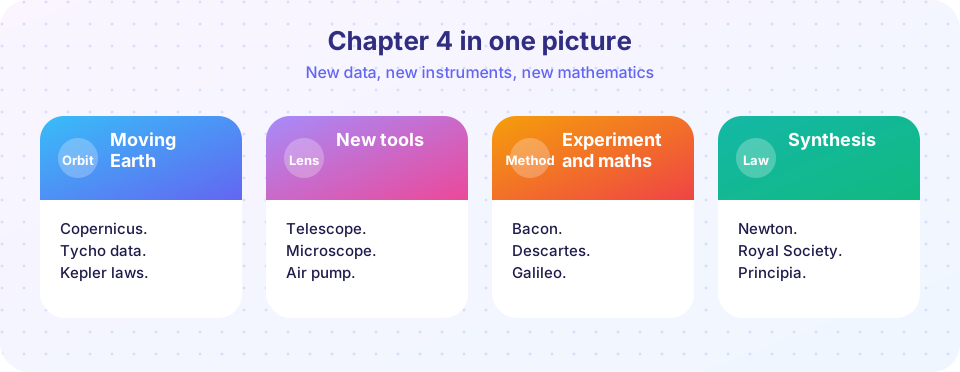
Between 1543 and 1687, new data, new instruments and new mathematics reshaped astronomy, physics and anatomy. This review gathers the story in one picture and one table and tests you with ten mixed questions.
What you will learn
- A one-table recap of the chapter
- How data, instruments, method and law fed one another
- Your readiness for chapter 5 (Enlightenment to Darwin)
Key terms
Heliocentric: Sun-centred.
Ellipse: closed curve with two foci; the shape of planetary orbits.
Induction / deduction: reasoning from cases to rules, and from rules to cases.
Inverse-square law: a force that falls as 1 over distance squared.
Recap table
| Person | Years | Key contribution | Evidence or method |
|---|---|---|---|
| Copernicus | 1473-1543 | Sun-centred model, 1543 | Retrograde motion explained simply |
| Vesalius | 1514-1564 | Human anatomy corrected, 1543 | Dissection and illustration |
| Tycho Brahe | 1546-1601 | Accurate observations | Large instruments, 1 arcminute |
| Kepler | 1571-1630 | Three laws of planetary motion | Mars data; 8-arcminute error |
| Galileo | 1564-1642 | Telescope discoveries, law of fall | Ramps, observation |
| Bacon | 1561-1626 | Induction and shared research | Novum Organum, 1620 |
| Harvey | 1578-1657 | Circulation of blood, 1628 | Measurement and dissection |
| Descartes | 1596-1650 | Deduction, coordinates, mechanism | Discourse on Method, 1637 |
| Newton | 1643-1727 | Laws of motion and gravitation, 1687 | Mathematics and observation |
How the pieces fit
- Data. Tycho's accurate positions.
- Pattern. Kepler's three laws from the data.
- Instruments. Galileo's telescope and ramps provide new facts and the first mathematical laws of motion on Earth.
- Method and community. Bacon and Descartes suggest approaches; the Royal Society creates a public forum.
- Synthesis. Newton explains Kepler and Galileo with one set of laws, which can be tested.
Each step used the previous: without Tycho, no Kepler; without Kepler and Galileo, no Newton.
Try it
First, a quick calculation connects the chapter: use Kepler's third law to predict a planet's period from its distance, and check Newton's version with masses. Second, a flashcard helper.
Press Run (or Ctrl + Enter) to see the result here.
Program input · what you'd type while the program runs
Type the answers before you press Run, one per line. Each time the program reads a line (with input()), it gets the next line from this box.
Press Run (or Ctrl + Enter) to see the console output here.
No output.
Check your understanding
Quick check · 10 questions
of 10 answered You scored / 10 · perfect!
-
1. Which two books were published in 1543?
Both challenged ancient authorities. -
2. Why was Tycho Brahe's work vital for Kepler?
Kepler used Tycho's data to find his laws. -
3. What is Kepler's second law?
A planet moves faster nearer the Sun. -
4. Which observation contradicted Ptolemy's Venus?
Ptolemy's model allowed only crescent-to-new phases. -
5. What did Galileo find about distance on a ramp?
1, 4, 9, 16 units for 1, 2, 3, 4 intervals. -
6. Which method did Bacon stress?
Descartes stressed deduction. -
7. What is the Royal Society's motto's meaning?
Nullius in verba. -
8. Which law did Newton propose in 1687?
F = G m1 m2 / r^2. -
9. What does the Moon test show?
9.8 divided by about 3600 matches the Moon's centripetal acceleration. -
10. Why do some historians question the label Scientific Revolution?
Alchemy, theology and medieval ideas persisted alongside the new work.
Summary
- 1543 to 1687 saw a moving Earth, accurate data, ellipses, telescopes, mathematical laws of motion and a unifying law of gravitation.
- Data, instruments, method, community and mathematics reinforced one another.
- The label "revolution" is useful but debated.
- Chapter 5 follows the new science into the Enlightenment, chemistry, life sciences and Darwin.
Track your progress
Create a free account to tick off lessons and pick up where you left off on any device.
of History of Science lessons completed