


















Lesson 11 of 44 · Greek and Islamic Science
Chapter overview: Greek and Islamic science
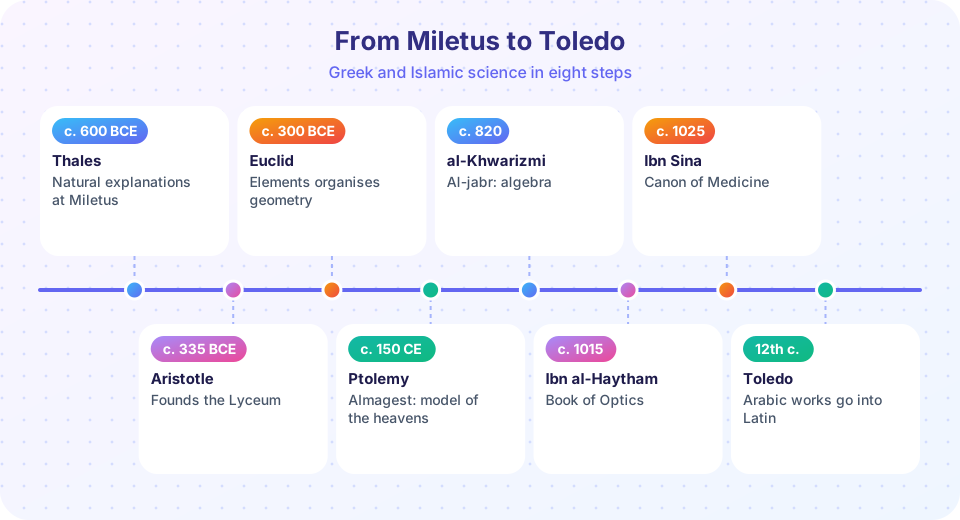
A map of Greek natural philosophy, Hellenistic mathematics and astronomy, the Islamic Golden Age and the translation movement that carried knowledge to Europe.
Around 600 BCE, in the Greek trading city of Miletus on the coast of what is now Turkey, a few thinkers began to ask a new kind of question. Instead of "which god causes this?" they asked "what is nature made of, and how does it work?" and they answered with arguments others could criticise. That habit of giving reasons in public is one of the most important inventions in the history of knowledge.
This chapter follows it through two connected stories: the Greek and Hellenistic world, which built geometry and cosmology, and the Islamic world, which translated, tested and extended that heritage, and then passed a much richer version to Europe.
What you will learn
- How Greek natural philosophy changed the way people explain nature
- What Hellenistic Alexandria added in mathematics and astronomy
- How scholars in the Islamic world translated, tested and extended earlier work
- How these ideas reached Latin Europe
Key terms
Natural philosophy: the study of nature through reasoned argument.
Hellenistic: the period after Alexander the Great (died 323 BCE) when Greek culture spread across the eastern Mediterranean and beyond.
House of Wisdom: a Baghdad centre of translation and scholarship in the 9th century.
Translation movement: the large effort to translate Greek, Persian, Syriac and Sanskrit works into Arabic, and later Arabic works into Latin.
Three connected stories
Greek reasoning. Thales, Anaximander, Pythagoras, Democritus, Hippocrates and Aristotle proposed explanations that used natural causes, mathematics and observation. They disagreed with one another, and the disagreement made the field move.
Hellenistic achievement. After Alexander's conquests, Alexandria became a centre of study. Euclid organised geometry, Archimedes found laws of levers and floating bodies, Eratosthenes measured Earth, Hipparchus catalogued stars, and Ptolemy built a model of the heavens that lasted fourteen centuries.
Islamic science. From the 8th century, the Abbasid caliphs in Baghdad sponsored translations from Greek, Syriac, Persian and Sanskrit. Scholars wrote on algebra, optics, medicine and astronomy, corrected earlier authorities and built observatories. In the 12th and 13th centuries, translators in Toledo, Sicily and elsewhere carried Arabic books into Latin, which fed the new universities of Europe.
Greek and Hellenistic
Islamic Golden Age
Passing it on
What this chapter covers
| Lesson | Focus |
|---|---|
| Greek natural philosophy | Thales to Aristotle: methods and disagreements |
| Hellenistic science | Euclid, Archimedes, Eratosthenes, Ptolemy |
| The Islamic Golden Age | Algebra, optics, medicine, observatories, Toledo |
| Chapter 3 review | Recap and quiz |
Why Arabic and Latin words keep turning up
Many English science words travelled this route. Algebra comes from the Arabic al-jabr, algorithm from the name of al-Khwarizmi, zenith and azimuth from Arabic terms in astronomy, and alcohol and alkali from Arabic chemistry. They are small fossils of the transmission.
Common misconceptions
"The Greeks invented science from nothing." They built on Babylonian data and Egyptian geometry, as chapter 2 showed.
"Islamic scholars only preserved Greek books." They also corrected them, wrote new works and made original advances in algebra, optics, medicine and astronomy.
"Greek ideas were always right because they were first." Aristotle's physics and Ptolemy's cosmology were wrong in important ways, and the people who found this out included medieval and Islamic scholars.
Try it
First, list words with Arabic roots and count them. Second, trace one text through the translation chain.
Press Run (or Ctrl + Enter) to see the result here.
Program input · what you'd type while the program runs
Type the answers before you press Run, one per line. Each time the program reads a line (with input()), it gets the next line from this box.
Press Run (or Ctrl + Enter) to see the console output here.
No output.
Check your understanding
Quick check · 4 questions
of 4 answered You scored / 4 · perfect!
-
1. What new habit marked early Greek natural philosophy?
Giving public reasons for explanations is the key innovation. -
2. Where did Gerard of Cremona translate Arabic works into Latin?
Toledo was a major translation centre in the 12th century. -
3. Which English word comes from al-Khwarizmi's name?
Algorithm is from Algoritmi, the Latinised form of his name. -
4. What is the best description of the role of Islamic scholars?
They made original advances as well.
Summary
- Greek philosophers began explaining nature by natural causes and argument.
- Hellenistic Alexandria produced Euclid, Archimedes, Eratosthenes, Hipparchus and Ptolemy.
- Scholars of the Islamic world translated, tested and extended this heritage and added algebra, optics and medicine.
- Translators at Toledo and elsewhere carried it into Latin, which fed Europe's universities.
Next: Greek natural philosophy
Track your progress
Create a free account to tick off lessons and pick up where you left off on any device.
of History of Science lessons completed