


















Lesson 15 of 44 · Greek and Islamic Science
Chapter 3 review: Greek and Islamic science
Review chapter 3 of the History of Science course: Greek philosophy, Hellenistic mathematics and astronomy, the Islamic Golden Age and Toledo, with a recap table and a ten-question quiz.
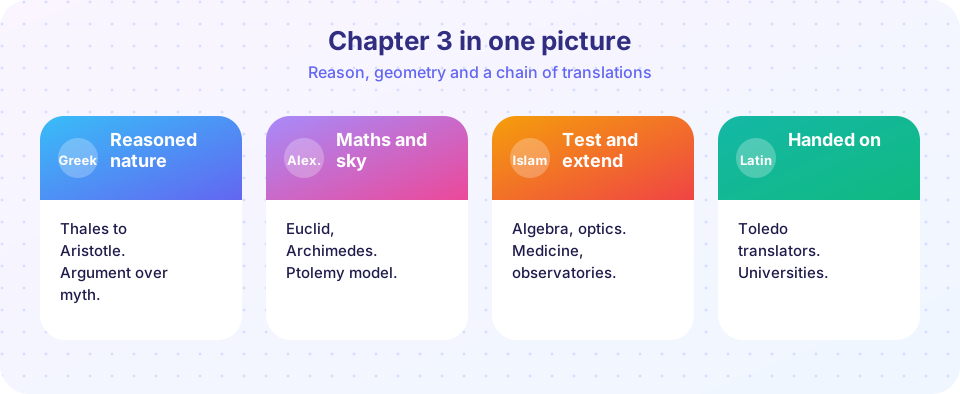
This chapter followed a chain: Greek questions, Hellenistic mathematics, Islamic translation and extension, and Latin transmission. The review pulls the chain together and tests you with ten mixed questions.
What you will learn
- A one-table recap of the chapter
- How the chain of transmission fits together
- Your readiness for chapter 4 (the Scientific Revolution)
Key terms
Natural philosophy: reasoned study of nature.
Epicycle: a small circle riding on a larger one to model planetary motion.
Al-jabr: the operation that gave algebra its name.
Translation movement: the transfer of texts across languages that carried knowledge between civilisations.
Recap table
| Figure | Date | Contribution |
|---|---|---|
| Thales | c. 600 BCE | Natural explanation: water as the underlying stuff |
| Pythagoreans | c. 500 BCE | Number in nature; string ratios |
| Democritus | c. 430 BCE | Atoms and void |
| Hippocratic writers | 5th-4th c. BCE | Natural causes of disease |
| Aristotle | 384-322 BCE | Logic, observational biology, four causes; wrong physics |
| Euclid | c. 300 BCE | Proof from axioms |
| Archimedes | c. 287-212 BCE | Pi bounds, lever, buoyancy |
| Eratosthenes | c. 240 BCE | Earth's size from a shadow |
| Ptolemy | c. 150 CE | Almagest, epicycle model |
| al-Khwarizmi | c. 820 | Algebra, decimal numerals |
| Ibn al-Haytham | c. 1015 | Optics and experiment |
| Ibn Sina | c. 1025 | Canon of Medicine |
| al-Tusi, Ibn al-Shatir | 1200s-1300s | Alternatives to Ptolemy |
| Gerard of Cremona | 1175 | Almagest into Latin |
The chain of transmission
Greek texts → Syriac and Arabic translations in Baghdad (8th-10th centuries) → commentary, correction and new work across the Islamic world → Latin translations at Toledo and elsewhere (12th century) → the medieval universities → the questions that Copernicus, Vesalius and Galileo faced in the 1500s.
At each step the text changed. Translators added notes; scholars corrected errors; the questions asked shifted. Knowledge in history is rarely a package that is passed on unchanged; it is a conversation.
Try it
First, count how many figures in the recap fall into each period. Second, sort them by date and compute gaps, which shows the pace of the chain.
Press Run (or Ctrl + Enter) to see the result here.
Program input · what you'd type while the program runs
Type the answers before you press Run, one per line. Each time the program reads a line (with input()), it gets the next line from this box.
Press Run (or Ctrl + Enter) to see the console output here.
No output.
Check your understanding
Quick check · 10 questions
of 10 answered You scored / 10 · perfect!
-
1. Who is credited with the first clear natural, non-mythical explanation that everything comes from water?
Thales of Miletus, around 600 BCE. -
2. Which ratio gives a musical fifth on a string?
A string two-thirds as long gives a fifth. -
3. Which text gave rules of proof for geometry from axioms?
Euclid's Elements. -
4. What did Eratosthenes need to compute Earth's circumference?
He multiplied the distance by 360 divided by the shadow angle. -
5. What is an epicycle used to model?
Epicycles on deferents reproduce the loops. -
6. Who wrote the book that gave algebra its name?
Al-jabr is in the title of his c. 820 book. -
7. What did Ibn al-Haytham mainly establish?
He supported intromission with experiments including the camera obscura. -
8. Which invention of al-Tusi helped replace Ptolemy's equant?
The Tusi couple produces linear motion from circular motion. -
9. Where did the major 12th-century Latin translations of Arabic science take place?
Toledo, after 1085. -
10. Which statement about Islamic science is most accurate?
It was an active, continuing tradition.
Summary
- Greek thinkers introduced reasoned, natural explanations and a debate culture.
- Hellenistic scholars built proof, measured Earth and modelled the heavens.
- Scholars of the Islamic world translated, corrected and extended, with original work in algebra, optics, medicine and astronomy.
- Toledo's translations fed Europe's universities, setting the stage for the Scientific Revolution.
Track your progress
Create a free account to tick off lessons and pick up where you left off on any device.
of History of Science lessons completed