


















Lesson 1 of 44 · Getting Started
Course map: how to read the history of science
Start here: who the History of Science course is for, what you need, how the nine chapters fit together and a simple way to study each lesson.
Science did not appear all at once. It grew over thousands of years, in many places, out of questions about the sky, the body, numbers and matter. This course follows that growth from clay tablets in Mesopotamia to quantum theory and DNA, and it asks a question that textbooks usually skip: how did people come to know what we now take for granted?
You do not need any science background. If you can read a short article and follow a simple calculation, you are ready. Where a lesson uses a little mathematics, the calculation is small and the code does the arithmetic for you.
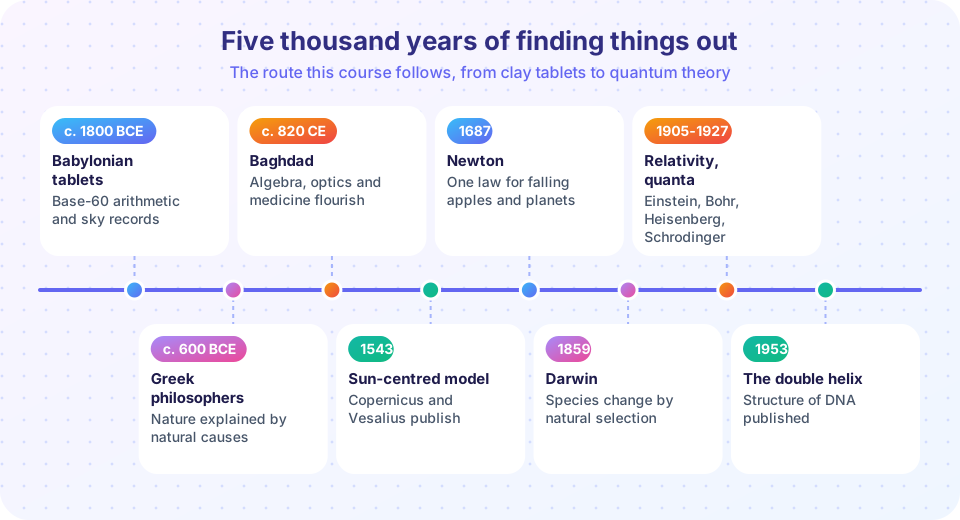
What you will learn
- Who this course is for and what it assumes
- How the nine chapters are arranged and why
- How to study a history lesson so you remember it
- What "science" means in this course, and why the word itself is young
Key terms
History of science: the study of how scientific ideas, methods and institutions developed, and why.
Natural philosophy: the older name for the study of nature, used until the 1800s, before "scientist" existed.
Primary source: a document or object made at the time, such as a notebook, letter or instrument.
Context: the religious, political, economic and technical setting in which an idea appears.
Who this course is for
The course is written for curious learners aged about 14 and up, and for adults who want the story behind school science. It follows no single national syllabus. It uses the shared core of what students in many countries meet: the heliocentric model, the laws of motion, atoms, evolution, relativity and DNA. Dates are given in BCE and CE, units are metric, and examples come from every continent, because the history of science is not only a European story.
Nine chapters
Chapters 1 to 3
- Getting Started
- Science Before Science
- Greek and Islamic
Chapters 4 to 6
- Scientific Revolution
- Enlightenment to Darwin
- Physics and Chemistry
Chapters 7 to 9
- Twentieth Century
- Science and Society
- Projects
Chapters 1 to 4 are covered in this part of the course. Each chapter opens with an overview, has two to four content lessons, and ends with a review and a larger quiz.
How to study each lesson
- Read the learning goals first. Five bullets tell you what to look for.
- Look at the picture before the text. Each lesson has an illustration; try to explain it to yourself in one sentence.
- Do the Try it blocks. They are short programs and widgets. Change a number and see what happens: the history becomes concrete when you can recompute an old result.
- Answer the quiz without scrolling up. Retrieval, not rereading, builds memory.
- Keep a one-page timeline. Add every new date. By chapter 4 you will see patterns that no single lesson shows.
What "science" means here
The word scientist was coined by William Whewell in 1833. Before then, people who studied nature were called natural philosophers, physicians, astronomers, mathematicians or alchemists. This course does not pretend that a Babylonian scribe or a Greek physician was a modern scientist. It asks instead what they knew, how they knew it, and what later people did with it. Some of their claims were wrong. Many were careful, and some were remarkably accurate.
Common misconceptions
"Science progresses in a straight line." It does not. Ideas were lost, rediscovered, rejected and revived, and good ideas often took centuries to be accepted.
"The Middle Ages were a dark age with no science." Chapter 3 shows that Baghdad, Cairo, Cordoba, Samarkand and later European universities were active centres of study.
"One genius changes everything." Famous names matter, but they worked with instruments, earlier results, patrons and colleagues. You will meet the people, and the networks behind them.
Try it
The first block plots the six eras the course uses on one axis, so you can see how unevenly time is spread. The second is a small console tool that tells you which chapter a year belongs to.
Press Run (or Ctrl + Enter) to see the result here.
Program input · what you'd type while the program runs
Type the answers before you press Run, one per line. Each time the program reads a line (with input()), it gets the next line from this box.
Press Run (or Ctrl + Enter) to see the console output here.
No output.
Check your understanding
Quick check · 4 questions
of 4 answered You scored / 4 · perfect!
-
1. Who coined the word scientist, and in which decade?
William Whewell proposed the word in 1833. Before that, people used natural philosopher, physician or astronomer. -
2. Which is a primary source?
A primary source was made at the time by the people involved. The other two are later interpretations. -
3. How is the course organised?
The chapters follow time with themes inside each. Chapter 8 steps back to look at method and society. -
4. Which belief does the course reject?
Progress was uneven, with ideas lost, rediscovered and revised.
Summary
- The history of science asks how people came to know what they know, not only what they know.
- The course runs through nine chapters, mostly in time order, from ancient knowledge to the present.
- Study actively: goals, picture, Try it, quiz, timeline.
- "Science" is a young word, and this course uses it loosely for organised, evidence-based study of nature in any period.
- Progress was uneven, collective and global.
Track your progress
Create a free account to tick off lessons and pick up where you left off on any device.
of History of Science lessons completed