


















Lesson 18 of 44 · The Scientific Revolution
Galileo and the new instruments
How the telescope, microscope and careful experiments changed astronomy and physics: Galileo's discoveries, the law of falling bodies, Vesalius, Harvey and Hooke.
In 1608 spectacle makers in the Netherlands, among them Hans Lipperhey, patented a device that made distant objects look closer. In the summer of 1609 Galileo Galilei, a professor of mathematics at Padua, heard about it, worked out the optics and built his own, improving it until it magnified about twenty times. When he pointed it at the sky, the heavens looked different. The instrument turned arguments about what should be true into evidence about what is visible.
What you will learn
- What Galileo saw through the telescope, and why it mattered
- How his inclined-plane experiments led to the law of falling bodies
- How the microscope and anatomy added to the new evidence
- Why Galileo was tried in 1633, and what happened
Key terms
Telescope: an instrument using lenses to magnify distant objects.
Uniform acceleration: a steady increase of speed over time.
Microscope: an instrument that magnifies small objects.
Inquisition: the Roman Catholic Church tribunal that investigated suspected heresy.
What the telescope showed
In 1610 Galileo published Sidereus Nuncius (The Starry Messenger), reporting:
- Mountains and craters on the Moon. The Moon was not a smooth, perfect sphere as Aristotelian cosmology taught; it had a rough surface like Earth's.
- Four moons of Jupiter, first seen on 7 January 1610. Over several nights they moved relative to the planet, so they orbit it. Not everything circled Earth, and a moving planet did not have to lose its moons, an answer to an objection against a moving Earth. He named them the Medicean stars after his patrons, the Medici.
- Many more stars, including a Milky Way that resolves into stars.
- Later in 1610, the phases of Venus. In Ptolemy's model, Venus always lies between Earth and Sun and can show only crescent-to-new phases; Galileo saw nearly full phases, which the Sun-centred arrangement predicts and the Ptolemaic one cannot. The Tychonic model (planets orbiting the Sun, the Sun orbiting Earth) could also explain them, so the observation ruled out Ptolemy, not every Earth-centred system.
- Sunspots, which implied the Sun's surface changes and rotates, again against perfect, unchanging heavens.
Motion on ramps
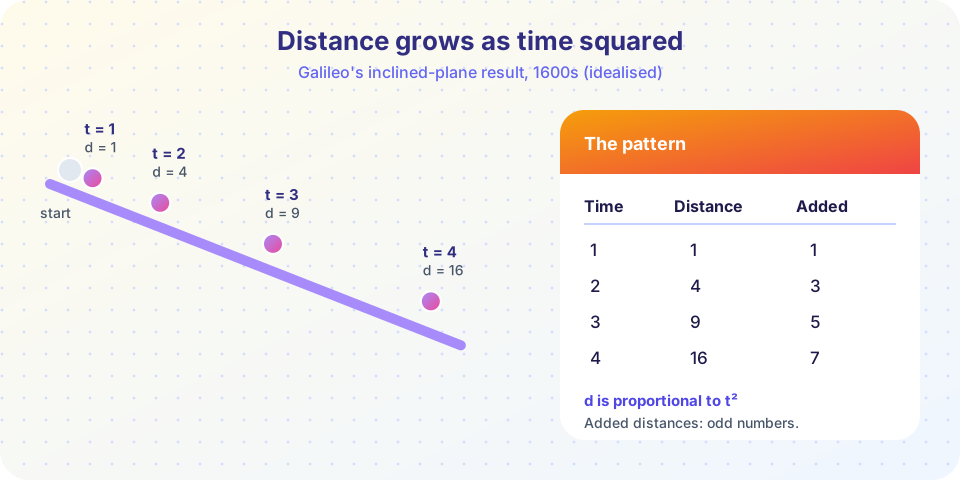
Aristotle said heavy bodies fall faster. Galileo studied motion by slowing it down: balls rolling on a smooth inclined plane. Using a water clock to time the intervals, he found that the distance covered grows as the square of the time: if a ball covers 1 unit in the first interval, it covers 4 units in the first two, 9 in the first three, 16 in four. The added distance in each interval is 1, 3, 5, 7, the odd numbers. This is the law of uniform acceleration: d = ½at².
He also argued that, ignoring air, bodies of different weights fall at the same rate, and reasoned that a moving body continues at constant speed unless something slows it down (an early form of inertia). He wrote this up in Discourses and Mathematical Demonstrations Concerning Two New Sciences in 1638. The legend that he dropped balls from the tower at Pisa is not supported by his own writings (lesson 1.3).
The microscope and the body
Instruments were also turned on the small and the near. Andreas Vesalius's Fabrica (1543) corrected Galen by dissecting human bodies himself and publishing beautiful anatomical plates. William Harvey (1578 to 1657) showed in 1628 that blood circulates, using measurements of the heart's output. Robert Hooke's Micrographia (1665) used the microscope to draw fleas, mould and cork, where he saw tiny box-like compartments he called "cells". Antonie van Leeuwenhoek (1632 to 1723), a Dutch draper, ground single-lens microscopes of great clarity and described "animalcules", bacteria and protozoa, in the 1670s. Evangelista Torricelli made the first mercury barometer in 1643, and Robert Boyle used an air pump in the 1660s to study the "spring of the air", leading to Boyle's law (pressure times volume is constant at constant temperature).
Galileo and the Church
In 1616 the Church warned Galileo not to hold or defend heliocentrism as true. In 1632 he published the Dialogue Concerning the Two Chief World Systems, a lively comparison of Ptolemaic and Copernican views that, readers felt, clearly favoured Copernicus and gave the pope's own argument to a character called Simplicio. In 1633 the Inquisition found him "vehemently suspected of heresy," made him recant, and placed him under house arrest for the rest of his life; he died in 1642. The case combined theology, personal rivalries, the politics of the Thirty Years' War and Galileo's sharp tongue. The Church acknowledged errors in the handling of the case in the late 20th century.
Common misconceptions
"Galileo invented the telescope." He did not; he heard of the Dutch device and built a much better one, and was the first to use it systematically on the sky.
"Galileo proved Copernicus right." His observations were strong evidence against Ptolemy but did not decide between all models. The tides argument he offered as proof was wrong.
"Galileo was tortured." He was threatened and forced to recant, and then lived under house arrest. The claim of torture is not supported.
Try it
First, compute and plot Galileo's law and the odd-number pattern. Second, simulate the phases of Venus in the Copernican arrangement and compare to what Ptolemy predicts.
Press Run (or Ctrl + Enter) to see the result here.
Program input · what you'd type while the program runs
Type the answers before you press Run, one per line. Each time the program reads a line (with input()), it gets the next line from this box.
Press Run (or Ctrl + Enter) to see the result here.
Program input · what you'd type while the program runs
Type the answers before you press Run, one per line. Each time the program reads a line (with input()), it gets the next line from this box.
Check your understanding
Quick check · 5 questions
of 5 answered You scored / 5 · perfect!
-
1. What did Galileo see around Jupiter in January 1610?
They orbit Jupiter, so not everything circles Earth. -
2. Which observation contradicted Ptolemy's model of Venus?
Ptolemy's arrangement allows only crescent-to-new phases. -
3. How does distance grow in a uniformly accelerated motion starting at rest?
d = (1/2) a t squared. -
4. What did Hooke call the small compartments in cork?
Micrographia (1665) introduced the word. -
5. What happened to Galileo in 1633?
He lived under house arrest until his death in 1642.
Summary
- Galileo did not invent the telescope but used it to find lunar mountains, Jupiter's moons, Venus's phases and sunspots.
- Ramp experiments revealed d proportional to t squared and the odd-number rule, and the independence of fall from weight.
- Vesalius, Harvey, Hooke, Leeuwenhoek, Torricelli and Boyle extended the evidence with anatomy, microscopes and the air pump.
- Galileo's trial in 1633 combined theology, politics and personality.
Track your progress
Create a free account to tick off lessons and pick up where you left off on any device.
of History of Science lessons completed