


















Lesson 14 of 44 · Greek and Islamic Science
The Islamic Golden Age: translate, test, extend
Learn how scholars in Baghdad, Cairo, Cordoba and Maragha translated Greek works and made new advances in algebra, optics, medicine and astronomy, then shaped Europe.
In 762 the Abbasid caliph al-Mansur founded Baghdad as a capital. Within decades it had paper mills, bookshops and a court that paid scholars. Under al-Ma'mun (ruled 813 to 833) the House of Wisdom became a centre for translating books from Greek, Syriac, Persian and Sanskrit into Arabic. Because Arabic was a common language from Spain to Central Asia, scholars across a huge region could read the same books and argue about them. The result was one of the most productive centuries and a half in the history of science.
What you will learn
- How the translation movement worked and why it mattered
- What al-Khwarizmi, al-Razi, Ibn al-Haytham, Ibn Sina and others contributed
- How astronomers questioned Ptolemy and built observatories
- How this knowledge reached Europe through Toledo and the universities
Key terms
Al-jabr: Arabic for "restoration", moving a subtracted term to the other side of an equation; the origin of the word algebra.
Intromission theory: the theory that vision happens when light enters the eye.
Canon: a standard reference work; here Ibn Sina's medical encyclopedia.
Observatory: an institution with instruments and staff for long-term sky observation.
Translators and patrons
Translators such as Hunayn ibn Ishaq (808 to 873), a Christian physician who knew Greek, Syriac and Arabic, rendered Galen and Hippocrates into Arabic. Wealthy families, including the Banu Musa brothers, funded the search for manuscripts and paid generous fees. Translators did not just copy; they added commentaries, corrected texts and developed technical vocabulary that did not yet exist in Arabic.
Mathematics: algebra and numbers
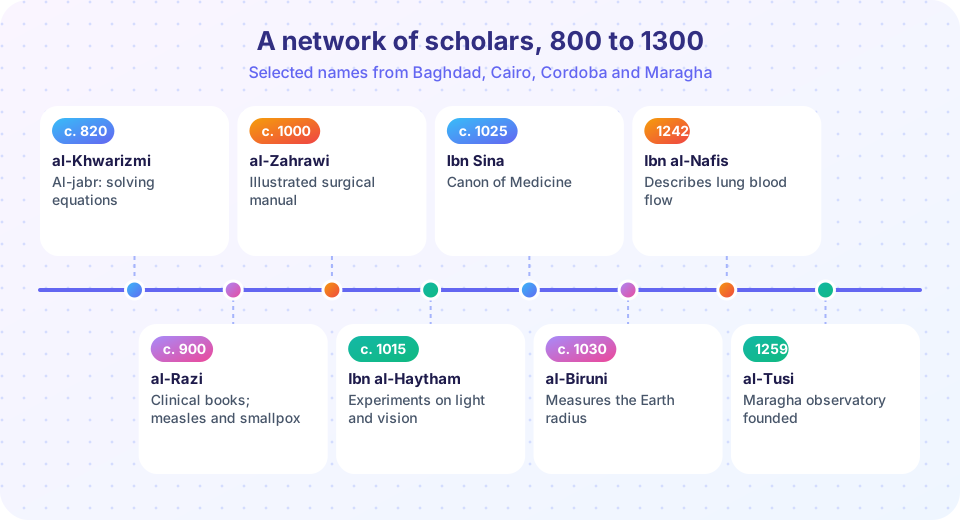
Muhammad ibn Musa al-Khwarizmi (about 780 to 850) wrote al-Kitab al-mukhtasar fi hisab al-jabr wa'l-muqabala (about 820). It gives systematic methods for solving linear and quadratic equations, justified by geometric diagrams, and classifies them into six types so that all coefficients are positive. A classic case in the book is "a square and ten roots equal thirty-nine", i.e. x² + 10x = 39: halve 10 to get 5, square it to get 25, add to 39 to get 64, take the root 8 and subtract 5: x = 3. His other book on Indian numerals introduced the decimal positional system to a wide readership, and the word algorithm comes from his Latinised name.
Omar Khayyam (1048 to 1131) classified cubic equations and solved them with intersecting conics, and al-Kashi (died about 1429) computed π to 16 digits.
Optics: Ibn al-Haytham
Ibn al-Haytham (Alhazen, about 965 to 1040), working in Cairo, wrote the Book of Optics. He argued that vision occurs when light from an object enters the eye, rejecting the older idea that the eye sends out rays. He studied reflection, refraction and the camera obscura (a dark room or box with a small hole), used it to show that light travels in straight lines and that the image is inverted, and built arguments on experiments he described step by step. Historians often call his emphasis on testing claims by repeated, controlled observation an early form of the experimental method. His work, translated into Latin, strongly influenced Kepler, Descartes and Newton.
Medicine
Al-Razi (Rhazes, about 865 to 925) wrote clinical case notes and a text distinguishing smallpox from measles, and challenged Galen in Doubts about Galen. Ibn Sina (Avicenna, 980 to 1037) wrote the Canon of Medicine (about 1025), a five-book encyclopedia organised by subject that stayed a standard text in Europe into the 1600s. Al-Zahrawi (Abulcasis, about 936 to 1013) wrote an illustrated surgical manual with drawings of instruments. Ibn al-Nafis (1213 to 1288) described the passage of blood from the right to the left side of the heart through the lungs, and correctly denied that it passes through pores in the septum, as Galen taught. Hospitals (bimaristans) were established in many cities with trained staff and records.
Astronomy and geography
Astronomers made accurate observations at observatories in Baghdad, Damascus and Maragha (founded 1259 by Nasir al-Din al-Tusi). They found errors in Ptolemy's parameters and in some of his models. Al-Tusi invented the Tusi couple, a geometric device in which one circle rolls inside another to produce straight-line motion, and Ibn al-Shatir (about 1304 to 1375) built a lunar and planetary model without the equant. These models resemble those Copernicus later used, and historians continue to investigate how they might have reached him. The astrolabe, a portable instrument for measuring altitudes and telling time, was perfected in this world.
Al-Biruni (973 to 1048) estimated Earth's radius by measuring the dip of the horizon from a mountaintop and got about 6,340 km, within about 1 percent of the modern mean 6,371 km. He also wrote on India, mineralogy and the possible rotation of Earth.
From Baghdad to Toledo
The caliphate fragmented in later centuries, but scholarship continued across the Islamic world. In 1085 Christian Toledo, a city with a large Arabic-reading community, fell to Castile and became a centre of translation. Gerard of Cremona (about 1114 to 1187) and colleagues rendered dozens of works, including Ptolemy's Almagest (in 1175), Ibn Sina's Canon, al-Khwarizmi's algebra and Ibn al-Haytham's optics, into Latin. These texts gave the new universities of Paris, Oxford and Bologna a rich curriculum.
Common misconceptions
"Islamic science was just preservation." The scholars made original discoveries, from algebraic methods to new theories in optics and revisions of Ptolemy.
"It all ended in 1258 when Baghdad fell." The city's libraries suffered greatly, but scholarship moved on in Maragha, Samarkand, Cairo, Istanbul and Andalusia.
"It was purely religious or purely secular." Many scholars were deeply religious, and many were interested in practical questions such as prayer times and the direction of Mecca, which stimulated astronomy and geometry.
Try it
First, solve al-Khwarizmi's equation by completing the square with the steps printed. Second, test al-Biruni's horizon-dip method and see how sensitive it is.
Press Run (or Ctrl + Enter) to see the result here.
Program input · what you'd type while the program runs
Type the answers before you press Run, one per line. Each time the program reads a line (with input()), it gets the next line from this box.
Press Run (or Ctrl + Enter) to see the result here.
Program input · what you'd type while the program runs
Type the answers before you press Run, one per line. Each time the program reads a line (with input()), it gets the next line from this box.
Check your understanding
Quick check · 5 questions
of 5 answered You scored / 5 · perfect!
-
1. What does the word algebra come from?
Al-jabr names the operation of moving a term across an equation. -
2. What did Ibn al-Haytham argue about vision?
He supported the intromission theory with experiments. -
3. Which work by Ibn Sina stayed a standard medical text in Europe for centuries?
The Latin Canon was used into the 1600s. -
4. What did Ibn al-Nafis correctly describe?
He denied that blood crosses the septum through pores. -
5. Where did Gerard of Cremona translate Arabic works into Latin?
Toledo was a centre of translation after 1085.
Summary
- The House of Wisdom and its translators turned Arabic into a shared language of science.
- Al-Khwarizmi created systematic algebra; Ibn al-Haytham put optics on an experimental footing.
- Al-Razi, Ibn Sina, al-Zahrawi and Ibn al-Nafis advanced medicine and surgery, and bimaristans spread hospitals.
- Observatories at Maragha and elsewhere refined and questioned Ptolemy, using devices such as the Tusi couple.
- Toledo's translators carried this knowledge into Latin and Europe's universities.
Next: Chapter 3 review
Track your progress
Create a free account to tick off lessons and pick up where you left off on any device.
of History of Science lessons completed