


















Lesson 39 of 44 · Science, Society and Method
Chapter 8 Review: Science, Society and Method
A recap of chapter 8 with a one-picture summary, a comparison of Popper, Kuhn and Lakatos, and a ten-question quiz on method, credit, war and ethics.
This chapter asked how science changes, who does it and what follows from its power. Use this page to compare the philosophies of method, to recall the case studies and to test your understanding.
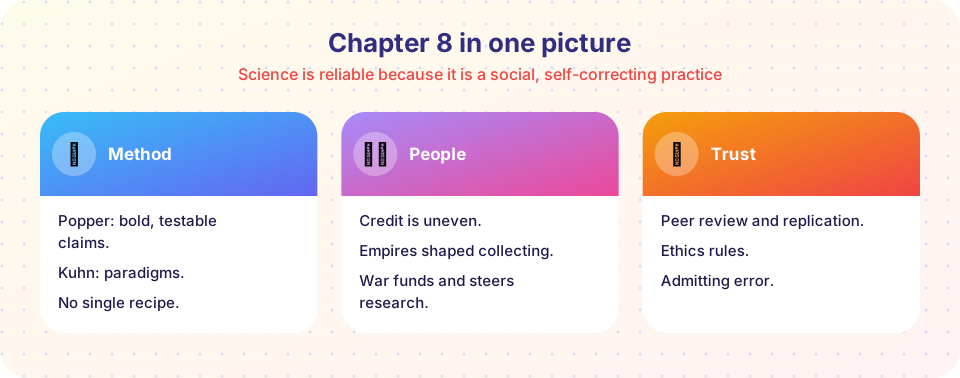
What you will learn
- A side-by-side view of Popper, Kuhn and Lakatos.
- The cases that illustrate credit, empire, war and ethics.
- Why science's reliability comes from practices, not from a single method.
The chapter in one table
| Idea | Who | Core claim | Test it on |
|---|---|---|---|
| Falsification | Popper | Good theories make risky predictions that could fail | Relativity and the 1919 eclipse |
| Paradigm shift | Kuhn | Normal science, anomalies, crisis, revolution | Phlogiston to oxygen; Newton to Einstein |
| Research programme | Lakatos | Hard core plus protective belt; progressive or degenerating | Neptune versus Vulcan |
| Norms and credit | Merton, Rossiter | Shared norms, uneven recognition | Meitner, Wu, Bell Burnell |
| Research ethics | Nuremberg, Belmont | Consent, beneficence, justice | Tuskegee, Nazi experiments |
Key terms
Falsifiability: a claim could be refuted by some possible observation.
Normal science: puzzle-solving within a paradigm.
Matthew effect: extra credit to the already famous.
Dual use: research with both beneficial and harmful applications.
Patterns across the lessons
- No single method. Different fields use different reasoning styles; frameworks capture parts of the picture.
- Evidence and community together. Results become knowledge when others test, criticize and replicate them.
- Credit is social. Recognition depends on rank, gender, nationality and timing.
- Power brings responsibility. Ethical rules emerged after abuses, and they keep evolving.
Common misconceptions
"The social side of science undermines it." The social checks (peer review, replication, open criticism) are what make results trustworthy.
"Philosophers of science disagree, so anything goes." They disagree about details and agree that evidence matters; Feyerabend's slogan was a provocation.
Try it
First, a classifier that maps a short description to a philosopher. It is a simple lookup for practice.
Press Run (or Ctrl + Enter) to see the result here.
Program input · what you'd type while the program runs
Type the answers before you press Run, one per line. Each time the program reads a line (with input()), it gets the next line from this box.
Second, an interactive credit-audit worksheet. Tick the roles named in a made-up announcement and see how many are left out.
Check your understanding
Quick check · 10 questions
of 10 answered You scored / 10 · perfect!
-
1. Which philosopher stressed bold, falsifiable conjectures?
Popper treated falsifiability as the mark of science. -
2. What triggers a crisis in Kuhn's model?
Persistent anomalies undermine confidence in a paradigm. -
3. What is incommensurability?
Kuhn used the idea to explain why debates across paradigms are hard. -
4. What did Lakatos call a programme that predicts new facts?
Progressive programmes keep making successful novel predictions. -
5. Which case shows the same strategy working once and failing once?
An unseen planet explained Uranus but not Mercury, whose anomaly needed general relativity. -
6. What is the Matilda effect?
Margaret Rossiter named it in 1993. -
7. What is dual use research?
Haber's ammonia process is a classic example. -
8. What are the three principles of the Belmont Report?
They guide research ethics review in many countries. -
9. Why was Semmelweis's hand-washing result rejected?
Several scientific and social factors combined. -
10. Which statement about the social side of science is best?
Reliability is a collective achievement.
Summary
- Popper, Kuhn and Lakatos each capture part of how science changes.
- Credit, empire and war show that science is a human, institutional activity.
- Ethical rules are part of the history, and they changed after abuses.
Track your progress
Create a free account to tick off lessons and pick up where you left off on any device.
of History of Science lessons completed