


















Lesson 13 of 44 · Greek and Islamic Science
Hellenistic science: Euclid, Archimedes, Eratosthenes and Ptolemy
Meet the mathematicians and astronomers of Alexandria and Syracuse: proof in Euclid, Archimedes' pi bounds, Eratosthenes measuring Earth and Ptolemy's epicycle model.
When Alexander the Great died in 323 BCE, his generals divided his empire. One of them, Ptolemy I, ruled Egypt and founded the Museum and Library of Alexandria, an institution that paid scholars to study. For the next five centuries the city was the world's centre of mathematics and astronomy. Here Greek geometry became rigorous, the size of Earth was measured, and a model of the heavens was built that astronomers used until the 1500s.
What you will learn
- How Euclid's Elements built geometry from axioms and proofs
- How Archimedes bounded pi and found the law of the lever and of buoyancy
- How Eratosthenes measured Earth
- How Ptolemy's model of epicycles and deferents worked, and why it lasted
Key terms
Axiom: a starting statement accepted without proof.
Proof: a chain of logical steps from axioms to a conclusion.
Epicycle: a small circle whose centre moves on a larger circle (the deferent).
Stadion: a Greek unit of length; its exact size varies in the sources.
Euclid: proof as a method
Euclid (about 300 BCE) wrote the Elements, thirteen books that start from a few definitions, five postulates and some common notions, and derive hundreds of theorems. Its method is the point: every claim is justified by earlier ones. The Elements includes the theorem of Pythagoras (I.47), a proof that there are infinitely many primes (IX.20), and an algorithm for the greatest common divisor, still called Euclid's algorithm. For two thousand years it was the standard model of mathematical reasoning and the textbook of geometry, until the 1800s.
Archimedes: mathematics meets physics
Archimedes of Syracuse (about 287 to 212 BCE) found the law of the lever (balance when weight × distance is equal on both sides), and the principle of buoyancy: a body immersed in fluid feels an upward force equal to the weight of fluid displaced. The tale that he discovered it in the bath and shouted "Eureka" is a later story, told centuries afterward.
He bounded pi by inscribing and circumscribing regular polygons around a circle, going up to 96 sides, and showed that 223/71 < π < 22/7, i.e. between about 3.1408 and 3.1429. In The Method he described heuristics using balancing to discover results, and in The Sand Reckoner he built a notation for huge numbers to count the grains of sand that would fill the universe. He was killed in 212 BCE when Roman soldiers took Syracuse.
Eratosthenes: the size of Earth
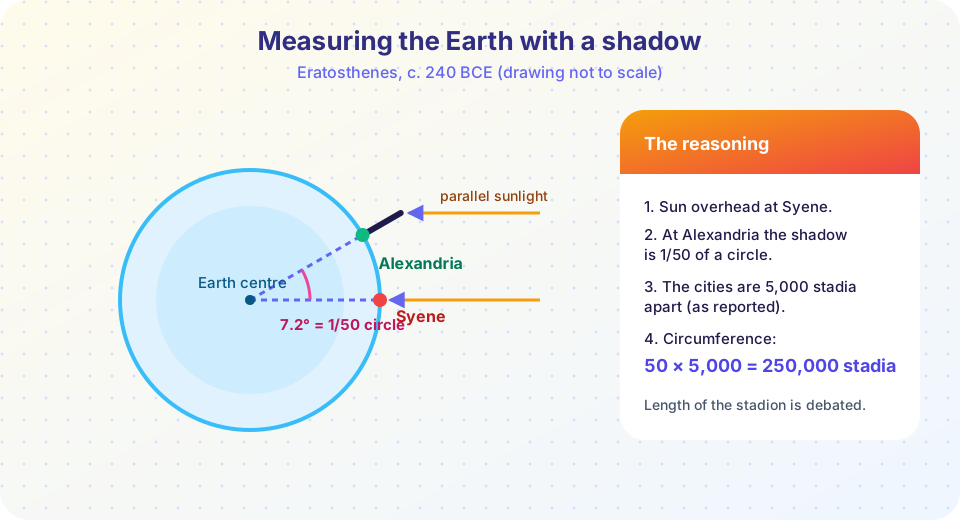
Eratosthenes (about 276 to 194 BCE), a librarian at Alexandria, heard that at noon on the summer solstice the Sun shines straight down a well at Syene (modern Aswan). At the same moment in Alexandria a vertical rod casts a shadow whose angle is about 7.2 degrees, one fiftieth of a circle. If the Sun's rays are parallel, the angle at Earth's centre between the two cities is also 7.2 degrees. With a reported distance of 5,000 stadia, Earth's circumference is 50 × 5,000 = 250,000 stadia.
What that equals in kilometres depends on which stadion he used. If it was about 157.5 m, the result is roughly 39,400 km, within a few percent of the real 40,000 km. If it was about 185 m, the result is about 46,000 km. Even then the method is the achievement: geometry plus one shadow measurement. Remember also that the cities are not exactly on the same meridian, nor Syene exactly on the tropic, so the match is partly luck.
Hipparchus and Ptolemy
Hipparchus (about 190 to 120 BCE) catalogued around 850 stars, compared his data with older records and discovered precession, a slow shift of the equinox points relative to the stars, about one degree per 72 years (he estimated at least one degree per century). He built early trigonometry using tables of chords.
Ptolemy (about 100 to 170 CE) wrote the Mathematike Syntaxis, later called the Almagest. It presents a geocentric model: Earth sits at the centre; each planet moves on a small circle (epicycle) whose centre moves on a larger circle (deferent). An equant point shifted the effective centre of uniform motion. Combining circles reproduces the observed retrograde loops, where planets seem to move backward for a few weeks.
The model was not foolish. It fitted observations well, used the same mathematical tools for every planet and let astronomers make tables to predict positions. Its limit came when more precise data, from Tycho and then telescopes, showed errors that adding more circles could not remove neatly.
Other Hellenistic achievements. The physicians Herophilus and Erasistratus in Alexandria studied anatomy by dissection. Galen (129 to about 216 CE) later wrote a vast medical corpus based mostly on animal dissection that dominated medicine until the 1500s. The Antikythera mechanism, a bronze geared device from the 2nd or 1st century BCE found in a shipwreck, calculated positions of the Sun, Moon and eclipse cycles, a reminder that technical skill could be astonishing.
Common misconceptions
"Eratosthenes' number was exactly right." The conversion of stadia to kilometres is uncertain, and his two cities are not on exactly the same meridian. The method is brilliant; the accuracy is partly fortunate.
"Ptolemy's epicycles were piled on to save a bad idea." Ptolemy used a small, fixed set of circles per planet. Later medieval astronomers added more as data improved; that is normal model refinement.
"Archimedes shouted Eureka and invented science." The bath story is a later anecdote. His real work was mathematical and mechanical.
Try it
First, recompute Eratosthenes' result for two stadion lengths and Archimedes' polygon bounds. Second, draw the Ptolemaic loops that produce retrograde motion.
Press Run (or Ctrl + Enter) to see the result here.
Program input · what you'd type while the program runs
Type the answers before you press Run, one per line. Each time the program reads a line (with input()), it gets the next line from this box.
Press Run (or Ctrl + Enter) to see the result here.
Program input · what you'd type while the program runs
Type the answers before you press Run, one per line. Each time the program reads a line (with input()), it gets the next line from this box.
Check your understanding
Quick check · 5 questions
of 5 answered You scored / 5 · perfect!
-
1. What is Euclid's main contribution in the Elements?
The method of proof from first principles is the key. -
2. What did Eratosthenes need besides the shadow angle?
50 times the distance gives the circumference. -
3. What is an epicycle?
Combined with a deferent, it reproduces retrograde loops. -
4. What did Hipparchus discover?
He compared star positions with older records. -
5. Which principle is credited to Archimedes?
He gave the law of floating bodies and the lever.
Summary
- Euclid made proof from axioms the model of reasoning.
- Archimedes bounded pi, found the lever and buoyancy laws and combined math with mechanics.
- Eratosthenes' shadow method measured Earth, though stadion length makes the accuracy uncertain.
- Ptolemy's epicycle and deferent model fitted data for 1,400 years until better data and a new physics arrived.
Next: The Islamic Golden Age
Track your progress
Create a free account to tick off lessons and pick up where you left off on any device.
of History of Science lessons completed