


















Lesson 34 of 44 · Twentieth-Century Revolutions
Moving Continents and an Expanding Universe
Two twentieth-century stories of evidence: Wegener's continental drift and how plate tectonics won, and how Leavitt, Hubble and Lemaître found an expanding universe.
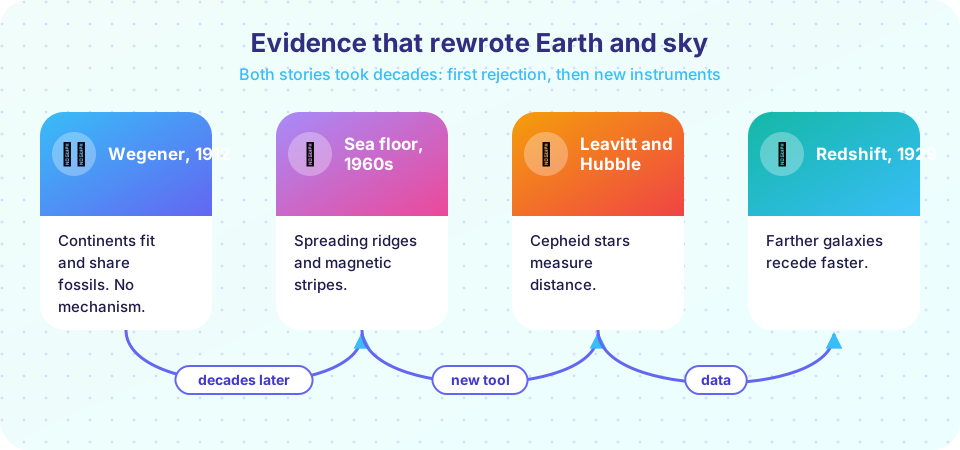
Two big ideas look very different: that the continents drift over the globe, and that the universe is expanding. Yet they share a plot. A bold proposal; evidence from the field or sky; a missing mechanism or missing instrument; years of doubt; then new data that changes minds. Comparing them shows that acceptance in science depends on more than being right.
What you will learn
- What Alfred Wegener argued in 1912 and why most geologists rejected it.
- How sea-floor mapping and magnetic stripes created plate tectonics.
- How Leavitt, Hubble and Lemaître discovered that galaxies recede.
- Why the Hubble constant has been revised and is still debated.
Key terms
Continental drift: Wegener's proposal that continents move across the Earth's surface.
Plate tectonics: the modern theory that the lithosphere is divided into plates that move over the mantle.
Cepheid variable: a pulsating star whose period of brightness change is linked to its true luminosity, so it can serve as a distance indicator.
Redshift: the stretching of light to longer wavelengths from receding sources.
Wegener and his critics
Alfred Wegener, a German meteorologist and polar explorer, noticed what others had: the coasts of South America and Africa fit like jigsaw pieces. In 1912 he proposed that all continents once formed a single supercontinent, later called Pangaea, which broke up and drifted. His book The Origin of Continents and Oceans (1915; expanded editions to 1929) assembled evidence: matching rock formations and mountain belts across the Atlantic, identical fossils such as the freshwater reptile Mesosaurus and the plant Glossopteris on continents now separated by oceans, and ancient glacial deposits in places now tropical.
Geologists responded that the physics did not work: how could continents plow through solid ocean floor? Wegener's proposed forces (tidal and centrifugal effects) were far too weak, as physicists such as Harold Jeffreys showed. Many also argued that land bridges could explain the fossils. The idea was seen as an outsider's speculation, and Wegener died in 1930 on an expedition in Greenland. Arthur Holmes proposed mantle convection in 1929 as a possible engine, but it did not persuade the field then.
The ocean floor speaks
After World War II, naval technology (sonar, magnetometers) allowed surveys of the sea floor. Marie Tharp and Bruce Heezen mapped the mid-Atlantic ridge in the 1950s and found a central rift valley; Tharp's drawings of the ocean floor showed a continuous global ridge system. Heezen at first doubted her reading of the rift valley, and her role was long under-recognized. Palaeomagnetic studies showed that rocks of different ages on different continents recorded magnetic poles that appeared to wander, unless the continents themselves had moved.
In 1962 Harry Hess proposed sea-floor spreading: new crust forms at ridges and moves away. In 1963 Fred Vine and Drummond Matthews (and independently Lawrence Morley) explained magnetic stripes on the sea floor: as new basalt cools, it records the Earth's magnetic field, and since the field reverses periodically, symmetric stripes form on either side of the ridge. Tuzo Wilson (1965) described transform faults; in 1967 and 1968 Jason Morgan, Dan McKenzie and Robert Parker described the motion of rigid plates. Within a few years, nearly all geologists had accepted plate tectonics. The Atlantic widens by about 2 to 3 centimeters per year, about as fast as fingernails grow.
The size of the universe
In 1908 Henrietta Swan Leavitt, one of the "computers" at Harvard College Observatory, catalogued thousands of variable stars in the Magellanic Clouds. In 1912 she reported that the brighter Cepheids have longer periods. Because the stars in a cloud are at about the same distance, this implies a period-luminosity law that turns period into a ruler for distance once calibrated.
In 1920 Harlow Shapley and Heber Curtis debated whether the spiral nebulae were inside our galaxy or separate "island universes." In 1923 to 1924 Edwin Hubble, using the 100-inch telescope on Mount Wilson, found Cepheids in the Andromeda nebula and showed that it is far beyond the Milky Way. (His distance was about three times too small, a calibration error corrected in the 1950s.) The universe was suddenly much larger.
Expansion
Vesto Slipher had measured Doppler shifts in spiral nebulae since 1912 and found that most were redshifted. In 1927 the Belgian priest and physicist Georges Lemaître, solving Einstein's equations, showed that an expanding universe was a natural solution and derived a linear relation between distance and speed from data. In 1929 Hubble, with Milton Humason, published a similar linear relation from more galaxies: the farther a galaxy, the faster it recedes, v = H₀ × d. Hubble's constant from this paper was about 500 km/s per megaparsec; modern measurements give about 67 to 73, and the difference between early-universe and local methods (the "Hubble tension") is an active research puzzle.
The expansion implied a hot, dense beginning. Fred Hoyle, who favored a steady-state universe, jokingly called the rival picture the "big bang" in a 1949 radio broadcast. In 1965 Arno Penzias and Robert Wilson found a uniform microwave background hiss, which Robert Dicke's group identified as the afterglow of the early universe, predicted earlier by Gamow, Alpher and Herman. This evidence ended the steady-state debate for most cosmologists.
Why acceptance differed
Hubble's expansion, with data and a theory in hand, was accepted in a few years. Drift was not accepted for half a century. Historians point to the missing mechanism, the lack of decisive data, Wegener's outsider status, regional differences in geology (southern hemisphere geologists were more receptive) and the Atlantic ocean as an unmapped place. When the data arrived, change was quick.
Common misconceptions
"Wegener was right about everything." His mechanism was wrong, and his estimated drift rates were too high. He was right that the continents moved.
"The universe expands into something." Expansion describes growing distances between galaxies, not an explosion in a pre-existing space.
"Hubble discovered expansion alone." Lemaître and Slipher, and Leavitt's distance scale, were all essential.
Try it
First, convert the Hubble constant into an age of the universe, 1/H₀. With Hubble's 1929 value, the age comes out younger than the Earth, a famous problem.
Press Run (or Ctrl + Enter) to see the result here.
Program input · what you'd type while the program runs
Type the answers before you press Run, one per line. Each time the program reads a line (with input()), it gets the next line from this box.
Second, how long did it take the Atlantic to open? Plot distance against time for different spreading rates.
Press Run (or Ctrl + Enter) to see the result here.
Program input · what you'd type while the program runs
Type the answers before you press Run, one per line. Each time the program reads a line (with input()), it gets the next line from this box.
Check your understanding
Quick check · 5 questions
of 5 answered You scored / 5 · perfect!
-
1. Why did most geologists reject Wegener's continental drift in the 1910s and 1920s?
Physicists showed his proposed forces were too weak, and land bridges were seen as alternative explanations. -
2. What explained the magnetic stripes on the sea floor?
Vine, Matthews and Morley linked stripes to sea-floor spreading and field reversals. -
3. What did Leavitt discover?
The period-luminosity law allowed astronomers to measure distances. -
4. What did Hubble's 1929 relation state?
v = H0 d, with later revisions of H0. -
5. What did Penzias and Wilson find in 1965?
The cosmic microwave background supported the Big Bang over steady-state theory.
Summary
- Wegener's drift (1912) was doubted for lack of mechanism; sea-floor spreading and plate tectonics provided it in the 1960s.
- Leavitt's Cepheid law and Hubble's observations enlarged the universe.
- Lemaître and Hubble found that galaxies recede with speed proportional to distance.
- The cosmic microwave background (1965) favored the Big Bang.
- Acceptance depended on mechanisms, data, instruments and the status of the proposers.
Next: Chapter 7 review
Track your progress
Create a free account to tick off lessons and pick up where you left off on any device.
of History of Science lessons completed