


















Lesson 24 of 44 · Enlightenment to Darwin
Darwin, Wallace and Natural Selection
How Charles Darwin and Alfred Russel Wallace reached natural selection, what the Origin of Species argued, and why acceptance was gradual.
In 1859 a long book with a plain title appeared in London: On the Origin of Species by Means of Natural Selection. It argued that all living things share common ancestors and that a simple process, repeated over very long times, can produce new species and the fit between organisms and their surroundings. Its first printing, 1,250 copies, sold out the first day to booksellers. This lesson follows how the idea was built, what it claimed, and how scientists reacted.
What you will learn
- The path from the Beagle voyage to the Origin.
- Why Alfred Russel Wallace shares credit for the theory.
- The logical structure of natural selection.
- Why the theory was accepted unevenly, and what was missing until genetics.
Key terms
Natural selection: the process by which heritable traits that improve survival or reproduction become more common in a population.
Variation: differences among individuals in a population.
Common descent: the idea that all organisms share ancestors if you go back far enough.
Artificial selection: selective breeding by people, which Darwin used as an analogy.
From voyage to notebooks
Darwin (1809 to 1882) spent 1831 to 1836 as naturalist and companion to Captain FitzRoy on HMS Beagle. He collected fossils of giant extinct mammals in South America, noted how similar species replace each other across regions, and read Lyell's Principles of Geology, which gave him the idea of slow change over huge spans. In the Galápagos he noted that mockingbirds differed between islands; the famous finches were sorted and understood only later by the ornithologist John Gould, and the label "Darwin's finches" is from the twentieth century.
Back in England he began private notebooks on the "transmutation of species" in 1837. In 1838 he read Thomas Malthus's Essay on the Principle of Population (1798), which argued that human populations grow faster than food supplies. Darwin saw that the same pressure applies to all organisms: more young are born than can survive, so the struggle favors individuals with some advantage. He also studied pigeon breeders, whose selection of variation had made fantails, pouters and tumblers from one wild rock dove. If people can change a species in a few generations, nature might do the same over millions of years.
Wallace and the shared announcement
Darwin worked for twenty years without publishing his main theory, gathering evidence and writing a huge manuscript. In June 1858 he received a letter from Alfred Russel Wallace, a naturalist collecting in the Malay Archipelago, outlining a similar theory. Wallace had been inspired by the same Malthus. Friends Lyell and Joseph Hooker arranged that both men's ideas be read at the Linnean Society on 1 July 1858, with neither author present. Darwin then wrote the Origin in about a year.
Wallace's field work is essential. He also drew the line between Asian and Australian fauna, now called the Wallace Line. As with many collectors he depended on local assistants, such as Ali, his helper in Borneo and later years, whose skills and work are rarely noted in popular accounts.
The argument in four steps
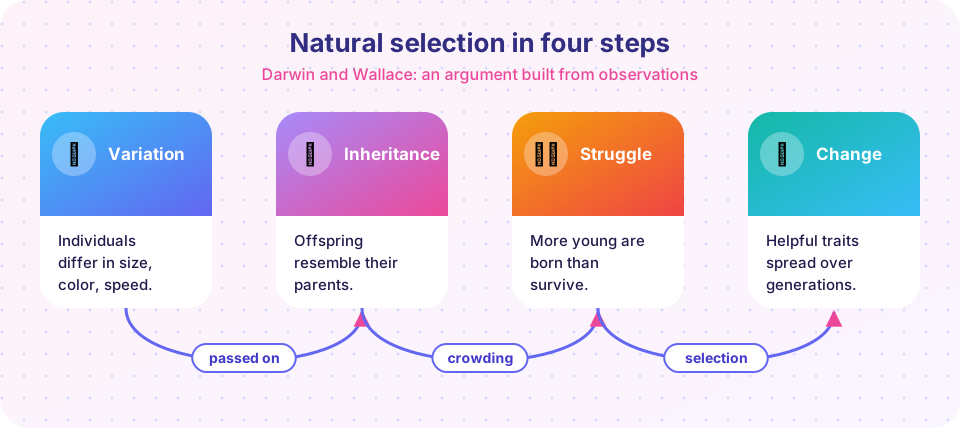
The core of natural selection can be stated as a short chain:
- Variation. Members of a population differ in traits.
- Heritability. Some of that variation is passed from parents to offspring.
- Overproduction. More offspring are produced than can survive and reproduce.
- Differential success. Individuals whose traits suit the environment leave more offspring, so those traits become more common.
If all four hold, populations change over generations. The Origin then supports this with many lines of evidence: the fossil succession, biogeography (island species resemble nearby mainland ones), embryology, similar bone patterns in different limbs (homology), and rudimentary organs. The book's final image is a "tangled bank" of plants, insects and worms, all shaped by laws acting around us.
Reception
Reviews were mixed. Many scientists accepted that species change (evolution) relatively quickly, but natural selection as the main cause was disputed until the 1930s and 1940s. There were reasons. Kelvin's short age of the Earth (previous lesson) seemed to leave too little time. Blending inheritance, the common idea at the time, seemed to dilute any useful variation; Fleeming Jenkin pressed this objection in 1867. Darwin did not know that Gregor Mendel had in 1866 described discrete particles of heredity, which solves the problem (see the chapter on genes). The "modern synthesis" of selection and genetics came together in the 1930s and 1940s through Ronald Fisher, J.B.S. Haldane, Sewall Wright, Theodosius Dobzhansky and Ernst Mayr.
Religious and social reactions varied. Some churchmen, such as Charles Kingsley, welcomed the theory; others objected strongly. Social uses of "evolution" were often misleading: Herbert Spencer coined "survival of the fittest" and used it to justify social competition, and later eugenic movements twisted biology into policy. Darwin himself in The Descent of Man (1871) wrote about human ancestry, and his views on race and sex reflected the prejudices of his era; reading him critically means separating his core argument from the era's assumptions.
Common misconceptions
"Humans came from monkeys." Humans and living apes share a common ancestor; neither descends from the other.
"Evolution is progress toward perfection." Selection favors what works in a particular environment at a particular time. Parasites that lose organs can be well adapted.
"Individuals evolve." Individuals do not change their heredity; populations change as the share of heritable traits shifts across generations.
"It is just a theory." In science, a theory is a well-supported explanation, not a guess. Natural selection has been observed in action in bacteria, finches and many other cases.
Try it
Here is a minimal simulation of selection. A trait gives a fitness advantage s. The frequency p of the trait updates each generation by p' = p(1+s) / (1 + p*s). This is a standard simple model, not a model of real genetics.
Press Run (or Ctrl + Enter) to see the result here.
Program input · what you'd type while the program runs
Type the answers before you press Run, one per line. Each time the program reads a line (with input()), it gets the next line from this box.
Next, a stochastic version with random chance (genetic drift) and no advantage, in a small and a large population. Notice how small populations wander more.
Press Run (or Ctrl + Enter) to see the result here.
Program input · what you'd type while the program runs
Type the answers before you press Run, one per line. Each time the program reads a line (with input()), it gets the next line from this box.
Check your understanding
Quick check · 5 questions
of 5 answered You scored / 5 · perfect!
-
1. Which book by Malthus helped both Darwin and Wallace?
Malthus's essay on population pressure suggested to both men a struggle for existence. -
2. What happened on 1 July 1858?
Lyell and Hooker arranged a joint reading when Wallace's letter reached Darwin. -
3. Which is NOT one of the four steps of natural selection?
The steps are variation, heritability, overproduction and differential success. Inheritance of acquired traits is not required. -
4. Why was natural selection not widely accepted as the main mechanism until the 1930s?
Kelvin's age, the blending inheritance objection and the missing genetics left gaps that the modern synthesis later filled. -
5. What did Herbert Spencer contribute to the language of evolution?
Spencer coined the phrase, which Darwin adopted later but which is often misread as justifying social competition.
Summary
- Darwin built his theory from the Beagle voyage, Lyell's deep time, Malthus and animal breeding.
- Wallace independently reached the same mechanism; both were announced together in 1858.
- Natural selection follows from variation, heritability, overproduction and differential success.
- Acceptance of selection took until the modern synthesis combined it with genetics.
- Popular slogans and social uses of Darwin often distorted the science.
Next: Chapter 5 review
Track your progress
Create a free account to tick off lessons and pick up where you left off on any device.
of History of Science lessons completed