


















Lesson 3 of 44 · Getting Started
How historians of science work
Learn how historians use primary and secondary sources, context and careful dating, and how to avoid presentism, myths and great-man stories.
Everyone has heard that Galileo dropped two balls from the Leaning Tower of Pisa to show that heavy and light objects fall together. It is a vivid story. The trouble is that there is no sign Galileo ever did it. The tale first appears in a biography written by his last student, Vincenzo Viviani, many years after the event was supposed to have happened, and no letter or notebook by Galileo mentions a tower experiment. Galileo did study falling bodies, but with balls rolling on ramps.
This lesson shows how historians sort evidence from legend, and gives you the same tools.
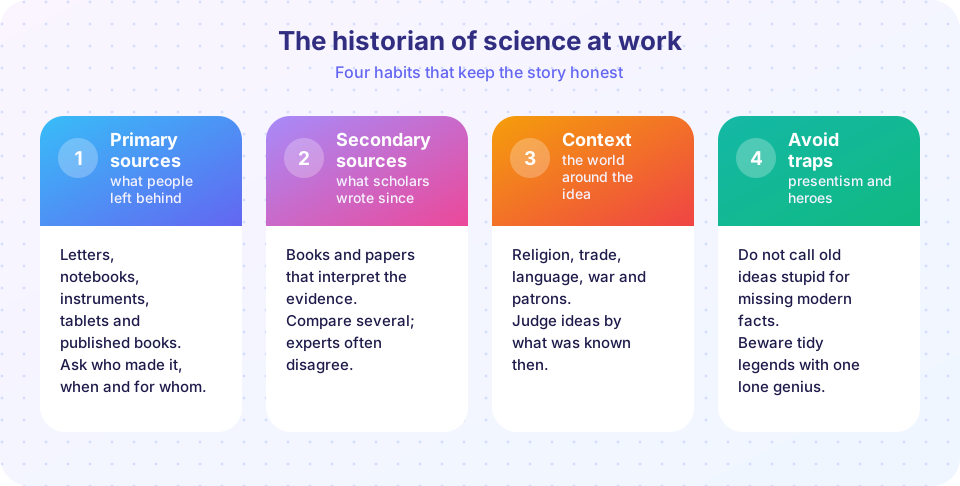
What you will learn
- The difference between primary and secondary sources, and why dates and authorship matter
- How context changes what an old statement means
- What presentism and "Whig history" are, and how to avoid them
- How to test a famous science story before believing it
Key terms
Primary source: material created at the time, such as a notebook, instrument, letter or first edition.
Secondary source: a later work that interprets primary sources, such as a scholarly biography.
Presentism: judging the past only by present-day knowledge and values.
Whig history: a story told as steady progress toward today, with heroes and villains (named after a critique by Herbert Butterfield in 1931).
Provenance: the recorded history of who made, owned and copied a source.
Reading sources
A historian starts with questions. Who made this, when, for whom, and why? A letter to a patron may exaggerate success. A published book may hide dead ends. A notebook is often the most honest, but it may be hard to decode.
Key checks:
- Date. How close is the source to the events? A diary written that week is stronger evidence than a memoir written fifty years later.
- Author. Did the writer see the event or hear about it? Did they have a reason to flatter or attack someone?
- Independence. If three sources agree, do they really have separate origins, or does one copy another? Three copies of one error are not three confirmations.
- Material evidence. Instruments, observatories, tablets and manuscripts can be dated by handwriting, ink, materials or radiocarbon.
In science, a good case is Galileo's notes on Jupiter's moons in January 1610. They are primary evidence, with dated sketches, of what he saw each night. A story that he did an experiment at Pisa, told by a biographer, is secondary evidence from long afterwards, and fails the date check.
Rebuilding the context
Words change meaning. When Isaac Newton wrote about occult qualities, he did not mean ghosts; the word meant hidden causes not directly visible. When medieval writers spoke of an "element" they meant the four of Aristotle (earth, water, air, fire), not an entry in the periodic table. Without the context, we mistranslate the idea.
Context also includes institutions and money. Early telescopes were useful for navigation and military observation, which is part of why governments paid for them. Seeing that link helps explain why optics developed when it did.
Two traps: presentism and heroes
Presentism treats past thinkers as if they were poor versions of us. A presentist might say that Ptolemy "got it wrong" because Earth is not the centre. A historian asks a better question: given what Ptolemy could measure, why did his model work so well? The answer is that it predicted planet positions to a precision that satisfied astronomers for more than a thousand years.
Whig history makes the past a march toward the present, with wise winners and foolish losers. It hides the fact that many losing ideas were reasonable at the time, and many winning ones were opposed for good reasons. The great-man story, one genius alone against a closed-minded world, is a cousin of this trap. The real picture usually includes many people. The theory of evolution, for example, was developed independently by Charles Darwin and Alfred Russel Wallace, and built on work by geologists, breeders and naturalists.
Famous science myths and what the record shows
| Story | What the evidence says |
|---|---|
| Galileo dropped balls from the Pisa tower | No contemporary evidence; the account comes from a later biography |
| Medieval people thought Earth was flat | Educated medieval Europeans knew it was a sphere; the flat-Earth story was spread in the 1800s |
| Newton discovered gravity when an apple hit his head | He later told friends that watching an apple fall helped him think about gravity; there is no hitting-the-head scene |
| Columbus proved the Earth was round | Scholars already knew it was round; the debate was about its size, and Columbus underestimated it |
When you meet a famous story, ask three questions: Who first wrote it down? How long after? Is there a primary source? If the answers are "a biographer," "decades," and "no," treat the story as a legend until shown otherwise.
Common misconceptions
"Primary sources are always true." They are evidence, not truth. A primary source can be mistaken, biased or forged.
"Secondary sources are less useful." Scholars working from many primary sources often see patterns a single document cannot show.
"Context is an excuse for bad ideas." Context explains why an idea made sense; it does not require us to approve it. Explaining is not excusing.
Try it
First, a scoring exercise with invented example sources (not real documents) so you can practise weighing evidence. Then a small console quiz that classifies statements as presentist or contextual.
Press Run (or Ctrl + Enter) to see the result here.
Program input · what you'd type while the program runs
Type the answers before you press Run, one per line. Each time the program reads a line (with input()), it gets the next line from this box.
Press Run (or Ctrl + Enter) to see the console output here.
No output.
Check your understanding
Quick check · 5 questions
of 5 answered You scored / 5 · perfect!
-
1. Which is the strongest evidence that Galileo observed Jupiter's moons in January 1610?
Dated primary notes made at the time are the best evidence of what he saw. -
2. What is presentism?
Presentism ignores what people could know then and why their ideas worked. -
3. Three books agree on a story but all copy one earlier book. How many independent confirmations?
They share one origin, so they confirm that book, not the event. -
4. Which statement is contextual rather than presentist?
It explains the word in its own time. -
5. What did most educated medieval Europeans believe about Earth's shape?
The sphere was standard doctrine; the flat-Earth story was popularised in the nineteenth century.
Summary
- Historians ask who, when, for whom and how independent each source is.
- Primary sources show what people made and wrote at the time; secondary sources interpret them.
- Context changes meaning: words, tools and institutions all matter.
- Presentism, Whig history and great-man stories distort the past; many famous science anecdotes are later legends.
- Use three questions on any story: who first wrote it, how long after, and is there a primary source?
Track your progress
Create a free account to tick off lessons and pick up where you left off on any device.
of History of Science lessons completed