


















Lesson 29 of 44 · Physics and Chemistry Transformed
Faraday, Maxwell and the Idea of a Field
How Oersted, Faraday and Maxwell turned electricity and magnetism into field theory, predicted that light is an electromagnetic wave, and how Hertz confirmed it.
In 1820 a lecturer in Copenhagen noticed a compass needle twitch when an electric current switched on nearby. Within seventy years, that twitch had grown into a theory that explained light, predicted invisible waves and made radio possible. The story has an unusual cast: a bookbinder's apprentice who became the best experimenter of his century, and a mathematician who turned his sketches into equations.
What you will learn
- What Oersted and Faraday discovered and why induction mattered.
- What a field is and why Faraday's picture of lines of force was a conceptual leap.
- How Maxwell predicted electromagnetic waves and found their speed.
- How Hertz confirmed the prediction and what happened to the "ether."
Key terms
Electromagnetic induction: producing an electric current or voltage by changing the magnetic flux through a circuit.
Field: an electric or magnetic influence defined at each point of space.
Magnetic flux: the amount of magnetic field passing through a surface.
Ether (aether): a hypothetical medium thought to carry light waves, later abandoned.
Oersted and Faraday
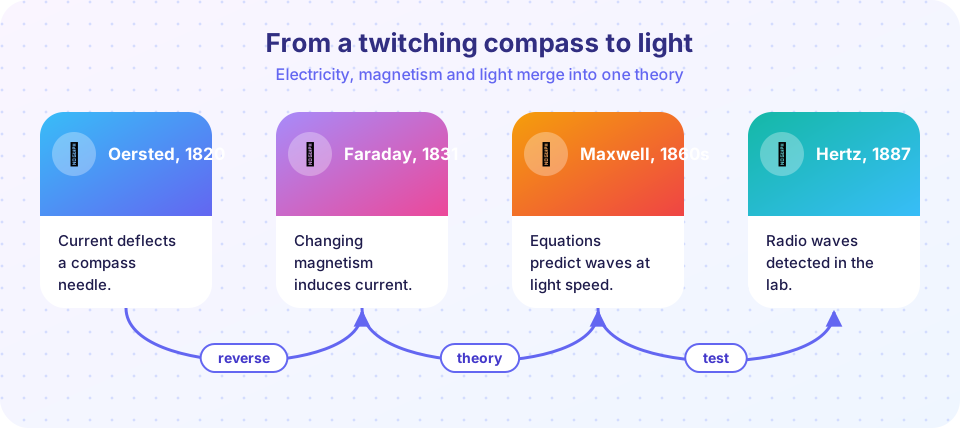
On 21 April 1820 Hans Christian Ørsted found that a current in a wire deflects a magnetic needle. Electricity and magnetism were connected. André-Marie Ampère quickly gave a mathematical description of the forces between currents. Michael Faraday, assistant to Humphry Davy at the Royal Institution in London, built the first device in 1821 to turn this effect into continuous rotation, an early electric motor.
Faraday asked the reverse question: if current makes magnetism, can magnetism make current? On 29 August 1831 he wound two coils on an iron ring. When he connected a battery to one coil, the galvanometer on the other twitched, but only at the moment of connecting or disconnecting. Further tests showed that a magnet moving through a coil also drives current. The key is change: a steady magnetic field does nothing, a changing one induces a voltage. In modern form the voltage equals the rate of change of flux, EMF = -N dΦ/dt. This is the principle of the generator and transformer.
Lines of force
Faraday had little mathematics, but he had a powerful visual imagination. Iron filings sprinkled on paper over a magnet fall into curved lines, and he took these to represent something real in space: lines of force, filling the space around magnets and charges. Most physicists, following Newton, pictured forces as "action at a distance": bodies pull on each other directly across empty space. Faraday argued instead that the space itself carries the influence and that the forces are mediated step by step. This is the idea of a field.
Maxwell's equations
James Clerk Maxwell, a Scottish physicist, admired Faraday's lines and set out to give them mathematical form. In papers from 1855 to 1865 he built a model in which electric and magnetic fields act on each other. He added one new term: a changing electric field, like a current, produces a magnetic field (the "displacement current"). The equations then predicted something new: waves of electric and magnetic fields traveling through empty space.
Maxwell calculated their speed from constants measured in electrical experiments. The result matched the measured speed of light, about 3 × 10⁸ m/s. In his 1865 paper he wrote that light is an electromagnetic disturbance. In the modern form, the speed is c = 1/√(μ₀ ε₀), where μ₀ is the magnetic constant and ε₀ the electric constant. The equations that physicists now write as four short lines are largely the work of Oliver Heaviside and others who simplified Maxwell's original set of about twenty in his 1873 Treatise on Electricity and Magnetism. Maxwell died of cancer in 1879 at age 48.
Hertz and radio
Maxwell's theory was met with skepticism, and few understood it. In 1887 to 1888 Heinrich Hertz built a spark-gap transmitter and a loop receiver in Karlsruhe, and showed that electromagnetic waves travel across a room, reflect, refract and have a finite speed equal to light's. He is said to have remarked that the experiment seemed to have no practical use; within a decade Guglielmo Marconi was sending messages by radio. The SI unit of frequency, the hertz, honors him.
What about the ether? Maxwell and most physicists assumed waves needed a medium. The Michelson-Morley experiment of 1887 failed to detect motion through it, and Einstein's 1905 relativity made it unnecessary (next chapter). The fields themselves became the fundamental objects.
Common misconceptions
"Faraday was uneducated and so lacked rigor." He lacked formal mathematics but his experiments were meticulous, and his notebooks and published papers are a model of method.
"Maxwell merely wrote down Faraday's ideas." He added the displacement current, made quantitative predictions and discovered that light is a wave.
"Hertz proved the ether exists." He confirmed waves, not a medium.
Try it
First, compute the speed of electromagnetic waves from the two constants, as Maxwell did.
Press Run (or Ctrl + Enter) to see the result here.
Program input · what you'd type while the program runs
Type the answers before you press Run, one per line. Each time the program reads a line (with input()), it gets the next line from this box.
Second, a plot of induction: a coil spins in a magnetic field, so the flux varies as a cosine and the voltage as a sine.
Press Run (or Ctrl + Enter) to see the result here.
Program input · what you'd type while the program runs
Type the answers before you press Run, one per line. Each time the program reads a line (with input()), it gets the next line from this box.
Check your understanding
Quick check · 5 questions
of 5 answered You scored / 5 · perfect!
-
1. What did Faraday show in 1831?
Induction depends on change: connecting, disconnecting or moving a magnet. -
2. What is Faraday's key conceptual contribution?
Space itself carries electric and magnetic influence. -
3. What new term did Maxwell add to the equations?
This addition predicted electromagnetic waves. -
4. What did Maxwell find about the wave speed?
c = 1 over square root of mu-zero epsilon-zero equals about 3 times 10^8 m/s. -
5. Who first detected radio waves in the lab, in 1887 to 1888?
Hertz built a transmitter and receiver. Marconi later developed radio communication.
Summary
- Oersted (1820) linked currents to magnetism; Faraday (1831) linked magnetism to currents via induction.
- Faraday's lines of force became the field concept.
- Maxwell added displacement current, predicted electromagnetic waves and identified light as one.
- Hertz confirmed radio waves in 1887 and 1888.
- The ether idea failed and fields became fundamental, paving the way for relativity.
Next: Chapter 6 review
Track your progress
Create a free account to tick off lessons and pick up where you left off on any device.
of History of Science lessons completed