


















Lesson 31 of 44 · Twentieth-Century Revolutions
Chapter 7 Overview: Twentieth-Century Revolutions
A guide to chapter 7: relativity and quantum theory, the gene and the double helix, plate tectonics and the expanding universe, with a timeline.
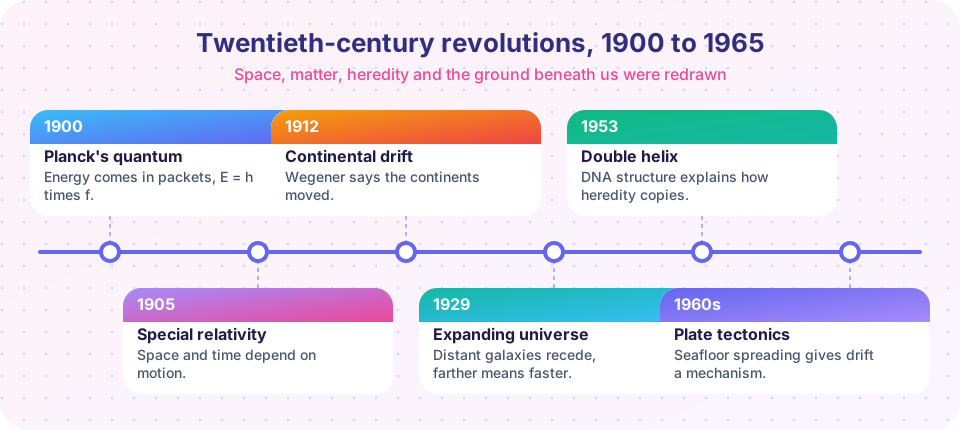
By 1900 many physicists believed the big laws were known. Within a few decades, space and time, matter, heredity, the Earth's crust and the whole universe were redescribed. This chapter picks four stories: relativity and quantum theory, genes and DNA, continental drift and plate tectonics, and the expanding universe. Each began with surprising evidence and a few people willing to take it seriously.
What you will learn
- Why the old picture left cracks that new theories filled.
- How experiments and instruments (eclipses, X-ray photographs, sea-floor surveys, telescopes) decided debates.
- How to compare the pace of acceptance for different revolutions.
- A map to the four stories of the chapter.
Key terms
Quantum: a discrete packet of energy; the idea that energy is exchanged in steps.
Relativity: theories of Einstein relating space, time, motion and gravity.
Gene: a unit of heredity; later identified as a stretch of DNA.
Paradigm shift: Thomas Kuhn's term for the replacement of one framework of ideas by another (see chapter 8).
The cracks in 1900
Several puzzles did not fit classical physics. The spectrum of light from hot objects ("black-body radiation") could not be explained by Maxwell's waves and Boltzmann's statistics. Michelson and Morley's 1887 experiment found no motion through the ether. Radioactivity (1896) seemed to violate energy conservation until it was understood. In biology, Mendel's results (1866) were rediscovered in 1900, but how heredity worked at the molecular level was unknown. In geology, the fit of the continents' coastlines was an old observation with no explanation.
Each puzzle turned into a revolution. It is useful to ask for each: Who proposed the new idea? What new measurements decided between theories? How long did acceptance take? Who was left out of the story?
Four stories
Speed of acceptance
What decided it
A guide to the chapter
- Relativity and quantum theory follows Planck, Einstein, Bohr, Heisenberg and Schrödinger.
- Genes and the double helix goes from Mendel's peas to Watson, Crick, Franklin and Wilkins.
- Moving continents and the expanding universe compares Wegener's slow vindication with Hubble's rapid impact.
- The chapter review summarizes all four.
If you want the science itself, see the site's physics, relativity and quantum mechanics tracks; this course concentrates on how people came to know these things.
Common misconceptions
"Einstein overthrew Newton." Newtonian physics remains an excellent approximation at everyday speeds and weak gravity. Relativity extends it.
"Revolutions are sudden." Even the fast cases took years of experiments and debate.
Try it
A simple script to sort the revolutions by how long acceptance took, using approximate dates in this chapter's lessons.
Press Run (or Ctrl + Enter) to see the result here.
Program input · what you'd type while the program runs
Type the answers before you press Run, one per line. Each time the program reads a line (with input()), it gets the next line from this box.
And an interactive card that lets you pick a revolution and see what decided it.
Check your understanding
Quick check · 4 questions
of 4 answered You scored / 4 · perfect!
-
1. Which experiment in 1887 found no motion through the ether?
Their interferometer showed no ether wind, a puzzle that relativity later resolved. -
2. What kind of event helped decide acceptance of general relativity?
The eclipse expeditions measured the deflection predicted by Einstein. -
3. Which of these revolutions took about half a century to be accepted?
Wegener proposed drift in 1912; plate tectonics was accepted in the 1960s. -
4. Who wrote that scientific change comes in paradigm shifts?
Kuhn's 1962 book The Structure of Scientific Revolutions introduced the term.
Summary
- Cracks in classical physics, genetics and geology led to four revolutions.
- Instruments and measurements decided between rival ideas.
- Acceptance ranged from a few years to half a century.
- Newtonian physics survives as an approximation; it was extended, not discarded.
Track your progress
Create a free account to tick off lessons and pick up where you left off on any device.
of History of Science lessons completed