


















Lesson 22 of 44 · Enlightenment to Darwin
Lavoisier and the Chemical Revolution
How Antoine Lavoisier, with Marie-Anne Paulze Lavoisier, used the balance to overturn phlogiston, name oxygen and establish conservation of mass.
In the early 1700s a burning candle, a rusting nail and a smelting furnace all seemed to share a secret. The most successful explanation said that burning things release a fire-stuff called phlogiston. A hundred years later chemists spoke instead of oxygen, of compounds with fixed compositions, and of a rule that total mass never changes. This lesson tells how that switch happened and why historians call it a revolution.
What you will learn
- What the phlogiston theory claimed and why it was a sensible theory.
- How Priestley, Scheele and Lavoisier each contributed to the discovery of oxygen.
- Why conservation of mass became a working rule of chemistry.
- How a new naming system changed how chemists thought.
Key terms
Phlogiston: a hypothetical substance thought to be released when materials burn or metals rust.
Calcination: heating a metal in air to turn it into a powdery "calx" (what we call an oxide).
Conservation of mass: in a closed system, the total mass before and after a chemical change is the same.
Element (Lavoisier's sense): a substance that no chemical method has yet been able to break down.
Why phlogiston made sense
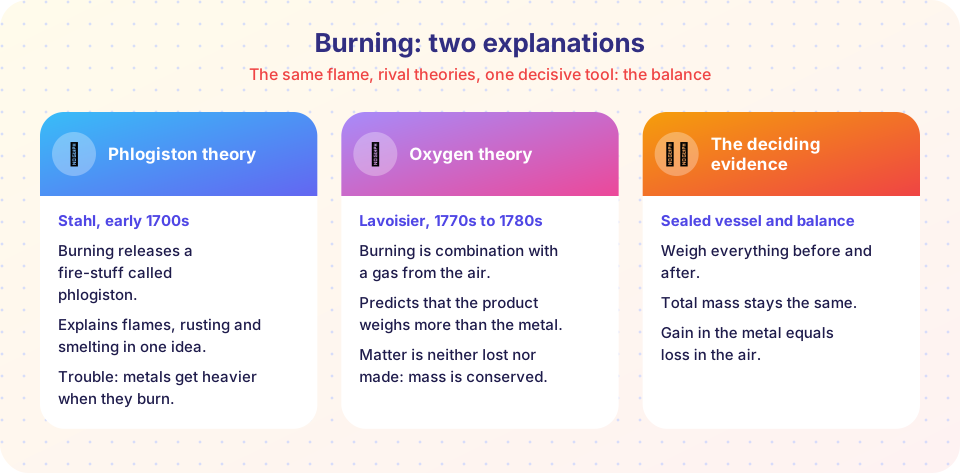
Georg Ernst Stahl and others developed the phlogiston idea in the early 1700s. It unified many observations. Wood burns and leaves ash, which is lighter than the wood: phlogiston escapes. A metal heated in air turns to a calx; heating the calx with charcoal brings the metal back, so charcoal, rich in phlogiston, must restore what was lost. A candle in a sealed jar goes out because the air becomes saturated with phlogiston and can hold no more.
This was not stupidity. It organized a lot of facts with one simple story. The theory's weak point was weight. Metals gain weight when they become calxes, yet the theory said they lose something. Some defenders suggested phlogiston had negative weight, or simply did not worry about weight, since chemistry then was mostly about qualities such as color, smell and reactivity.
Three people, one gas
In 1774 the English minister and chemist Joseph Priestley focused sunlight onto red mercury calx and collected a gas in which a candle burned brilliantly and a mouse lived longer. He called it "dephlogisticated air" and kept the phlogiston framework. The Swedish chemist Carl Wilhelm Scheele had prepared the same gas by 1771 to 1772, calling it "fire air," but published only in 1777. Priestley visited Paris in autumn 1774 and described the experiment to Lavoisier.
Antoine Lavoisier understood what the gas implied. He had already shown, around 1772 to 1773, that phosphorus and sulfur gain weight when burned. In a series of careful experiments he heated metals in sealed vessels with a known volume of air, weighing everything before and after. Tin heated in a sealed flask gained weight, and the air lost an equal amount: the metal had combined with part of the air. In 1777 to 1778 he named that part "oxygène," Greek for "acid former," because he believed it was in all acids (it is not: hydrochloric acid has none).
Marie-Anne Paulze Lavoisier (1758 to 1836) was far more than a bystander. She translated English chemistry papers for her husband, made the technical drawings for the Traité élémentaire de chimie (1789), and kept laboratory notes. She later edited and published his unfinished memoirs.
Mass is conserved
Lavoisier's working rule was that nothing is lost or created in a chemical change. He wrote that in every operation the quantity of matter is the same before and after, and treated that as an axiom that let him check any experiment by balancing the books. If the numbers did not add up, he suspected a leak or a missing gas. This turned the balance from a tool for assaying coins into the central instrument of chemistry.
He then applied the rule to water. Henry Cavendish had burned "inflammable air" (hydrogen) in air and found that water formed. In 1783 Lavoisier and Pierre-Simon Laplace repeated this and showed that water is a compound, not an element. Lavoisier named the light gas hydrogène, "water former." Water had been one of the four ancient elements; now it was a compound. The old four-element scheme collapsed.
A new language
In 1787 Lavoisier, with Louis-Bernard Guyton de Morveau, Claude Louis Berthollet and Antoine Fourcroy, published Méthode de nomenclature chimique. Names would describe composition: the old "oil of vitriol" became sulfuric acid, and "flowers of zinc" became zinc oxide. His 1789 textbook listed 33 "simple substances" that could not yet be decomposed. Many were real elements (oxygen, hydrogen, nitrogen, sulfur, phosphorus, carbon, iron, copper, zinc and others); some were not. The list included light and caloric, the supposed fluid of heat, and several earths (such as lime and silica) that were later shown to be compounds.
Lavoisier was a tax collector for the Ferme générale, a private company that collected taxes for the French crown. During the Terror he was arrested and guillotined on 8 May 1794. The mathematician Joseph-Louis Lagrange reportedly remarked that it took a moment to cut off the head and perhaps a century to produce another like it.
How completely did it replace phlogiston?
Lavoisier's change was not instantly accepted. Priestley defended phlogiston until his death in 1804. Historians point out that there was no single decisive experiment: the oxygen theory won because it explained more with fewer assumptions, tied into measurement, and had a persuasive teaching book. Lavoisier also made errors. He believed oxygen was the principle of acidity and kept caloric. A fair summary: he did not discover oxygen alone, but he understood and systematized it.
Common misconceptions
"Phlogiston was just silly." It was a reasonable theory for its time and made predictions. It lost because it conflicted with careful weighing and because the oxygen theory was simpler.
"Lavoisier discovered oxygen." Scheele and Priestley prepared it first; Lavoisier explained what it was and why it mattered.
"One experiment proved it." Acceptance took about two decades of arguments, replications and teaching.
Try it
First, a balance-sheet calculator for combustion. It checks that mass is conserved when magnesium burns, using standard atomic masses (Mg 24.305, O 15.999).
Press Run (or Ctrl + Enter) to see the result here.
Program input · what you'd type while the program runs
Type the answers before you press Run, one per line. Each time the program reads a line (with input()), it gets the next line from this box.
Second, a plot of the "phlogiston puzzle": the mass of the ash relative to the metal for different metals burning to common oxides.
Press Run (or Ctrl + Enter) to see the result here.
Program input · what you'd type while the program runs
Type the answers before you press Run, one per line. Each time the program reads a line (with input()), it gets the next line from this box.
Check your understanding
Quick check · 5 questions
of 5 answered You scored / 5 · perfect!
-
1. What problem did the phlogiston theory have with metals?
Calcination adds weight, which conflicts with the idea that something escapes. -
2. Who first prepared oxygen gas?
Scheele (published 1777) and Priestley (1774) isolated it. Lavoisier explained its role. -
3. What does conservation of mass say?
The sum of the masses of reactants equals the sum of the products in a closed system. -
4. Which item on Lavoisier's 1789 list of simple substances was NOT a real material element?
Caloric, the supposed fluid of heat, is a theoretical entity that later work rejected. Light was also on the list. -
5. Why did the name 'oxygen' (acid former) turn out to be wrong?
Lavoisier thought oxygen was in every acid, but hydrochloric acid, for one, has none.
Summary
- Phlogiston was a coherent theory that struggled with weight gain in burning metals.
- Priestley and Scheele isolated oxygen; Lavoisier explained and systematized it.
- Conservation of mass made the balance a central tool of chemistry.
- A systematic nomenclature (1787) tied names to composition.
- Marie-Anne Paulze Lavoisier contributed as translator, illustrator and recorder.
- Acceptance was gradual, and Lavoisier himself kept some mistakes.
Track your progress
Create a free account to tick off lessons and pick up where you left off on any device.
of History of Science lessons completed