


















Lesson 6 of 44 · Science Before Science
Chapter overview: Science before science
A map of ancient knowledge in Mesopotamia, Egypt, China, India, the Americas and the Pacific: what people measured, recorded and calculated, and why.
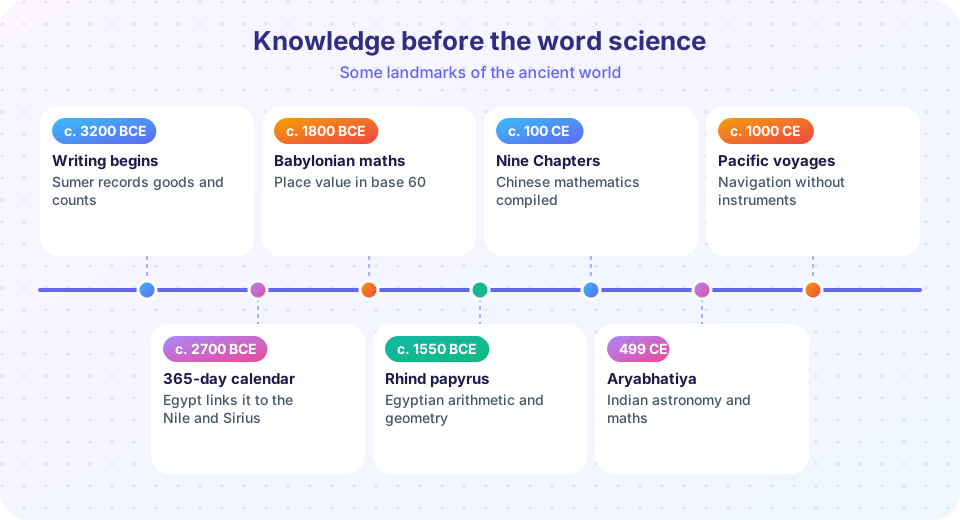
Long before anyone used the word science, people were measuring, counting and predicting. Farmers needed to know when to plant. Priests and kings needed calendars. Builders needed right angles and areas. Sailors needed the stars. Healers needed treatments that worked. Out of these practical needs came real, testable knowledge: arithmetic, geometry, astronomy and medicine.
This chapter tours that knowledge across the world. It does not claim these people were "early scientists" in a modern sense. It asks what they knew, how they recorded it and how reliable it was.
What you will learn
- Why calendars, counting and healing were the first sciences
- Which regions and records the chapter covers
- How people stored and passed on knowledge without printing
- What historians can and cannot conclude from fragments
Key terms
Calendar: a system that organises time using cycles of the Sun, Moon or stars.
Sexagesimal: counting in base 60, as the Babylonians did.
Papyrus: a writing material made from the papyrus plant, used in Egypt.
Astronomical record: a dated log of observations of the sky, such as eclipses.
Three needs, three kinds of knowledge
Time. The Sun gives the day, the Moon about 29.5 days, and the seasons about 365.24 days. These cycles do not fit neatly, so every culture had to decide how to fix the calendar. Egypt used a simple 365-day civil year. Babylonian astronomers tracked lunar months and found long cycles. The Maya combined a 260-day count and a 365-day count.
Number and shape. Taxes, grain stores, canals and temples all needed arithmetic and geometry. Babylonian scribes developed a place-value system; Egyptian scribes worked with unit fractions; Chinese mathematicians wrote problem collections with general methods; Indian mathematicians refined decimal place value and zero.
Health. Medical texts from Egypt and Mesopotamia describe symptoms, treatments and sometimes remarkable surgery, mixed with prayers and charms. The mixture is a reminder that practical and religious ideas were not separate boxes.
Four regions
Two more worlds
How it was kept
How knowledge was stored
Without printing, knowledge lived in clay tablets, papyrus scrolls, bamboo strips, palm-leaf manuscripts, bark paper and human memory. Clay survives fire, which is why we know so much about Mesopotamia; papyrus survives only in dry places such as Egypt; palm leaf and bamboo rot in the damp. This is a survivor bias: the regions with durable materials look more advanced to us than they may have been. When a record is silent, we must say "unknown", not "nothing".
Oral traditions mattered as much in many places. Polynesian navigators memorised star paths and wave patterns in chants and taught them through apprenticeship. These are knowledge systems that historians can only study through descendants, observation and the sparse written accounts of outsiders.
What this chapter covers
| Lesson | Region | Highlights |
|---|---|---|
| Mesopotamia and Egypt | Near East | Base 60, Plimpton 322, sky logs, 365-day calendar, medical papyri |
| China and India | Asia | Nine Chapters, Zhang Heng, Aryabhata, Brahmagupta, Madhava |
| Americas and the Pacific | Americas, Oceania | Maya Venus table, quipu, wayfinding |
| Chapter 2 review | all | Recap and ten-question quiz |
Common misconceptions
"Ancient peoples only had myths." Alongside myth they had accurate astronomical records, effective arithmetic and surgical knowledge. Mixed does not mean empty.
"Real science began with the Greeks." The Greeks drew heavily on Babylonian and Egyptian data and methods, as the next lessons show.
"Where we lack records, nothing happened." The loss of perishable records means large parts of the story are invisible to us.
Try it
Two warm-ups. The first converts seconds into hours, minutes and seconds: a living leftover of base 60. The second turns a day number into an Egyptian civil calendar date.
Press Run (or Ctrl + Enter) to see the result here.
Program input · what you'd type while the program runs
Type the answers before you press Run, one per line. Each time the program reads a line (with input()), it gets the next line from this box.
Press Run (or Ctrl + Enter) to see the console output here.
No output.
Check your understanding
Quick check · 4 questions
of 4 answered You scored / 4 · perfect!
-
1. Why does clay survive better than papyrus?
Clay tablets survive in large numbers, which biases what we know. -
2. Which count combined with a 365-day count to make the Maya calendar round?
260 and 365 days together repeat every 18,980 days, about 52 years. -
3. What is survivor bias in this context?
Durable materials preserve more evidence, which skews our picture. -
4. Where does the 60-minute hour come from?
Base 60 passed through Greek astronomy into time and angle measurement.
Summary
- Calendars, counting and healing were the first practical sciences everywhere.
- Mesopotamia, Egypt, China, India, the Americas and the Pacific all contributed.
- Perishable records mean historians must separate "unknown" from "did not exist".
- Mixed practical and religious thought does not make the practical part less real.
Next: Mesopotamia and Egypt
Track your progress
Create a free account to tick off lessons and pick up where you left off on any device.
of History of Science lessons completed