


















Lesson 10 of 44 · Science Before Science
Chapter 2 review: Science before science
Review chapter 2 of the History of Science course: Mesopotamia and Egypt, China, India, the Americas and the Pacific, with a recap table and a ten-question quiz.
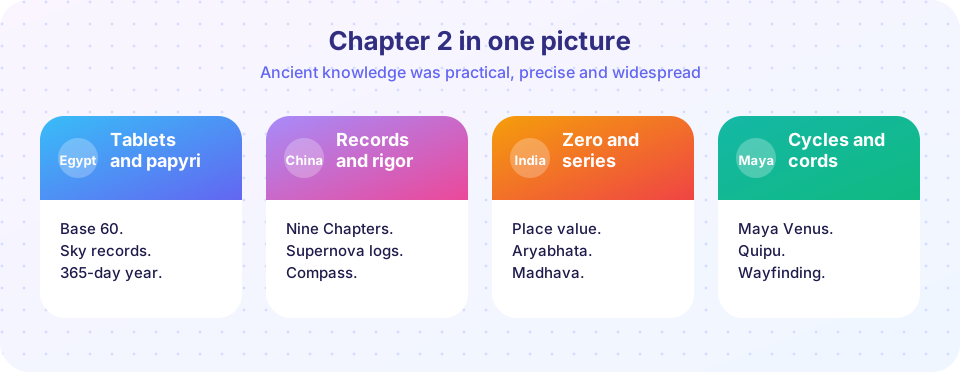
This review gathers the chapter's main points in one picture and one table, shows a way to compare traditions, and then tests you with ten mixed questions.
What you will learn
- A compact recap of the four lessons
- How to compare traditions fairly
- Your readiness across the chapter
Key terms
Place value: digit position gives worth.
Saros: a 223-month eclipse cycle.
Synodic period: a planet's return to the same position relative to the Sun, seen from Earth.
Survivor bias: durable records make some regions look more advanced.
Recap table
| Region | Key achievements | Example |
|---|---|---|
| Mesopotamia | Base-60 place value, sky logs, accurate square roots | YBC 7289: 1;24,51,10 |
| Egypt | 365-day civil calendar, medical and math papyri | Rhind papyrus, Edwin Smith papyrus |
| China | Elimination method, polygon estimate of pi, comet and supernova records, compass | Nine Chapters, Zhang Heng, Shen Kuo |
| India | Decimal place value, zero rules, sine tables, infinite series | Aryabhata, Brahmagupta, Madhava |
| Maya | Venus table, base 20 with zero, calendar round | 584-day cycle |
| Inca | Quipu decimal records | Knotted cords |
| Polynesia | Instrument-free navigation | Hōkūle'a voyage, 1976 |
Comparing fairly
When comparing traditions, avoid ranking them by one yardstick. Ask three questions of each:
- What was the need? Calendar, taxes, navigation, healing.
- What was the method? Tablets and tables, rods, cords, apprenticeship.
- What was the result? Precision, predictions, durable techniques.
By these questions a Polynesian navigator and a Babylonian astronomer are both experts with different media. The history becomes richer and fairer.
Try it
First, compare the accuracy of several ancient estimates of pi in one table. Second, a simple plot of how close each calendar year length is to the real year.
Press Run (or Ctrl + Enter) to see the result here.
Program input · what you'd type while the program runs
Type the answers before you press Run, one per line. Each time the program reads a line (with input()), it gets the next line from this box.
Press Run (or Ctrl + Enter) to see the result here.
Program input · what you'd type while the program runs
Type the answers before you press Run, one per line. Each time the program reads a line (with input()), it gets the next line from this box.
Check your understanding
Quick check · 10 questions
of 10 answered You scored / 10 · perfect!
-
1. Which culture's text gives the base-60 value 1;24,51,10 for the square root of 2?
YBC 7289 is a Babylonian clay tablet. -
2. How long was the Egyptian civil year?
Twelve 30-day months plus five extra days. -
3. Who described magnetic declination in 1088?
Shen Kuo's Dream Pool Essays. -
4. Which text gave rules for zero and negative numbers in 628 CE?
Brahmagupta treated zero as a number. -
5. What does a Maya shell glyph represent?
It is the zero placeholder in base-20 numerals. -
6. What does the Saros predict?
223 lunar months. -
7. What did the Edwin Smith papyrus describe?
It lists 48 cases. -
8. Which is a source of survivor bias?
Durable materials preserve more evidence. -
9. How did Polynesian navigators find their way?
No instruments were used; the knowledge passed through apprenticeship. -
10. What did Madhava's Kerala school find?
They found series results in the 1300s and 1400s.
Summary
- Practical needs drove arithmetic, calendars, astronomy and medicine across the world.
- Mesopotamia gave place value and sky records, Egypt a calendar and papyri, China records and methods, India zero and series, the Americas and Pacific cycles, cords and wayfinding.
- Compare by need, method and result, not by one yardstick.
- Be careful with survivor bias and with non-written systems.
Track your progress
Create a free account to tick off lessons and pick up where you left off on any device.
of History of Science lessons completed