


















Lesson 37 of 44 · Science, Society and Method
How Science Changes: Popper, Kuhn and After
Compare Popper's falsification, Kuhn's paradigm shifts and Lakatos's research programmes, with case studies from Neptune, Mercury and Semmelweis.
Is science a ladder of proven facts, or a series of bold guesses that survive tests until they do not? Do old theories get gradually corrected, or does one worldview replace another? Twentieth-century philosophers and historians disagreed sharply, and their disagreement is still useful. By the end of this lesson you will be able to describe three major pictures of scientific change and apply each to real cases from earlier chapters.
What you will learn
- Why induction is a problem and how Popper responded with falsification.
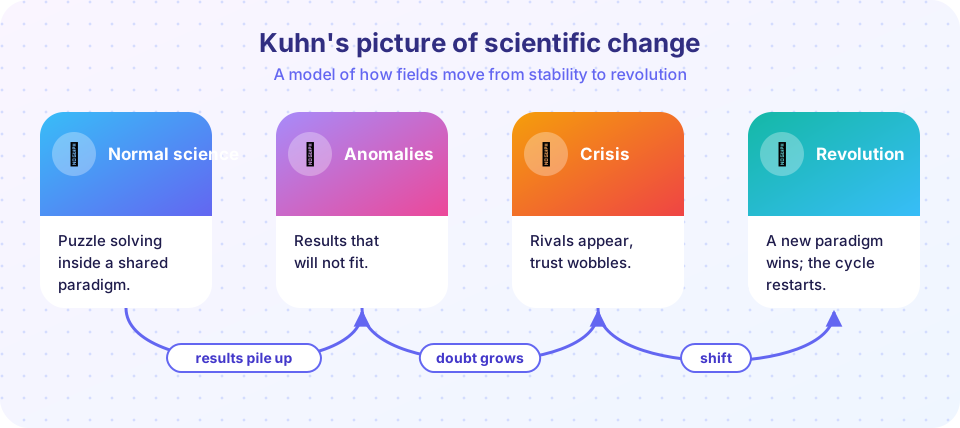
- Kuhn's cycle: normal science, anomaly, crisis, revolution.
- Lakatos's research programmes as a middle position.
- How to use these frameworks on real episodes, and where each one fails.
Key terms
Induction: reasoning from observed cases to a general rule; David Hume showed no amount of cases logically guarantees it.
Falsifiability: a claim is scientific if some possible observation could show it false (Popper).
Paradigm: in Kuhn, a framework of theories, methods and exemplary problem solutions shared by a community.
Research programme: Lakatos's term for a series of theories sharing a "hard core" protected by auxiliary assumptions.
The problem of induction
David Hume pointed out in the 1700s that no number of white swans proves that all swans are white, and no argument based on past regularities can logically guarantee that the future will resemble the past. If science relies on inductive generalization, what justifies it? Philosophers have given many responses; two have shaped how historians talk about change.
Popper: conjecture and refutation
Karl Popper, in Logik der Forschung (1934; English translation 1959), proposed that science does not prove theories but tests them. A theory is scientific if it forbids something: it says that certain observations will not occur. A single clear counterexample can refute "all swans are white"; no number of confirmations can prove it. Good science makes bold, risky predictions and drops theories that fail them.
Popper's favorite contrast was between Einstein and some other popular theories of the day. Einstein's general relativity predicted something specific: starlight would bend by a certain amount near the Sun; if the 1919 eclipse had shown no bending, the theory would have been in trouble. Theories that could explain any outcome (he used certain readings of Marxist history and psychoanalysis as examples) were, he argued, not testable. This is the demarcation problem: where to draw the line between science and non-science.
Limitations: scientists do not abandon a theory at the first anomaly, and with good reason. Tests rely on auxiliary assumptions about instruments and conditions, so a failed prediction might blame the assumption rather than the theory (the Duhem-Quine thesis). When the orbit of Uranus did not match Newton's laws, astronomers did not throw out gravity: Urbain Le Verrier and John Couch Adams predicted an unseen planet, and Neptune was found in 1846 near the predicted position. But when Mercury's orbit showed a similar anomaly, the planet "Vulcan" proposed by Le Verrier never appeared; the answer was general relativity in 1915. The same strategy worked once and failed once.
Kuhn: normal science and revolutions
Thomas Kuhn, a physicist turned historian, argued in The Structure of Scientific Revolutions (1962) that most science is normal science: researchers solving puzzles within a shared paradigm, such as Newtonian mechanics or Mendelian genetics, without questioning its foundations. Puzzles that resist solution are anomalies. Usually they are set aside or explained away. If anomalies accumulate and resist all efforts, a crisis opens, and rival frameworks gain attention. A revolution replaces the old paradigm with a new one, after which normal science resumes under new assumptions.
Kuhn stressed that rival paradigms are partly incommensurable: they use terms differently (mass in Newton and in Einstein are not identical concepts), pick different problems as important, and so cannot be compared by a neutral test alone. Persuasion, generational change and group commitments play roles. Critics argued that this made science look irrational or relativist; Kuhn replied that shared values such as accuracy, consistency, scope, simplicity and fruitfulness still guide choice. He later called the "revolution" pattern an idealization.
Lakatos and after
Imre Lakatos (1970) tried to combine the two. A research programme has a hard core of assumptions protected by a protective belt of adjustable auxiliary hypotheses. A programme is progressive if it keeps predicting new facts, and degenerating if it only patches itself after the fact. Scientists may rationally stay with a programme through anomalies as long as it is progressive. Paul Feyerabend, in Against Method (1975), went further, arguing that no single method describes all successful science and that rules often hinder; his slogan "anything goes" is more of a provocation than a recommendation.
More recent historians stress practices: how experiments, instruments and communities produce results, and how trust is built. No framework has won universally, but together they offer a useful toolbox.
A case: Semmelweis
Ignaz Semmelweis noticed in 1847 at Vienna's General Hospital that women delivered by doctors and students in the First Clinic died of puerperal fever far more often than those attended by midwives in the Second. He deduced that the doctors carried "cadaverous particles" from autopsies and introduced hand-washing with chlorinated lime; mortality fell sharply. Yet most of the medical community rejected his idea. There was no accepted germ theory yet (that came with Pasteur and Koch decades later); the claim implied that doctors had been killing patients; and Semmelweis was abrasive. He died in 1865. Kuhn would point to incommensurable frameworks, Popper to a well-tested prediction ignored, sociologists to prestige and politics. A good account uses all three.
Common misconceptions
"Popper says science is just refuting theories." He emphasizes bold conjectures as well as tests, and he acknowledged that falsification is not mechanical.
"Kuhn says science is irrational." He argued that choices are guided by shared values but not by a single algorithm.
"Paradigm shift" means any big change. In Kuhn's sense it refers to a change of shared framework, not just any discovery.
Try it
A toy Bayesian update. Suppose theory A and rival B each predict an observation with different probabilities. This shows how confirming and disconfirming evidence shift belief, a modern complement to Popper. It is a teaching model, not a description of real scientists.
Press Run (or Ctrl + Enter) to see the result here.
Program input · what you'd type while the program runs
Type the answers before you press Run, one per line. Each time the program reads a line (with input()), it gets the next line from this box.
A toy simulation of Kuhn's cycle: each year a field meets anomalies at random; when the pile passes a threshold, a revolution happens and the pile resets. The numbers are invented to show the shape, not to model real history.
Press Run (or Ctrl + Enter) to see the result here.
Program input · what you'd type while the program runs
Type the answers before you press Run, one per line. Each time the program reads a line (with input()), it gets the next line from this box.
Check your understanding
Quick check · 5 questions
of 5 answered You scored / 5 · perfect!
-
1. What is the central idea of Popper's falsificationism?
Bold, risky predictions that could fail make a theory scientific in Popper's view. -
2. What did Kuhn call routine research inside a shared framework?
Normal science is puzzle-solving within a paradigm. -
3. What is the Duhem-Quine point?
Tests involve many assumptions, so refutation is not mechanical. -
4. What happened with the Uranus anomaly and the Mercury anomaly?
The same strategy worked once and failed once. -
5. How does Lakatos distinguish progressive from degenerating programmes?
Predictive success separates the two.
Summary
- Hume's problem of induction motivates Popper's emphasis on testing and falsification.
- Kuhn describes normal science, anomalies, crisis and revolution, with partly incommensurable paradigms.
- Lakatos treats research programmes as progressive or degenerating.
- No single model fits all cases; Neptune, Vulcan and Semmelweis show different patterns.
Track your progress
Create a free account to tick off lessons and pick up where you left off on any device.
of History of Science lessons completed