


















Lesson 30 of 44 · Physics and Chemistry Transformed
Chapter 6 Review: Physics and Chemistry Transformed
A recap of chapter 6 with a one-picture summary, a comparison table and a ten-question quiz on atoms, thermodynamics and electromagnetic fields.
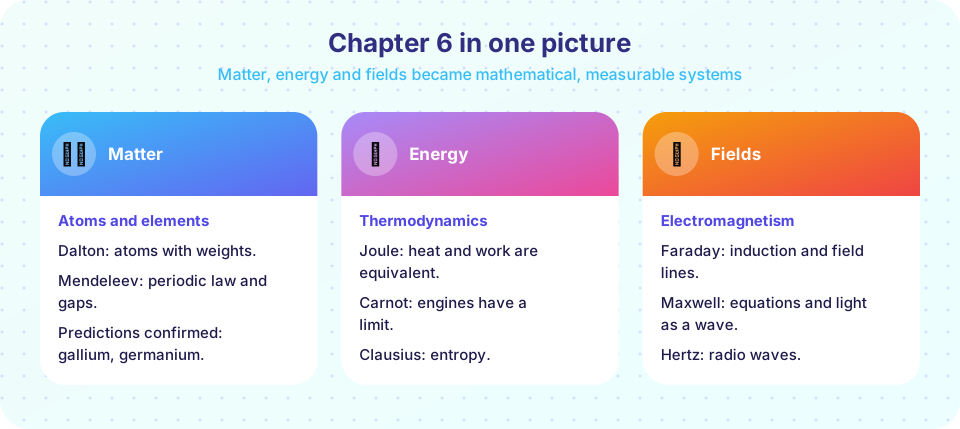
This chapter followed three unifications. Atoms with weights explained chemistry and led to the periodic table. Energy conservation and entropy tied heat to work. Fields tied electricity, magnetism and light together. Use this review to check names, dates and how the ideas connect.
What you will learn
- How the three stories fit together and what they left unsolved.
- The key people, dates and results, in one table.
- Which numbers tie theory to measurement (4.186 J/cal, c = 1/√(μ₀ε₀), Carnot efficiency).
The chapter in one table
| Story | Key people | Dates | Result | Test or measurement |
|---|---|---|---|---|
| Atoms | Dalton, Cannizzaro, Mendeleev, Moseley | 1808 to 1913 | Atoms with weights; periodic law; atomic number | Gallium (1875), germanium (1886), X-ray spectra |
| Energy | Carnot, Joule, Mayer, Helmholtz, Clausius | 1824 to 1865 | Efficiency limit; energy conservation; entropy | Paddle wheel, about 4.2 J per calorie |
| Fields | Oersted, Faraday, Maxwell, Hertz | 1820 to 1888 | Induction; electromagnetic waves; light as EM wave | Induction ring (1831), radio waves (1887) |
Key terms
Atomic number: the number of protons in a nucleus; it orders the periodic table.
First law: energy is conserved.
Second law: entropy of an isolated system does not decrease.
Displacement current: Maxwell's term: a changing electric field acts like a current in producing magnetic fields.
Patterns across the three stories
- Measurement made theory testable. Weights, temperature rises and voltages let others check claims.
- Predictions persuaded. New elements, a limit on engines and radio waves convinced skeptics.
- Unification was the goal. Each story absorbed separate laws into one theory.
- Loose ends remained. The inside of atoms, the nature of the ether and the radiation spectrum pointed toward 1900.
Common misconceptions
"Theories were accepted on elegance alone." Predictions and quantitative matches were decisive.
"Each discovery had one author." Energy conservation had several independent authors; the periodic law had several partial precursors.
Try it
A drill that connects each person to a number or symbol.
Press Run (or Ctrl + Enter) to see the result here.
Program input · what you'd type while the program runs
Type the answers before you press Run, one per line. Each time the program reads a line (with input()), it gets the next line from this box.
And an interactive thermodynamics widget: drag the cold temperature and watch the ideal limit.
Check your understanding
Quick check · 10 questions
of 10 answered You scored / 10 · perfect!
-
1. What is the main idea of Dalton's atomic theory?
Dalton explained definite and multiple proportions with atoms of characteristic weight. -
2. Why were Mendeleev's predictions important?
Gallium, scandium and germanium matched his predicted properties. -
3. What did Moseley's 1913 work do?
X-ray frequencies follow atomic number, not atomic weight. -
4. What is the Carnot efficiency limit for Th = 600 K and Tc = 300 K?
1 - 300/600 = 0.5. -
5. What did Joule measure?
He related mechanical work to temperature rise, about 4.2 J per calorie. -
6. Which concept did Faraday introduce?
He pictured space as carrying electric and magnetic influence. -
7. What did Maxwell predict from his equations?
He computed a wave speed matching light and concluded that light is electromagnetic. -
8. Who confirmed radio waves experimentally?
Hertz generated and detected them in 1887 to 1888. -
9. Why is energy conservation called a case of simultaneous discovery?
Common problems in engines, chemistry and physiology led several people to the same principle. -
10. What did the second law add to the first law?
Energy is conserved, but not all of it is available to do work.
Summary
- Matter, energy and fields were each reorganized around quantitative laws.
- Predictions (new elements, engine limits, radio waves) carried the arguments.
- Loose ends in atoms, radiation and the ether opened the way for the next chapter.
Track your progress
Create a free account to tick off lessons and pick up where you left off on any device.
of History of Science lessons completed