


















Lesson 21 of 44 · Enlightenment to Darwin
Chapter 5 Overview: From the Enlightenment to Darwin
A map of chapter 5: how chemistry, geology and biology were rebuilt between Newton and Darwin, with a timeline, key terms and a guide to each lesson.
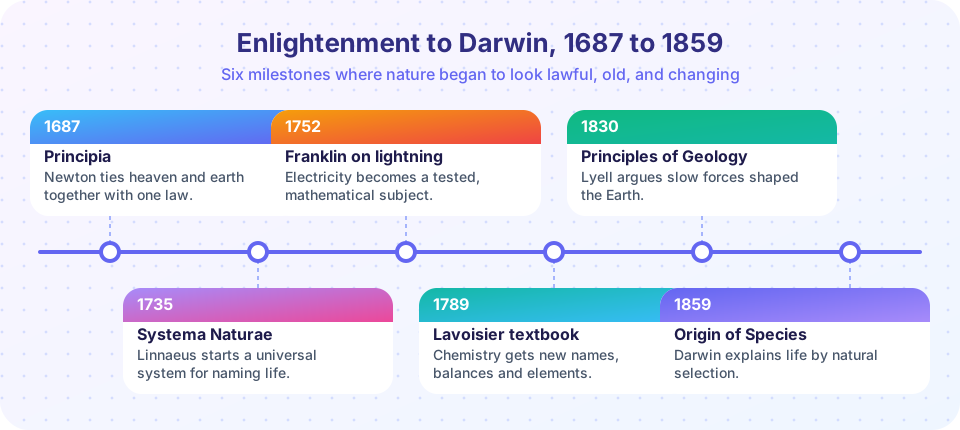
Newton's Principia of 1687 gave Europe a shocking idea: the whole universe might run on a few mathematical laws that people could discover. The next two centuries asked whether the same was true of matter, of the Earth and of life. This chapter follows three answers: Lavoisier's balance in chemistry, Hutton and Lyell's deep time in geology, and Darwin and Wallace's natural selection in biology.
What you will learn
- What historians mean by the Enlightenment and why it mattered for science.
- How scientific societies, journals and encyclopedias created a shared public conversation.
- A map of the three big stories in this chapter and how they connect.
- How to read a timeline critically, asking what it leaves out.
Key terms
Enlightenment: an eighteenth-century European movement that valued reason, evidence and public debate over inherited authority.
Natural philosophy: the older name for what we now call science; it covered physics, chemistry, biology and more.
Learned society: a club of investigators, such as the Royal Society (founded 1660) or the Paris Academy of Sciences (1666), that met, published and judged work.
Naturalism: explaining events by natural causes rather than by miracles or direct divine action.
The setting: a world that talks
Before 1600 a scholar mostly learned from books and a few teachers. By 1750 there was a web of institutions. The Royal Society's Philosophical Transactions (from 1665) and the Paris Academy's memoirs printed experiments with enough detail that others could try them. Coffeehouses, lecture courses and traveling demonstrators turned electricity and chemistry into public entertainment. Denis Diderot and Jean le Rond d'Alembert edited the Encyclopédie (1751 to 1772), which treated crafts and sciences as equal to philosophy.
Three habits grew out of this. First, measurement: instruments such as the thermometer, barometer and balance became more accurate and more trusted. Second, classification: Carl Linnaeus published Systema Naturae in 1735 and later fixed the two-part Latin names, such as Homo sapiens, that biologists still use. Third, public criticism: a claim was not accepted because a famous person said it, but because others could examine the evidence.
Three stories in chapter 5
What links them
Costs and limits
A guide to the chapter
- Lavoisier and the chemical revolution shows how a balance and a new vocabulary overturned the phlogiston theory.
- Deep time: Hutton and Lyell follows the discovery that the Earth is enormously old, and how later physics changed the estimate.
- Darwin and natural selection explains the argument of the Origin of Species and why it was accepted gradually.
- The chapter review pulls the threads together with a big quiz.
Common misconceptions
"The Enlightenment was a sudden break with religion." Many leading figures, including Newton and Linnaeus, were devout. The change was in what counted as a good explanation, and the debates ran in many directions.
"Great individuals did it alone." Each story here involved collaborators, instrument makers, translators and assistants. You will meet several whose names are often left out.
Try it
The first demonstration is a tiny timeline tool. It sorts events and prints the gap to the previous one, which shows how fast ideas arrived.
Press Run (or Ctrl + Enter) to see the result here.
Program input · what you'd type while the program runs
Type the answers before you press Run, one per line. Each time the program reads a line (with input()), it gets the next line from this box.
The second one is a small interactive card that shows what each story is about when you click a name.
Check your understanding
Quick check · 4 questions
of 4 answered You scored / 4 · perfect!
-
1. Which publication from 1735 began the modern system of naming organisms?
Linnaeus's Systema Naturae started his classification of nature; the two-part names came later, in works such as Species Plantarum (1753). -
2. What did learned societies and journals mainly provide?
Societies and journals created a public record that others could examine and test. -
3. Which pair of terms best describes Enlightenment habits?
Trust moved toward measurable evidence that others could inspect. -
4. Why is it risky to call the Enlightenment a sudden break with religion?
Newton and Linnaeus, among others, were devout. The shift was in explanations, not in a simple rejection of belief.
Summary
- The Enlightenment made evidence and public criticism central to learning about nature.
- Societies, journals and encyclopedias spread results quickly.
- Chemistry, geology and biology were each reorganized around measurement, time and natural causes.
- Individual stories hide many assistants and collaborators.
Track your progress
Create a free account to tick off lessons and pick up where you left off on any device.
of History of Science lessons completed