


















Lesson 26 of 44 · Physics and Chemistry Transformed
Chapter 6 Overview: Physics and Chemistry Transformed
A guide to chapter 6: atoms and the periodic table, the science of heat and energy, and Faraday and Maxwell's fields, with a timeline and key terms.
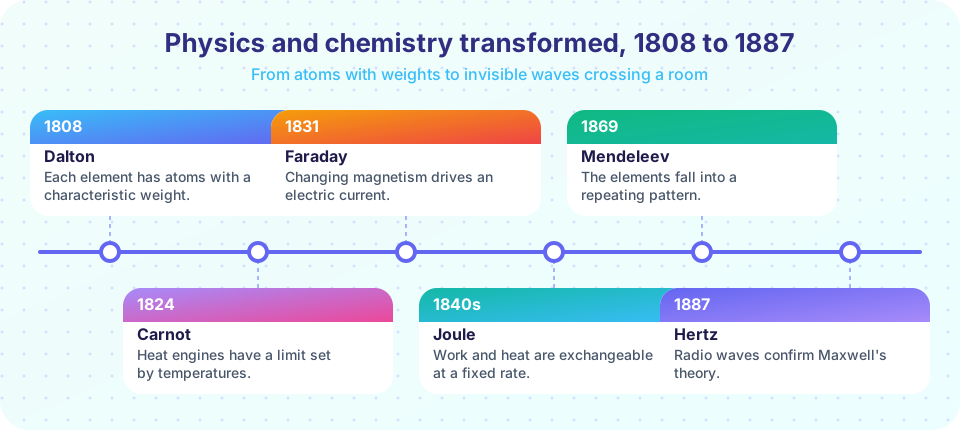
By 1800 chemists could weigh substances and physicists could describe falling bodies and planets. Over the next ninety years both fields discovered that they were about three deeper things: matter made of atoms, energy that changes form but is conserved, and fields that carry forces through empty space. This chapter covers the discoveries of Dalton, Mendeleev, Carnot, Joule, Clausius, Faraday and Maxwell.
What you will learn
- Why the nineteenth century was a golden age for combining experiment and mathematics.
- How steam engines, telegraphs and factories pushed basic science.
- A map of the three stories of this chapter.
- How to read a scientific "unification" and ask what it left out.
Key terms
Atomic theory: the idea that each element consists of identical atoms that combine in fixed ratios.
Energy: the capacity to do work; it changes form but is conserved.
Field: a quantity defined at every point in space, such as an electric or magnetic field.
Unification: showing that apparently different phenomena follow from one theory.
Why the 1800s?
Several forces came together. Industry: steam engines raised practical questions about efficiency and heat. Communication: telegraph lines (from the 1830s and 1840s) needed theory of electric currents. Education: after the French Revolution the École Polytechnique and German university laboratories trained many scientists in mathematics and experiment, and the word scientist itself was coined in 1833 by William Whewell. Instruments: better balances, batteries (Volta, 1800), thermometers and galvanometers allowed precise numbers.
The result was a style: define a quantity, measure it, find a law, then ask whether different laws are special cases of a bigger one. Dalton unified chemical ratios with atoms. Joule and others unified heat and mechanical work. Maxwell unified electricity, magnetism and light.
Three big unifications
Why now?
What is left open?
A guide to the chapter
- Atoms and the periodic table covers Dalton, the weights debate and Mendeleev's predictions.
- Energy and thermodynamics tells how steam engines led to conservation of energy and entropy.
- Faraday, Maxwell and fields shows how a new way of picturing forces predicted radio waves.
- The chapter review gives a one-page summary and a long quiz.
Common misconceptions
"Classical physics was finished by 1890." Some physicists said things like that, but there were open problems (black-body radiation, the nature of the ether, radioactivity) that led to new physics.
"Science progressed in a straight line." Dalton's atomic weights were often wrong, Avogadro's key idea was ignored for decades, and the "ether" was widely believed.
Try it
A short script that lists the milestones and the years between them.
Press Run (or Ctrl + Enter) to see the result here.
Program input · what you'd type while the program runs
Type the answers before you press Run, one per line. Each time the program reads a line (with input()), it gets the next line from this box.
And a quick interactive card to estimate which "unification" each person belongs to.
Check your understanding
Quick check · 4 questions
of 4 answered You scored / 4 · perfect!
-
1. Which of these is a field in the physicist's sense?
A field assigns a value (or vector) to every point in space, such as an electric or magnetic field. -
2. Who coined the word 'scientist' in 1833?
Whewell suggested the term at a meeting of the British Association for the Advancement of Science. -
3. Which technology most directly raised questions about heat and efficiency?
Engines made efficiency an economic question and led to Carnot's theory. -
4. Which pair are unifications achieved by Maxwell?
His equations showed light is an electromagnetic wave.
Summary
- Industry, communication and new labs drove nineteenth-century physics and chemistry.
- The chapter's three stories are atoms, energy and fields.
- Each story unified separate phenomena under one theory.
- Open problems at the end of the century led to the revolutions of chapter 7.
Track your progress
Create a free account to tick off lessons and pick up where you left off on any device.
of History of Science lessons completed