


















Lesson 7 of 44 · Science Before Science
Mesopotamia and Egypt: numbers, sky and healing
Explore Babylonian base-60 mathematics, Plimpton 322 and YBC 7289, the sky records behind eclipse prediction, the Egyptian calendar and the Rhind and Edwin Smith papyri.
Two river valleys, the Tigris and Euphrates in Mesopotamia and the Nile in Egypt, produced the oldest large bodies of written scientific knowledge. They differ in style. Mesopotamian scribes wrote on clay in cuneiform and left tens of thousands of tablets full of calculations and sky observations. Egyptian scribes wrote on papyrus and carved temples, leaving fewer mathematical texts but excellent medical and calendrical ones.
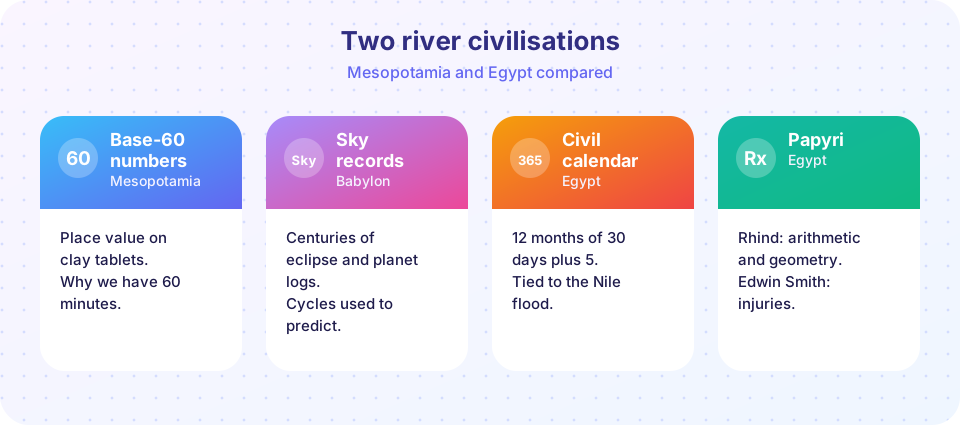
What you will learn
- How Babylonian place-value arithmetic worked, and what Plimpton 322 and YBC 7289 show
- How centuries of sky records led to predictions
- How the Egyptian civil calendar worked and why it drifted
- What the Rhind and Edwin Smith papyri reveal about mathematics and medicine
Key terms
Cuneiform: wedge-shaped writing pressed into clay.
Place value: a number system where a digit's position gives its worth, as in 305 versus 35.
Unit fraction: a fraction with numerator 1, such as 1/4.
Saros: a cycle of 223 lunar months (about 18 years 11 days) after which eclipses repeat in a similar pattern.
Babylonian mathematics
Babylonian scribes counted in base 60. Two wedge signs, a tall one for 1 and a corner for 10, were combined to write 1 to 59; the position of a group then gave its power of 60. This was a true place-value system, though early tablets did not mark an empty place consistently. We keep its legacy in 60 minutes per hour and 360 degrees in a circle.
YBC 7289, a small clay disc in the Yale Babylonian Collection (about 1800 to 1600 BCE), shows a square with diagonals and the number 1;24,51,10 for the square root of 2. In decimals that is 1 + 24/60 + 51/3600 + 10/216000, about 1.414213, correct to six places. A scribe was computing the diagonal of a square of side 30 and wrote 42;25,35 on it, which is 30 times the root of 2.
Plimpton 322, a tablet from about 1800 BCE, lists numbers that include Pythagorean triples. Its first row contains 119 and 169, and 119² + 120² = 169². Scholars still debate its purpose: a teacher's table of exercises, a list of regular numbers, or a tool for geometry problems. Notice that the Babylonians used the right-triangle relation more than a thousand years before Pythagoras.
They also solved quadratic problems, such as "find a rectangle whose area and sides satisfy…", using step-by-step methods that amount to completing the square, written as word recipes rather than symbolic algebra.
Sky records
Babylonian astronomers kept nightly logs, later called the Astronomical Diaries, from about the 700s BCE and for several centuries. They recorded planets, lunar positions, weather and eclipses. By comparing long runs of records they found cycles. One is the Saros: 223 synodic months equal about 6,585.32 days, nearly 18 years and 11 days, and after that interval a similar eclipse pattern returns (shifted about a third of the way around Earth, since the extra 0.32 day is eight hours). This enabled useful forecasts of when eclipses could happen, even without a physical model of why.
This is an important point for the history of science: they predicted without a geometric explanation. Later Greek astronomers took the data and built geometric models.
Egypt: calendar and papyri
The Egyptian civil calendar had 12 months of 30 days plus 5 extra days, 365 in all. It was simple and made accounts and administration easy. It slowly drifted against the seasons because the true year is about 365.24 days: one day of drift every four years, so the calendar slid through all the seasons in about 1,460 years. A separate observation, the heliacal rising of Sirius, the first morning the star is visible before dawn, warned of the Nile flood and was used to regulate religious festivals.
The Rhind Mathematical Papyrus (copied about 1550 BCE by the scribe Ahmes from an older text) holds 84 problems on fractions, areas, volumes and proportions. Egyptians wrote most fractions as sums of different unit fractions: 2/7 as 1/4 + 1/28. The papyrus includes a table of 2/n for odd n. It also gives an area rule for a circle equivalent to using π ≈ 3.16 (take 8/9 of the diameter and square it).
The Edwin Smith Surgical Papyrus (about 1600 BCE, based on older material) describes 48 injury cases in a fixed pattern: title, examination, diagnosis, verdict (treat, contend with, or not treat) and treatment. It is mostly free of magic and shows careful observation of the head, spine and chest. Egyptian medicine overall mixed such practical care with spells and offerings, as in the Ebers Papyrus.
Common misconceptions
"The Babylonians knew the Pythagorean theorem and so Pythagoras copied it." They clearly used the relation, but we have no proof of the general theorem in the Greek sense. Using a rule and proving it are different achievements.
"Egyptians built pyramids by mystical maths." The mathematics was practical and finite: arithmetic, fractions and basic geometry. The skill lies in surveying and organisation.
"The Egyptian calendar was an exact solar calendar." It was a 365-day bookkeeping year that drifted by one day every four years.
Try it
First, compute the Babylonian value for the square root of 2 and compare it with the true one, then check the Plimpton row. Second, split fractions into Egyptian unit fractions with a simple method, and compute how long the Egyptian calendar takes to drift through the seasons.
Press Run (or Ctrl + Enter) to see the result here.
Program input · what you'd type while the program runs
Type the answers before you press Run, one per line. Each time the program reads a line (with input()), it gets the next line from this box.
Press Run (or Ctrl + Enter) to see the result here.
Program input · what you'd type while the program runs
Type the answers before you press Run, one per line. Each time the program reads a line (with input()), it gets the next line from this box.
Check your understanding
Quick check · 5 questions
of 5 answered You scored / 5 · perfect!
-
1. What is special about YBC 7289?
The value 1;24,51,10 is correct to about six decimal places. -
2. What is the Saros?
223 lunar months is about 18 years and 11 days. -
3. How long was the Egyptian civil year?
Twelve months of 30 days plus five extra days. -
4. How is the Edwin Smith papyrus organised?
It describes 48 injury cases in a fixed, practical pattern. -
5. What did Plimpton 322 show?
Its first row has 119 and 169 with 119² + 120² = 169².
Summary
- Babylonians used base 60 with place value, solved quadratic-type problems and computed accurate square roots.
- Centuries of sky records led to cycles such as the Saros and to eclipse forecasts.
- Egypt's 365-day civil calendar drifted against the seasons; Sirius's rising guided the flood calendar.
- The Rhind and Edwin Smith papyri show practical arithmetic and observational medicine.
Next: China and India
Track your progress
Create a free account to tick off lessons and pick up where you left off on any device.
of History of Science lessons completed