


















Lesson 32 of 44 · Twentieth-Century Revolutions
Relativity and Quantum Theory: Two Revolutions in Physics
How Planck, Einstein, Bohr, Heisenberg and Schrödinger created quantum and relativity theory, how the 1919 eclipse tested Einstein, and the debates that followed.
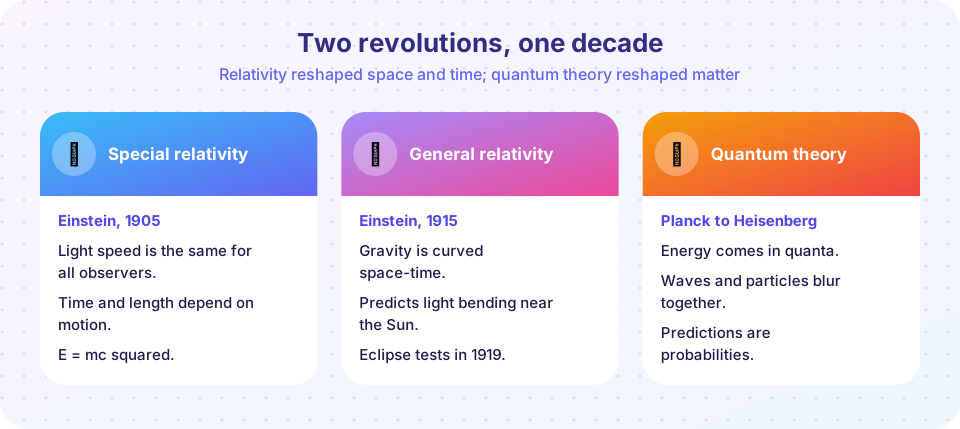
Two ideas reshaped physics between 1900 and 1930. One said that light and matter come in discrete packets and behave in ways that only probabilities can predict. The other said that space, time and gravity are connected in ways that depend on how observers move. Both began with small puzzles, and both met resistance, including from Albert Einstein himself in the quantum case. This lesson tells how they emerged and how the evidence decided.
What you will learn
- How Planck's 1900 formula and Einstein's 1905 papers started the quantum idea.
- What special and general relativity claim and how the 1919 eclipse tested them.
- How Bohr, Heisenberg and Schrödinger built quantum mechanics by 1927.
- Why debates over interpretation continued and continue.
Key terms
Quantum: a discrete packet of energy; for light, a photon with energy E = h × f.
Photoelectric effect: light ejecting electrons from a metal; the maximum energy depends on the light's frequency, not its intensity.
Time dilation: moving clocks run slower relative to an observer, by the factor γ = 1/√(1 − v²/c²).
Uncertainty principle: Heisenberg's limit on knowing both position and momentum precisely: Δx Δp ≥ ħ/2.
The quantum begins, 1900 to 1913
In December 1900 Max Planck found a formula that matched the measured spectrum of heat radiation. To derive it he had to assume that the oscillators in the walls exchange energy only in chunks of size E = h f, where h is a new constant (now 6.62607015 × 10⁻³⁴ J·s). Planck considered this a mathematical trick at first. In 1905 Einstein took it seriously: to explain the photoelectric effect he proposed that light itself consists of quanta. Light below a threshold frequency ejects no electrons however bright; above it, even faint light does. The maximum kinetic energy is h f − φ, where φ is the metal's work function. Robert Millikan's careful experiments (1914 to 1916), which he had hoped would refute the idea, confirmed it. Einstein received the 1921 Nobel Prize for this work, not for relativity.
In 1913 Niels Bohr modeled the hydrogen atom with electrons in fixed orbits that emit light when jumping between them, explaining the spectral lines. It worked well for hydrogen and failed for most other atoms, a sign that a deeper theory was needed.
Special relativity, 1905
In the same year Einstein published a theory built on two postulates: the laws of physics are the same for all observers in uniform motion, and the speed of light is the same for all of them. The consequences are strange. Moving clocks run slow, moving rods shorten, and simultaneity depends on the observer. Mass and energy are related, E = mc². The experiment of Michelson and Morley (1887) became easier to understand: there is no ether to move through. Hendrik Lorentz and Henri Poincaré had developed parts of the mathematics; Einstein's step was to rebuild the foundations. Hermann Minkowski in 1908 combined space and time into a four-dimensional "space-time."
General relativity and the 1919 eclipse
Einstein spent ten years extending relativity to gravity. His 1915 theory says that mass and energy curve space-time and that free bodies follow the straightest paths in it. It explained the otherwise unexplained 43 arcseconds per century of precession of Mercury's orbit and predicted that starlight passing the Sun is deflected by about 1.75 arcseconds, twice the Newtonian estimate. During the total solar eclipse of 29 May 1919, expeditions led by Arthur Eddington (Príncipe, off West Africa) and Andrew Crommelin (Sobral, Brazil) photographed stars near the Sun. Results were presented in London in November and made Einstein world-famous. Later critics argued that the data were not as clean as claimed, and modern reanalysis by historians and physicists has concluded that the main result holds; later tests, including radio astronomy and gravitational waves detected by LIGO in 2015, strongly support the theory.
Quantum mechanics, 1925 to 1927
In 1924 Louis de Broglie suggested that matter has wave properties. In 1925 Werner Heisenberg developed matrix mechanics with Max Born and Pascual Jordan. In 1926 Erwin Schrödinger wrote his wave equation. Paul Dirac unified and extended both, and his relativistic equation of 1928 led him to predict antimatter. Born suggested that the wave describes probability. In 1927 Heisenberg stated the uncertainty principle. The theory works spectacularly: it explains atoms, chemistry, semiconductors and lasers.
Interpretation was and remains contested. Bohr and Heisenberg's "Copenhagen" view stressed that quantum theory predicts outcomes of measurements and that classical concepts apply to the measuring apparatus. Einstein objected, writing in 1926 that he was convinced God does not play dice, and in 1935 with Podolsky and Rosen he argued the theory was incomplete. In 1964 John Bell showed that experiments could distinguish local hidden-variable theories from quantum mechanics; experiments since the 1970s, awarded the 2022 Nobel Prize (Aspect, Clauser, Zeilinger), have favored quantum theory.
Common misconceptions
"Relativity says everything is relative." It says the speed of light and the laws of physics are the same for everyone; some quantities, like time between events, depend on the observer.
"Quantum mechanics shows consciousness creates reality." The theory describes measurement outcomes; the role of observers is debated, but it does not require minds.
"Einstein was bad at math." He was a skilled mathematician who learned new tools with help from Marcel Grossmann for general relativity.
Try it
First, the photoelectric effect for a metal with work function 2.3 eV (similar to potassium). This is a simple calculator of the textbook equation, not a model of a real experiment.
Press Run (or Ctrl + Enter) to see the result here.
Program input · what you'd type while the program runs
Type the answers before you press Run, one per line. Each time the program reads a line (with input()), it gets the next line from this box.
Second, an interactive time-dilation explorer. Drag the slider to change speed as a fraction of light speed.
Check your understanding
Quick check · 5 questions
of 5 answered You scored / 5 · perfect!
-
1. What does the photoelectric effect show about light?
Einstein's 1905 explanation uses photons of energy h times f. -
2. For which work did Einstein receive the 1921 Nobel Prize?
The committee cited his services to theoretical physics and especially the photoelectric law. -
3. What did the 1919 eclipse expeditions measure?
Eddington's and Crommelin's teams measured star positions near the eclipsed Sun. -
4. What does Heisenberg's uncertainty principle say?
Delta x times delta p is at least h-bar over two. -
5. What did Bell's 1964 theorem allow?
Later experiments violated Bell inequalities, favoring quantum mechanics.
Summary
- Planck (1900) and Einstein (1905) introduced the quantum idea; Bohr (1913) applied it to atoms.
- Special relativity (1905) and general relativity (1915) revised space, time and gravity.
- The 1919 eclipse results made relativity famous; later tests have supported it strongly.
- Heisenberg, Schrödinger, Born and Dirac completed quantum mechanics by about 1927.
- Interpretation remains debated; Bell-type experiments constrain the options.
Track your progress
Create a free account to tick off lessons and pick up where you left off on any device.
of History of Science lessons completed