


















Lesson 35 of 44 · Twentieth-Century Revolutions
Chapter 7 Review: Twentieth-Century Revolutions
A recap of chapter 7 with a one-picture summary, a comparison table and a ten-question quiz on relativity, quantum theory, DNA, plate tectonics and cosmology.
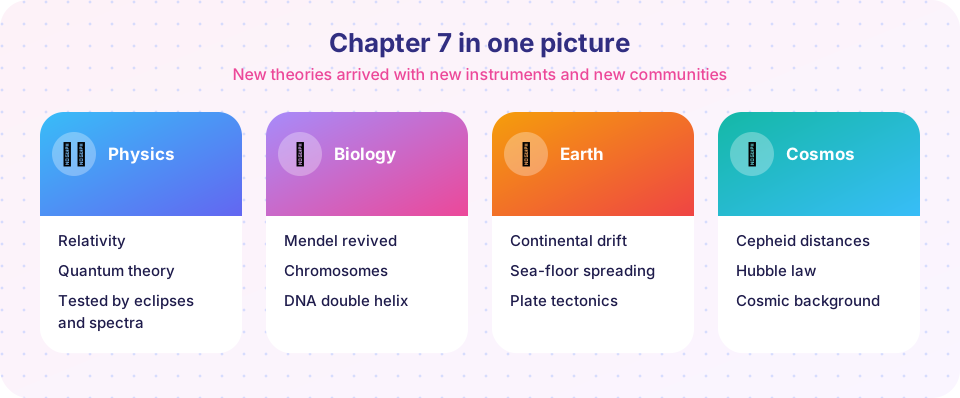
Four revolutions reshaped how we describe space, matter, heredity, the Earth and the universe. This review compares them side by side and asks what they have in common.
What you will learn
- The names, dates and decisive evidence for each revolution.
- Common patterns: puzzles, new tools, contested acceptance.
- How different the pace and politics of acceptance were.
The chapter in one table
| Revolution | Key people | Dates | Decisive evidence | Pace of acceptance |
|---|---|---|---|---|
| Quantum theory | Planck, Einstein, Bohr, Heisenberg, Schrödinger | 1900 to 1927 | Spectra, photoelectric effect, atomic structure | Over about 25 years |
| Relativity | Einstein, Eddington | 1905, 1915, 1919 | Mercury's orbit, eclipse deflection | A few years after 1919 |
| DNA and genes | Mendel, Morgan, Avery, Franklin, Watson, Crick | 1866 to 1962 | Crosses, chromosomes, X-ray images | Fast after 1953 |
| Plate tectonics | Wegener, Hess, Vine, Matthews, Tharp | 1912 to 1968 | Sea-floor stripes, ridges | About 50 years |
| Expanding universe | Leavitt, Hubble, Lemaître | 1912 to 1929 | Cepheids, redshifts, CMB (1965) | A few years |
Key terms
Cepheid: pulsating star used to measure distance.
Sea-floor spreading: new crust forms at ridges and moves outward.
Photon: quantum of light with energy h times f.
Semi-conservative replication: each new DNA double helix has one old and one new strand.
What the stories share
- Anomalies came first. Black-body radiation, the missing ether, Mendel's laws and the Atlantic fit all existed before their theories.
- New instruments mattered. Eclipse cameras, X-ray diffraction, sonar and magnetometers, and the 100-inch telescope each created decisive data.
- Credit was contested. Franklin, Tharp, Leavitt and Lemaître show how some contributors were under-recognized.
- Speed of acceptance varied with mechanism, data and the outsider status of the proposer.
Common misconceptions
"All revolutions were accepted at once." Acceptance ranged from a few years to half a century.
"New theories discard the old." Newtonian mechanics and Mendel's laws remain valid within their domains.
Try it
A drill that matches each person to a result.
Press Run (or Ctrl + Enter) to see the result here.
Program input · what you'd type while the program runs
Type the answers before you press Run, one per line. Each time the program reads a line (with input()), it gets the next line from this box.
And an interactive chronology checker: put the revolutions in order.
Check your understanding
Quick check · 10 questions
of 10 answered You scored / 10 · perfect!
-
1. Which year saw the eclipse expeditions that tested general relativity?
The total solar eclipse of 29 May 1919 was observed from Principe and Sobral. -
2. What did Planck's 1900 formula assume?
Quantization of energy exchange was the key assumption. -
3. Which experiment showed that DNA, not protein, enters bacteria from phage?
They used radioactive phosphorus and sulfur labels in 1952. -
4. What do symmetric magnetic stripes on the sea floor record?
They supported sea-floor spreading. -
5. Who first reported the period-luminosity relation for Cepheids?
Leavitt reported it in 1912 using stars in the Magellanic Clouds. -
6. What is the best explanation for the long delay in accepting continental drift?
Mechanism and data, along with Wegener's outsider status, explain the delay. -
7. Which observation supported the Big Bang over steady-state theory?
Penzias and Wilson's discovery matched predictions of an early hot universe. -
8. Which statement about relativity and Newton is best?
Relativity extends Newtonian physics to high speeds and strong gravity. -
9. Why is credit for the double helix discussed?
Historians weigh data sharing, rivalry and the prize rules. -
10. What does Hubble's law say?
v = H0 d.
Summary
- Four revolutions rebuilt physics, biology, geology and cosmology.
- Decisive evidence came from new instruments and measurements.
- Pace and credit varied; mechanisms and outsider status mattered.
Track your progress
Create a free account to tick off lessons and pick up where you left off on any device.
of History of Science lessons completed