


















Lesson 9 of 43 · The Mind as Information Processor
Working memory and capacity
Learn what working memory is, Miller's magical number, Cowan's four chunks, chunking and Baddeley's multi-component model, with a digit-span demo and decay simulation.
Try to multiply 47 by 6 in your head. You hold 47 and 6, compute 42 (6 times 7), keep the 2 and carry 4 while working out 6 times 40, then combine the pieces. You are using a mental workspace that holds a few items for a few seconds and lets you work on them. This workspace is called working memory, and its limited size is one of the most robust facts about the mind.
What you will learn
- The difference between short-term memory as storage and working memory as storage plus manipulation.
- Miller's limit, Cowan's revision and what chunking does.
- The components of Baddeley and Hitch's model and the evidence for each.
- How forgetting from short-term memory was studied.
Key terms
Working memory: a limited-capacity system for holding and manipulating information over seconds.
Span: the longest list a person can repeat correctly.
Chunk: a meaningful unit that may itself contain several items.
Central executive: the control component that directs attention and coordinates the stores.
Rehearsal: repeating information silently or aloud to keep it available.
From short-term memory to working memory
Atkinson and Shiffrin (1968) described memory as stages: a brief sensory register, a short-term store, and a long-term store, with rehearsal moving information onward. The short-term store was seen as a passive holder. Alan Baddeley and Graham Hitch (1974) argued that it does more: it supports reasoning, comprehension and learning, so it must include active processing. They called the system working memory. A key piece of evidence: people could hold a list of digits in mind and still reason fairly well, which a single small store would not allow.
How much fits? Miller and Cowan
In 1956 George Miller summarized results showing that people can repeat about seven items, plus or minus two, from a list of digits, letters or words. He emphasized that the limit is in chunks, not raw items. If you group the letters F, B, I, C, I, A, N, A, S, A into FBI, CIA, NASA, you hold three chunks instead of ten letters.
Later work refined the number. Nelson Cowan (2001) reviewed studies that prevent rehearsal and chunking and concluded that the limit is closer to about four chunks. The "seven" of Miller's title is therefore best thought of as what rehearsal and chunking let you achieve, not the raw capacity of the workspace.
Chunking and expertise
Chunking is where knowledge boosts capacity. William Chase and Herbert Simon (1973) showed chess positions briefly to players of different skills. Masters recalled real game positions far better than beginners, but when pieces were arranged at random the advantage largely disappeared. Experts did not have bigger memories, they had learned thousands of meaningful patterns that let them store a whole cluster of pieces as one chunk.
Baddeley and Hitch's model
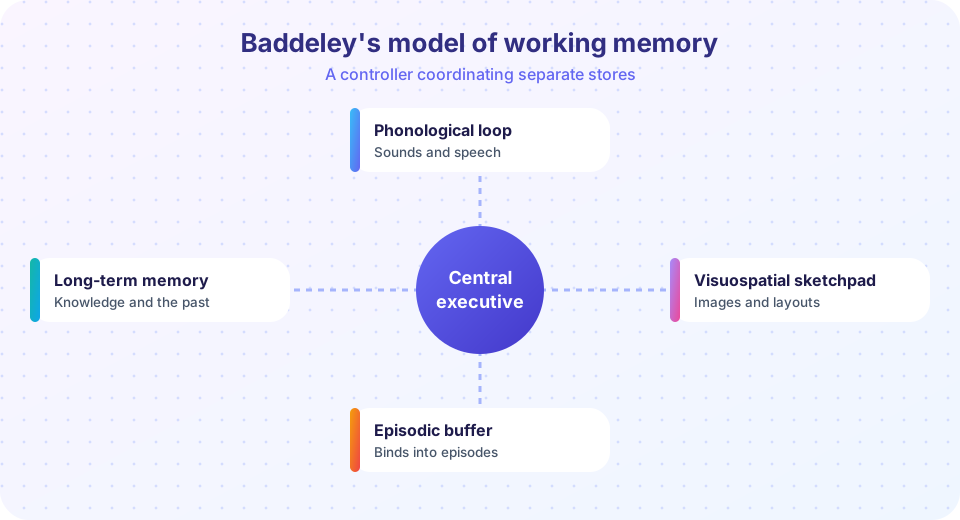
The model has several components, each supported by experiments.
- Phonological loop: holds sounds and speech in a rehearsal cycle. Evidence: the phonological similarity effect (lists of similar-sounding letters such as B, D, G, P, T are harder than dissimilar ones), the word-length effect (span is higher for short words than long ones, roughly what you can say in about two seconds), and articulatory suppression (saying "the, the, the" aloud disrupts rehearsal).
- Visuospatial sketchpad: holds visual and spatial information, such as the layout of a room. Tracking a moving spot disrupts spatial imagery more than verbal tasks.
- Central executive: directs attention, switches between tasks and controls the stores. It is the hardest part to specify precisely.
- Episodic buffer (added by Baddeley in 2000): a temporary space that binds information from different sources and from long-term memory into coherent episodes.
The separate-stores prediction works: a verbal task interferes more with the loop and a spatial task with the sketchpad, and their combination costs less than two tasks of the same type.
Forgetting from short-term memory
In 1959 Lloyd Peterson and Margaret Peterson gave participants a three-consonant trigram such as CHJ, then had them count backward by threes to prevent rehearsal. Recall fell steeply over about 18 seconds. This was taken as evidence for decay of unrehearsed traces, but later research (including work on interference from earlier trials) showed that previous items confuse later ones, and a modern view gives interference a major role. The key point: unrehearsed information is lost quickly, and what is lost is partly explained by competition rather than just time.
Why working memory matters
Working memory capacity correlates with reading comprehension, following instructions, mental arithmetic and reasoning tasks. Overloading it explains why complex instructions fail and why writing things down, using diagrams or breaking tasks into chunks helps. Training programs that claim to enlarge working memory generally improve performance on the trained tasks, but evidence for broad transfer to everyday cognition is weak.
Common misconceptions
"Everyone can hold exactly seven items." The number varies by person, material and strategy, and the pure capacity is closer to four chunks.
"Working memory is just short-term memory by another name." Short-term memory emphasizes storage. Working memory includes manipulation and control, and has several components.
"Brain games make you smarter in general." Practice improves the practiced task. Evidence that it improves other abilities is limited and contested.
Try it
A digit-span demonstration. Digits flash one at a time and you type them back. The list grows after each success. This is a classroom demonstration, not a clinical or diagnostic test, and results vary with attention, fatigue and device.
A model of the Brown-Peterson result. We assume an unrehearsed trace fades exponentially with a time constant, and add a "rehearsed" curve for comparison. The constants are illustrative, not fitted to the original data.
Press Run (or Ctrl + Enter) to see the result here.
Program input · what you'd type while the program runs
Type the answers before you press Run, one per line. Each time the program reads a line (with input()), it gets the next line from this box.
Check your understanding
Quick check · 5 questions
of 5 answered You scored / 5 · perfect!
-
1. Which description best fits working memory rather than a simple short-term store?
Baddeley and Hitch stressed that the system supports processing, not only storage. -
2. Chase and Simon's chess studies showed that expert advantage depends on
Masters recalled real positions much better, but the gap shrank for random arrangements. -
3. Saying 'the, the, the' aloud while trying to remember a word list is called
Suppression occupies the rehearsal process of the loop and reduces verbal span. -
4. Cowan estimated the pure capacity of working memory to be about
When rehearsal and chunking are limited, capacity is about four chunks. -
5. Which component was added later to bind information into coherent episodes?
Baddeley added the episodic buffer in 2000.
Summary
- Working memory is a limited workspace for holding and manipulating information over seconds.
- Miller's seven plus or minus two counts chunks and reflects strategies; Cowan's estimate is about four chunks.
- Baddeley and Hitch's model has a central executive, a phonological loop, a visuospatial sketchpad and an episodic buffer.
- Unrehearsed information is lost quickly, with interference playing a major role.
- Expertise expands effective capacity through chunking, not through a bigger raw store.
Next: Chapter 2 review
Track your progress
Create a free account to tick off lessons and pick up where you left off on any device.
of Cognitive Science lessons completed