


















Lesson 17 of 43 · Neuroscience Foundations
Neurons and signaling
Learn the parts of a neuron, the resting potential, the all-or-none action potential and chemical synapses, and simulate a leaky integrate-and-fire neuron.
Every thought, memory and movement you will ever have is carried out by cells that do something surprisingly simple: they add up incoming signals and, if the total is big enough, send a brief pulse to other cells. In this lesson you learn how a neuron is built, how it keeps an electrical charge across its membrane, how it fires, and how it talks to its neighbors. Then you will build a simple model neuron and watch it spike.
What you will learn
- The parts of a neuron and what each does.
- How the resting potential arises and how the action potential unfolds.
- How synapses transmit signals and how learning can change them.
- How a leaky integrate-and-fire model captures the basics.
Key terms
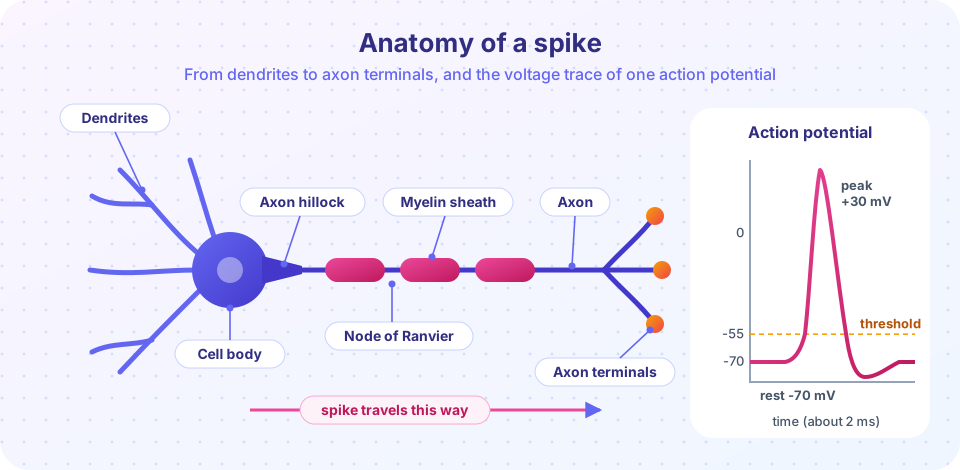
Resting potential: the voltage across the membrane of an unstimulated neuron, about -70 millivolts (inside relative to outside).
Action potential (spike): a brief, self-propagating reversal of membrane voltage, all or none.
Threshold: the voltage at which a spike is triggered, about -55 millivolts in many neurons.
Neurotransmitter: a chemical released at a synapse to signal the next cell.
Myelin: an insulating sheath around many axons that speeds conduction.
The parts of a neuron
Santiago Ramon y Cajal, using Camillo Golgi's staining method in the late 1880s, argued that the nervous system is made of separate cells, an idea called the neuron doctrine. Both men shared the 1906 Nobel Prize, though they disagreed about this very point.
A typical neuron has four functional regions:
- Dendrites: branching extensions that receive signals from other neurons.
- Cell body (soma): holds the nucleus and integrates inputs.
- Axon: a long thin fiber that carries the output. It starts at the axon hillock, where spikes are normally triggered.
- Axon terminals: endings that contact other cells at synapses.
Many axons are wrapped in myelin, made by oligodendrocytes in the brain and Schwann cells in peripheral nerves. Gaps in the myelin, the nodes of Ranvier, let the spike jump from node to node, a process called saltatory conduction. Conduction speeds range from well under 1 meter per second in thin unmyelinated fibers to about 100 meters per second or more in large myelinated ones.
The resting potential
A neuron is like a tiny battery. Its membrane separates salty fluid inside from salty fluid outside, with different ion concentrations on each side: much more potassium (K+) inside, much more sodium (Na+) and chloride (Cl-) outside. Ion channels in the membrane are selective, and at rest the membrane is mostly leaky to potassium. Potassium ions tend to flow out down their concentration gradient, leaving the inside negative. A sodium-potassium pump uses energy to push 3 Na+ out for every 2 K+ in, maintaining the gradients.
The voltage at which one ion's chemical and electrical forces balance is its equilibrium (Nernst) potential:
E = (R T / z F) ln([ion]outside / [ion]inside)
At body temperature (37 °C), for an ion with charge +1, RT/F times the base-10 conversion gives about 61.5 mV times log10 of the concentration ratio. For potassium this comes to roughly -90 mV, which is why the resting potential (about -70 mV) sits near it. You will compute this below.
The action potential
Alan Hodgkin and Andrew Huxley worked out the mechanism in 1952 using the giant axon of the squid, building a mathematical model that earned them a share of the 1963 Nobel Prize (with John Eccles).
- Depolarization. Inputs push the membrane toward less negative values. When the voltage at the axon hillock reaches threshold (about -55 mV), voltage-gated sodium channels open.
- Rising phase. Sodium rushes in, making the inside positive in a runaway process. The voltage peaks around +30 to +40 mV.
- Falling phase. Sodium channels inactivate and voltage-gated potassium channels open, letting potassium out and bringing the voltage back down, often briefly below rest (hyperpolarization).
- Refractory period. For about a millisecond or two the neuron cannot fire again (absolute refractory period), which limits maximum firing rates and makes the spike travel one way.
The spike is all or none: it has the same size whatever the strength of the stimulus. Information is carried by how often and when neurons fire, not by spike size. The spike regenerates at each patch of membrane, so it travels without fading.
Synapses
At the axon terminal, the arriving spike opens calcium channels. Calcium entry makes vesicles fuse with the membrane and release neurotransmitter into the synaptic cleft, a gap only about 20 nanometers wide. The transmitter binds to receptors on the next cell, opening ion channels and producing a small voltage change.
- Excitatory synapses, mainly using glutamate, push the next cell toward threshold (EPSP).
- Inhibitory synapses, mainly using GABA in the adult brain, push it away (IPSP).
A neuron sums thousands of these inputs over space and time, and fires when the total at the hillock crosses threshold. Chemical synapses allow plasticity: connections can strengthen or weaken. Donald Hebb (1949) proposed that connections strengthen when two cells are active together, often summarized as "cells that fire together wire together". Long-term potentiation, a lasting increase in synaptic strength, was demonstrated in the hippocampus by Tim Bliss and Terje Lomo in 1973, and it remains a leading candidate mechanism for learning, though its exact role in memory is still being worked out.
A model neuron
The leaky integrate-and-fire model keeps only the essentials: the voltage leaks back toward rest, input current pushes it up, and when it reaches threshold the model records a spike and resets. It leaves out ion channels, but it reproduces an important property: stronger input makes the neuron fire faster, once the input exceeds a minimum.
Common misconceptions
"Stronger stimuli make bigger spikes." Spikes are all or none. Stronger stimuli make neurons fire more often.
"Neurons communicate only with electricity." Within a neuron the signal is electrical, but most synapses are chemical. Some electrical synapses (gap junctions) also exist.
"Learning means growing new neurons." Most learning involves changes in synaptic strength and wiring. Adult neurogenesis exists in a few regions, but its role in humans is debated.
Try it
A Nernst potential calculator. Concentrations are typical textbook values for mammalian neurons in millimolar (mM), and calcium inside is about 0.0001 mM. Actual values vary.
Press Run (or Ctrl + Enter) to see the result here.
Program input · what you'd type while the program runs
Type the answers before you press Run, one per line. Each time the program reads a line (with input()), it gets the next line from this box.
A leaky integrate-and-fire neuron. Membrane time constant 20 ms, rest -70 mV, threshold -55 mV, resistance 10 megaohms. Input of 2 nA gives a steady-state target of -50 mV, above threshold, so the cell fires. Spikes are drawn as vertical lines for display; the model itself only resets the voltage.
Press Run (or Ctrl + Enter) to see the result here.
Program input · what you'd type while the program runs
Type the answers before you press Run, one per line. Each time the program reads a line (with input()), it gets the next line from this box.
Firing rate against input current. Below about 1.5 nA the steady-state voltage never reaches threshold, so there is no firing; above it, the rate rises with the input.
Press Run (or Ctrl + Enter) to see the result here.
Program input · what you'd type while the program runs
Type the answers before you press Run, one per line. Each time the program reads a line (with input()), it gets the next line from this box.
Check your understanding
Quick check · 5 questions
of 5 answered You scored / 5 · perfect!
-
1. Where are action potentials normally initiated?
The axon hillock has a high density of voltage-gated sodium channels and a low threshold. -
2. What does the all-or-none property mean?
Stimulus strength is coded by firing rate, not spike amplitude. -
3. Why is the resting potential close to the potassium equilibrium potential?
Potassium leak channels dominate at rest, pulling the voltage toward E(K). -
4. Which neurotransmitter is the main excitatory transmitter in the brain?
Glutamate is the main excitatory transmitter. GABA is the main inhibitory one in the adult brain. -
5. What does myelin do?
Myelin insulates axons and allows saltatory conduction between nodes.
Summary
- Neurons receive on dendrites, integrate in the soma, fire at the axon hillock and send spikes down the axon.
- The resting potential (about -70 mV) comes from ion gradients and selective permeability; the Nernst equation gives each ion's equilibrium voltage.
- The action potential is all or none, produced by sodium and potassium channels, as modeled by Hodgkin and Huxley.
- Chemical synapses release neurotransmitters, can be excitatory or inhibitory, and can change strength with experience.
- A leaky integrate-and-fire model reproduces the link between input strength and firing rate.
Track your progress
Create a free account to tick off lessons and pick up where you left off on any device.
of Cognitive Science lessons completed