


















Lesson 43 of 43 · Projects and Practice
Further Study: Where to Go After Cognitive Science
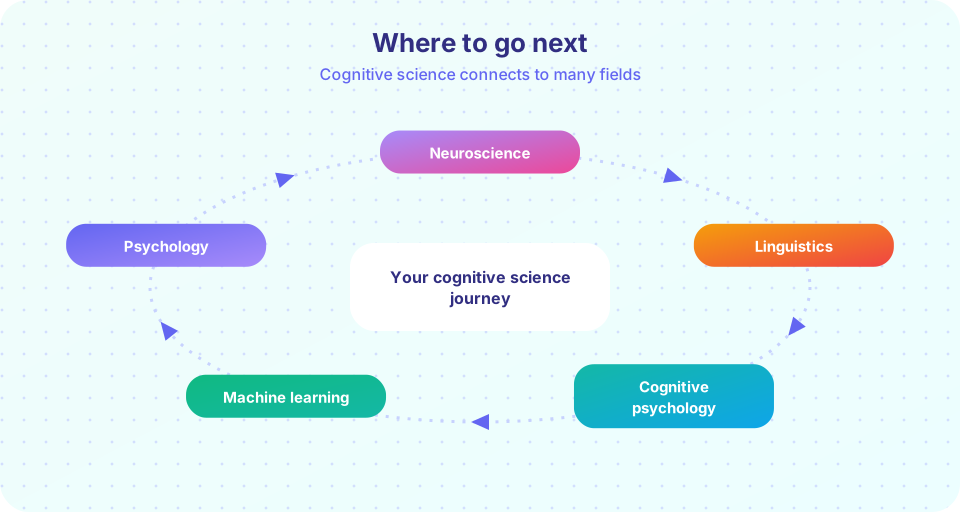
Plan your next steps after this course: neuroscience, linguistics, cognitive psychology, machine learning and psychology, with tracks on this site and how to read research.
Cognitive science is a meeting place. No one person masters all of it, and most researchers pick one angle: brains, language, behavior, computation or philosophy. This last lesson helps you choose a path and gives you habits for reading the research on your own.
What you will learn
- Which neighboring fields match which interests.
- Where to find related tracks on this site.
- How to read an empirical paper and judge its evidence.
Pick a path
| If you enjoyed... | Try next | Why |
|---|---|---|
| Neurons, vision pathways, dopamine, consciousness research | Neuroscience | The implementational level in depth |
| Parsing, priming, language acquisition | Linguistics | Systematic analysis of sound, structure and meaning |
| Memory, attention, reasoning experiments | Cognitive psychology | The experimental core of the field |
| The broader behavior and development of people | Introduction to psychology | The wider context of the mind |
| Perceptrons, backpropagation, networks | Machine learning and deep learning | Build and train the models you read about |
| Language models and text | Natural language processing | How machines handle language |
| Edge detection and vision models | Computer vision | Engineering view of what V1 and the ventral stream do |
How to read a research paper
You do not need to understand every equation to judge a study. Ask these questions in order:
- What is the question and the hypothesis? Is it stated before the data?
- Who or what was studied? How many participants, and are they typical of the population the claim covers?
- What was measured? Does the measure capture the concept, or just something nearby?
- What was compared? A good design has a control condition.
- How large is the effect? Look beyond p-values to effect sizes and confidence intervals.
- Has it been replicated? Prefer results seen by independent teams, and be alert to preregistered or multi-lab replications.
- What do the authors say are the limits? Honest limits sections are a sign of quality.
Keep a project going
The best way to learn is to build. Ideas that extend what you did in this chapter:
- Extend the Stroop demo with a neutral condition and more trials, and analyze your own data using the paired test from the project.
- Modify the Hopfield network to store larger patterns, or add noise during updates, and study spurious states.
- Re-implement the dopamine TD model with a delay that varies from trial to trial, and see how the error behaves.
- Write a one-page critique of one claim from the consciousness chapter, stating which evidence would change your mind.
Try it
Press Run (or Ctrl + Enter) to see the console output here.
No output.
Check your understanding
Quick check · 3 questions
of 3 answered You scored / 3 · perfect!
-
1. Which field gives the deepest look at the implementational level of explanation?
Neuroscience studies how neurons and circuits implement cognitive functions. -
2. Why prefer results that have been independently replicated?
Independent replication is a strong check on chance findings and hidden flaws. -
3. What should you look at besides a p-value?
They tell you how large and how precisely estimated the effect is.
Summary
- Cognitive science has many neighbors, and you can choose a path by interest.
- This site has tracks on neuroscience, linguistics, cognitive psychology, psychology, machine learning, deep learning, NLP and computer vision.
- Reading papers critically is a skill with a simple checklist.
- Keep building: small projects teach more than passive reading.
Track your progress
Create a free account to tick off lessons and pick up where you left off on any device.
of Cognitive Science lessons completed