


















Lesson 8 of 43 · The Mind as Information Processor
Attention and filtering
Explore the cocktail party problem, Broadbent's filter, Treisman's attenuation model and late selection, plus inattentional blindness and the Stroop effect.
Your senses deliver far more information than you can use. At a noisy party you hear dozens of voices, yet you follow one, and then, suddenly, you notice your own name across the room. Attention is the set of mechanisms that select some information for deeper processing and let the rest fade. Understanding where and how selection happens was one of the first big projects of the information-processing approach.
What you will learn
- The cocktail party problem and the dichotic listening method.
- How the filter, attenuation and late selection models explain the findings.
- What the Stroop effect, the spotlight metaphor and inattentional blindness show.
- Why the early versus late debate is now framed in terms of load.
Key terms
Selective attention: favoring some information while ignoring the rest.
Dichotic listening: playing different messages to the two ears.
Shadowing: repeating aloud a message as you hear it.
Early selection: filtering based on physical features, before meaning is analyzed.
Late selection: all input is analyzed for meaning, and selection happens afterward.
Inattentional blindness: failing to notice an unexpected object because attention is elsewhere.
The cocktail party problem
In 1953 Colin Cherry asked how a listener separates one voice from many. In his lab, participants wore headphones with a different message in each ear and had to shadow one. Afterward they could say little about the ignored ear. They noticed physical changes, such as a switch from a male to a female voice or a tone replacing speech, but they usually did not notice meaningful changes such as a switch of language or speech played backward.
Later work by Neville Moray (1959) found an exception: a fraction of participants (roughly a third in the classic report) heard their own name in the ignored ear. Other studies found that a word associated with a previously shocked word could trigger a response even in the unattended ear. Meaning could leak through.
Broadbent's filter model
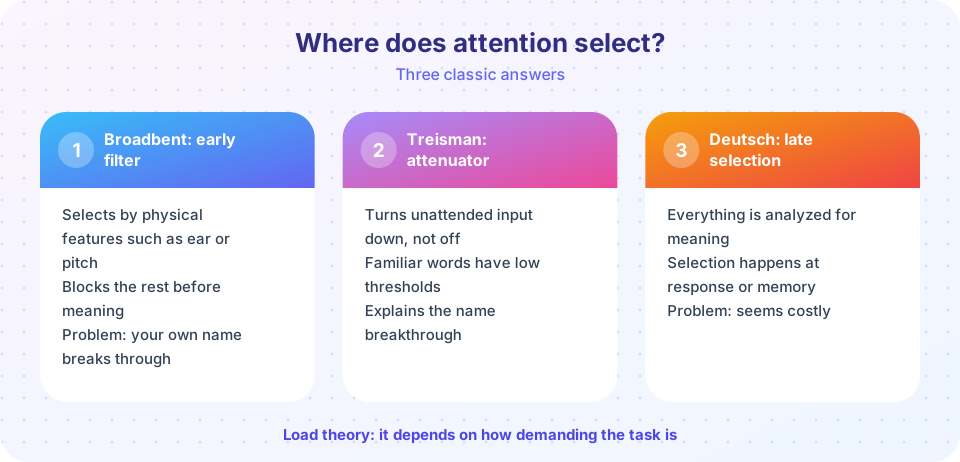
Donald Broadbent (1958) described attention as a filter that passes one channel and blocks the others, based on physical properties such as the ear or the pitch. Selected information goes to a limited-capacity stage for meaning and memory. It was a clean information-theory idea: a bottleneck protects a limited channel.
Problem: if the filter is perfect, you should never hear your own name in the ignored ear.
Treisman's attenuation model
Anne Treisman (1964) proposed that the filter does not block, it turns the volume down. Unattended messages are weakened but still analyzed. Words differ in their thresholds: familiar or important words, such as your name, have low thresholds and break through even when weakened, while ordinary words do not. This explains both the usual blindness and the occasional breakthrough.
Late selection
J. Anthony Deutsch and Diana Deutsch (1963) argued for the opposite end: everything is analyzed for meaning, and the bottleneck is at the stage of response or memory. Selection is late, and unattended meaning is processed fully but forgotten or not acted on.
Which one is right?
Evidence supports parts of each. Nilli Lavie's load theory (1995) proposes that it depends on the task. When the attended task is demanding (high perceptual load) there is little capacity left, so irrelevant stimuli are not processed (early selection). When the task is easy (low load), spare capacity spills over and distractors are processed (late-like effects). The debate thus shifted from "where is the filter?" to "what determines how much gets through?".
The Stroop effect
In 1935 John Ridley Stroop showed that naming the ink color of a word is slower when the word names a different color (the word RED printed in blue ink) than when ink and word match. Reading is so automatic that it interferes even though you are trying to ignore the meaning. The Stroop task is a standard measure of how well people can control attention and suppress an automatic response.
Spotlight and unnoticed gorillas
Michael Posner's cueing experiments (1980) showed that a cue pointing to a location speeds responses to targets there, supporting the metaphor of attention as a spotlight that can be moved around, with or without eye movements. In the famous study by Daniel Simons and Christopher Chabris (1999), viewers counted basketball passes among players in a video; about half failed to notice a person in a gorilla suit who walked across the scene. Attention does not just sharpen perception, it determines what reaches awareness at all.
Common misconceptions
"Multitasking works if you practice." People can combine a very practiced task with another, but for most demanding tasks switching and interference cost time and accuracy. Studies of drivers using phones find deficits for both hands-free and handheld use.
"Unattended information is completely ignored." Your name, strongly meaningful words and sudden changes can break through, which is why attenuation models fit better than a full block.
"The gorilla study shows people are bad at seeing." It shows how strongly attention shapes what you notice. Whether people notice depends on task difficulty and how similar the unexpected object is to the attended things.
Try it
A Stroop demonstration. Click the button that names the INK color, not the word. The page records your reaction times for congruent and incongruent trials. This is a demonstration of the effect, not a test of anything about you; your results depend on your device and browser.
A simulation of Treisman's idea. Each unattended word is weakened by a gain factor and compared with a threshold. Gain 0 is Broadbent's strict filter, a middle value is attenuation, and 1 is late selection (full analysis). The numbers are illustrative parameters, not measured values.
Press Run (or Ctrl + Enter) to see the result here.
Program input · what you'd type while the program runs
Type the answers before you press Run, one per line. Each time the program reads a line (with input()), it gets the next line from this box.
Check your understanding
Quick check · 5 questions
of 5 answered You scored / 5 · perfect!
-
1. In Cherry's dichotic listening studies, which change in the ignored ear was usually noticed?
Physical changes were noticed. Meaning changes such as a language switch usually were not. -
2. How does Treisman's model explain hearing your own name in the ignored ear?
Attenuation weakens but does not block the signal, and names need less signal to be recognized. -
3. Late selection models claim that
Deutsch and Deutsch proposed that selection comes after semantic analysis. -
4. According to load theory, when is selection earliest?
High load uses up capacity, so distractors are not processed. -
5. Why is the Stroop effect used as a measure of attention control?
Suppressing the automatic reading response takes control, slowing incongruent trials.
Summary
- Attention selects information for deeper processing; the cocktail party problem motivated the study of selection.
- Broadbent proposed an early filter, Treisman an attenuator, and Deutsch and Deutsch late selection.
- Load theory reconciles the models: high load leads to early selection, low load lets distractors in.
- The Stroop effect shows automatic processes competing with control, and inattentional blindness shows how attention shapes awareness.
Track your progress
Create a free account to tick off lessons and pick up where you left off on any device.
of Cognitive Science lessons completed