


















Lesson 16 of 43 · Neuroscience Foundations
Chapter 4 overview: Neuroscience foundations
Preview chapter 4: levels of brain organization from synapses to systems, and the essentials of neurons, brain areas and the methods used to study them.
Chapter 3 asked how mind and brain are related. Chapter 4 looks at the brain itself, with a simple goal: give you enough neuroscience to understand what later chapters say about memory, language, vision and consciousness, and to read a news story about a brain scan with healthy skepticism.
What you will learn
- The levels at which the brain can be studied and the size of each.
- Some key numbers about the human brain.
- How the lessons of this chapter fit together.
Key terms
Neuron: a cell specialized for receiving, integrating and sending electrical and chemical signals.
Synapse: the junction where one neuron communicates with another.
Circuit: a group of connected neurons that performs a function.
Cortex: the thin folded outer layer of the brain, central to perception, thought and action.
Glia: support cells of the nervous system.
Some numbers
The adult human brain weighs roughly 1.3 to 1.4 kilograms, about 2% of body mass, yet it uses around 20% of the body's resting energy. A careful 2009 count by Suzana Herculano-Houzel and colleagues, using a method that dissolves brain tissue into a suspension of cell nuclei, estimated about 86 billion neurons and a similar number of non-neuronal cells. Of these neurons, about 16 billion are in the cerebral cortex, and most of the rest are in the cerebellum. Each neuron can make thousands of connections, giving a total of very roughly a hundred trillion synapses, an estimate with wide uncertainty.
These numbers are large, but they are only useful when paired with structure. A pile of 86 billion identical cells would do nothing. What matters is how the cells differ and how they are wired.
Levels of the brain
From the smallest to the system
Ways to study it
Each method sees a different slice
What each lesson covers
- Neurons and signaling explains the structure of a neuron, the resting potential, the action potential and synaptic transmission, with a simulation.
- Brain organization and localization tours the lobes, famous cases such as Phineas Gage and H.M., and the debate about localization.
- Methods in cognitive neuroscience compares EEG, MEG, fMRI and stimulation, and explains the dangers of over-reading brain scans.
- Chapter 4 review recaps everything.
Bridging brain and mind
A running theme is the gap between levels. Knowing how a neuron fires does not tell you how you recognize a face. Knowing which regions respond to faces does not tell you what computation they perform. Cognitive neuroscience aims to connect the levels, and Marr's three levels from chapter 1 are a good guide: the neural facts are implementational, and they matter most when linked to algorithms and goals.
Common misconceptions
"We have 100 billion neurons." The older figure of 100 billion was a rounded estimate. The 2009 count found about 86 billion.
"Glia are just filler." Glial cells support neurons, insulate axons, clear waste and take part in signaling, and research on their roles is active.
"Bigger brain means more intelligence." Brain size alone is a poor predictor within humans and across species. Wiring, cell types and organization matter.
Try it
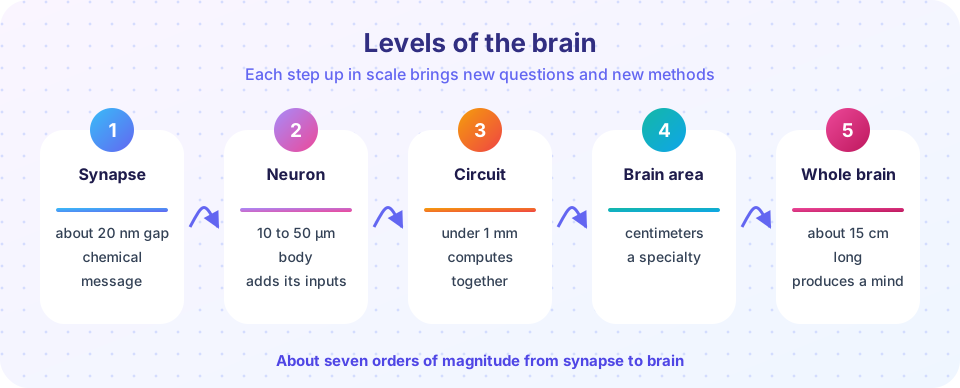
A zoom explorer. Click a level to see its typical size and the question it raises. Sizes are approximate and vary by cell type and person.
The same scales on a logarithmic chart. Values are rough, typical sizes in meters.
Press Run (or Ctrl + Enter) to see the result here.
Program input · what you'd type while the program runs
Type the answers before you press Run, one per line. Each time the program reads a line (with input()), it gets the next line from this box.
Check your understanding
Quick check · 4 questions
of 4 answered You scored / 4 · perfect!
-
1. About how many neurons does the human brain have, according to the 2009 count?
Herculano-Houzel and colleagues estimated about 86 billion neurons, correcting the older round figure of 100 billion. -
2. Roughly what share of the body's resting energy does the brain use?
The brain is about 2% of body mass but uses around a fifth of resting energy. -
3. Where are most of the brain's neurons found?
The cerebellum holds the majority, with about 16 billion in the cortex. -
4. Why do we need to link neural facts to algorithms and goals?
Marr's levels remind us that implementation details need computational and algorithmic interpretation.
Summary
- The brain can be studied from synapses to whole systems, across about seven orders of magnitude in size.
- The adult brain has about 86 billion neurons and uses about a fifth of resting energy.
- Chapter 4 covers neurons, brain organization and methods.
- Neural facts matter most when connected to what the brain computes.
Next: Neurons and signaling
Track your progress
Create a free account to tick off lessons and pick up where you left off on any device.
of Cognitive Science lessons completed