


















Lesson 5 of 43 · Getting Started
Chapter 1 review: Getting started
Review the definition of cognitive science, Marr's three levels, the cognitive revolution and the main research methods, with a recap table and a ten-question quiz.
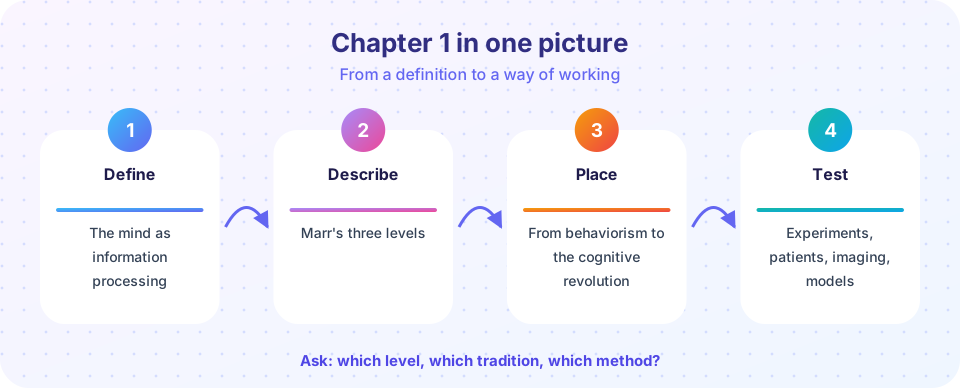
Chapter 1 gave you the vocabulary for everything that follows: what the field studies, how to describe a mental ability at several levels, where the field came from, and how it gathers evidence. This review pulls those pieces into one picture, a recap table and a longer quiz.
What you will learn
- How the four lessons of the chapter fit together.
- How to apply them to a new question about the mind.
- Which ideas you should be able to explain without notes.
The chapter in a table
| Lesson | Big idea | Key names or dates |
|---|---|---|
| Course map | Six fields study one subject | Sloan report, 1978 |
| What is cognitive science? | The mind as information processing; three levels of description | Marr, 1982 |
| A short history | Behaviorism gave way to the cognitive revolution | Watson 1913, Tolman 1948, Shannon 1948, 1956 events, Chomsky 1957 and 1959, Neisser 1967 |
| Methods | Experiments, patients, imaging, models; replication matters | Broca 1861, replication project 2015 |
Putting it to work
Suppose a news article says, "Scientists discover how the brain remembers names." Run through the chapter's checklist.
- Which level? Is the claim about the task (why remembering names is hard), the algorithm (how names are encoded and retrieved) or the implementation (which cells and regions)?
- Which tradition? Is the explanation rule-like (symbolic), network-like (connectionist), or probabilistic?
- Which method? Reaction times, a brain scan, a patient, a model? What can that method not show?
- Is it replicated? One small study or many?
- Do the methods converge? Does behavior, brain data and modeling tell the same story?
Making this a habit protects you from headlines that overstate what one experiment can show.
Key terms
Computational theory of mind: the hypothesis that cognition is computation over representations.
Cognitive map: an internal representation of spatial layout.
Double dissociation: two patients with opposite patterns of impairment on two tasks, suggesting separable mechanisms.
Converging evidence: agreement among different methods.
Common misconceptions
"Marr's levels are a ranking from best to worst." They are different kinds of question, not a hierarchy of importance. A full explanation connects all three.
"Replication failures mean psychology is fake." They mean single studies are uncertain and methods need to improve, which is how science works.
Try it
A method chooser. Describe a research question with three yes or no features, and the function suggests a starting method. It is a study aid with simple rules, not a research-design tool.
Press Run (or Ctrl + Enter) to see the result here.
Program input · what you'd type while the program runs
Type the answers before you press Run, one per line. Each time the program reads a line (with input()), it gets the next line from this box.
A sorting drill for Marr's levels. Read each statement, decide on a level, and check your answer in the console.
Press Run (or Ctrl + Enter) to see the console output here.
No output.
Check your understanding
Quick check · 10 questions
of 10 answered You scored / 10 · perfect!
-
1. Which pairing of Marr's levels with a question is correct?
Computational asks about the goal, algorithmic about representations and steps, implementational about physical realization. -
2. Who argued in 1913 that psychology should be the objective science of behavior?
Watson's 1913 paper launched classic behaviorism. -
3. Which contribution is associated with Shannon in 1948?
Shannon's information theory gave psychologists a way to talk about capacity limits. -
4. The journal Cognitive Science and the Cognitive Science Society date from
The journal began in 1977, the Sloan report appeared in 1978, and the society's first meeting was in 1979. -
5. A study finds that a region is more active during a task. What can you conclude?
Activation is correlational. Causal claims need manipulation or converging evidence. -
6. Why do researchers pre-register studies?
Pre-registration limits the temptation to try many analyses until one works. -
7. A model fits human data perfectly. What should you check next?
Different algorithms can produce the same outputs, so extra tests are needed. -
8. Tolman's cognitive map idea was a challenge to
Rats seemed to use an internal layout, which simple response chains could not explain. -
9. Which approach models cognition with networks of simple units whose connections are learned?
Connectionism (the PDP movement) uses networks trained by adjusting connection strengths. -
10. The best reason to combine methods is that
Converging evidence is the standard route to trustworthy conclusions.
Summary
- Cognitive science explains the mind as information processing, described at three levels.
- It grew from behaviorism's limits, computing, information theory and linguistics, with institutions founded around 1977 to 1979.
- Methods include experiments, patient studies, imaging and models, each with strengths and limits.
- Ask about level, tradition, method, replication and convergence whenever you meet a claim about the mind.
Track your progress
Create a free account to tick off lessons and pick up where you left off on any device.
of Cognitive Science lessons completed