


















Lesson 12 of 43 · Philosophy of Mind
Dualism, behaviorism and identity theory
Compare Descartes' substance dualism, Ryle's logical behaviorism and the mind-brain identity theory of Place and Smart: arguments, objections and what each got right.
Three answers to the mind-body problem dominated the story from the seventeenth century to the middle of the twentieth. Each solved something that bothered its predecessor and each ran into trouble that led to the next. Following this chain is the quickest way to understand why functionalism, the subject of the next lesson, became the favorite of cognitive science.
What you will learn
- Descartes' arguments for dualism and the interaction problem.
- Ryle's category mistake and what logical behaviorism claims.
- The mind-brain identity theory and the lightning analogy.
- The main objections to each view.
Key terms
Substance dualism: mind and body are two different kinds of substance.
Category mistake: treating something as belonging to the wrong logical category.
Disposition: a tendency to behave in a certain way in certain conditions.
Type identity: each type of mental state is identical to a type of brain state.
Leibniz's law: if two things are identical, they share all their properties.
Substance dualism
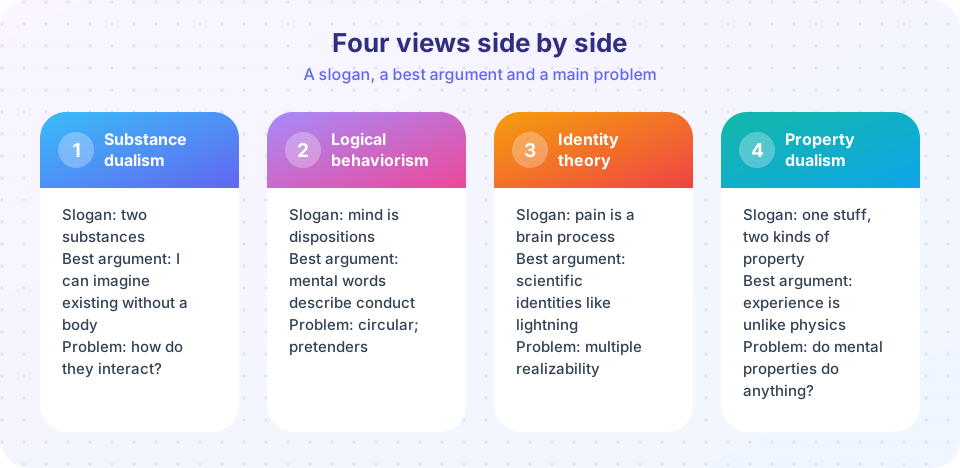
René Descartes (1596 to 1650) began by doubting everything he could doubt. He could doubt that his body existed (he might be dreaming) but not that he was thinking, hence "I think, therefore I am". He concluded that the thinking self is a distinct substance from the extended body. His arguments include:
- Conceivability: I can clearly conceive of myself existing without a body, so mind and body are distinct.
- Divisibility: bodies can be divided into parts, but the mind seems one and indivisible.
Descartes also thought the mind controls the body through a small brain structure, the pineal gland.
The interaction problem
In 1643 Princess Elisabeth of Bohemia asked Descartes how an unextended thing could push an extended body. Descartes never gave a fully satisfying answer. A modern version points to physics: if the physical world is causally complete, with every event explained by earlier physical events and the conservation laws, an immaterial mind would have nothing to do. Another objection is empirical: brain damage, drugs and anesthesia change the mind in lawful ways, which suggests that mental life depends on the brain.
Not all dualism is Descartes'. Property dualism accepts that there is only physical stuff but holds that it has irreducible mental properties. This view returns in the debate about consciousness in chapter 8.
Logical behaviorism
Gilbert Ryle's The Concept of Mind (1949) attacked what he called the "dogma of the ghost in the machine". His argument was about language. A visitor to Oxford is shown the colleges, libraries and lecture halls, then asks, "But where is the university?" The visitor has made a category mistake: the university is not another building beside the buildings, it is the way they are organized. In the same way, Ryle said, "mind" is not an extra thing behind behavior, it is a way of talking about what a person does and is disposed to do.
To say Maria believes it will rain is to say she is disposed to take an umbrella, say "looks like rain", close windows, and so on. Mental talk is shorthand for dispositions. This view, called logical or analytical behaviorism, fits with the scientific behaviorism of Watson and Skinner from the history lesson, though Ryle's was a thesis about meaning rather than methodology.
Problems
- No single behavior. What a belief leads to depends on desires and other beliefs. Maria takes an umbrella only if she wants to stay dry and believes umbrellas help. The analysis ends up mentioning other mental states and becomes circular.
- Pretenders and stoics. A perfect actor could behave as if in pain without feeling it, and a stoic could feel pain without any behavior. Hilary Putnam described a community of "super-spartans" who feel pain but never show it.
- Causes. We explain behavior by mental states. If a belief is only a pattern of behavior, it cannot also cause it.
These problems, along with the cognitive revolution's evidence for internal processing, ended the dominance of behaviorism.
Identity theory
In 1956 U. T. Place asked, "Is consciousness a brain process?" Place and J. J. C. Smart (1959) argued that it is, as a scientific discovery, not a matter of meaning. Lightning is an electrical discharge, water is H2O and temperature (in a gas) is mean molecular kinetic energy. None of these identities was obvious from the concepts involved. They were found by science. Likewise, a sensation of pain might turn out to be a specific kind of neural activity. (A traditional textbook example is "C-fiber firing", which is oversimplified.)
Answering the Leibniz's law objection
An objector says: my pain feels sharp and is known to me directly, but a pattern of neural activity is neither sharp nor known directly, so by Leibniz's law they cannot be identical. Identity theorists reply that the argument confuses how something is known or presented with what it is. You could know a man as the "masked robber" and not know that he is the mayor. The properties of how we know a thing do not show it is two things.
Problems
- Multiple realizability. Putnam (1967) pointed out that an octopus, a human and perhaps a robot could all feel pain, though their physical structures differ greatly. If pain is identical to one type of brain state, creatures without it cannot feel pain, which seems too narrow.
- Qualia. Some argue that even a complete physical description would leave out what it is like to have an experience. This is the central issue of chapter 8.
What each got right
Dualism saw that experience seems unlike anything in physics. Behaviorism saw that mental states are linked to what we do and that science needs observable evidence. Identity theory saw that the mind-brain link can be an empirical discovery. Functionalism keeps the best parts of each.
Common misconceptions
"Descartes thought animals and humans were the same." He considered animals to be machines without minds, a view few hold today.
"Behaviorism denies we have thoughts." Ryle's version holds that we have them, but that their nature is dispositional, not a hidden inner theater.
"Identity theory means the mind is unimportant." It says mental states are real, and are brain states, just as a real physical process can be known by different descriptions.
Try it
A learning model from the behaviorist tradition. The Rescorla-Wagner rule (1972) says that a stimulus gains associative strength V in proportion to how surprising the outcome is: change in V = rate * (lambda - V). We run 20 trials with a reward and then 20 without. This is a model of conditioning, shown as an example of a successful behaviorist-era theory that later added internal expectation (surprise).
Press Run (or Ctrl + Enter) to see the result here.
Program input · what you'd type while the program runs
Type the answers before you press Run, one per line. Each time the program reads a line (with input()), it gets the next line from this box.
A Leibniz's law checker. It compares the property lists of two supposedly identical things and reports differences, then reminds you of the identity theorist's reply about "how it is known". This is a simplified logic aid, not a proof.
Press Run (or Ctrl + Enter) to see the console output here.
No output.
Check your understanding
Quick check · 5 questions
of 5 answered You scored / 5 · perfect!
-
1. What was Princess Elisabeth's objection to Descartes?
She pressed the problem of causal interaction between two radically different substances. -
2. Ryle's 'category mistake' example about Oxford illustrates that
Ryle argued that mental terms describe the organization of behavior, not a hidden entity. -
3. A standard objection to logical behaviorism is that
What a belief produces depends on desires and other beliefs. -
4. Place and Smart compared mental states to
They argued the mind-brain identity is an empirical discovery, like many scientific identities. -
5. Which problem led many philosophers from identity theory to functionalism?
Creatures with different brains might share the same mental state, so it cannot be tied to one brain type.
Summary
- Descartes argued mind and body are distinct substances; the interaction problem and brain-dependence evidence count against this.
- Ryle's logical behaviorism treats mental talk as talk about dispositions, but it struggles with circularity and with causes.
- Identity theory holds that mental states are brain states, discovered empirically like other scientific identities.
- Multiple realizability pushed philosophers toward functionalism.
Track your progress
Create a free account to tick off lessons and pick up where you left off on any device.
of Cognitive Science lessons completed