


















Lesson 26 of 43 · Language, Vision and Embodiment
Language, Vision and Embodiment: Chapter Overview
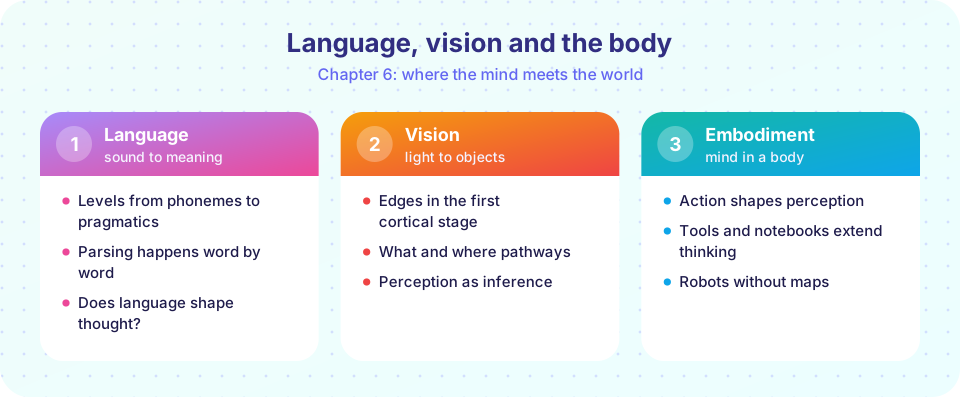
A map of chapter 6: how language is organized and understood, how vision builds a world from light, and how the body and tools shape thinking.
Models are only useful when applied to real abilities. This chapter takes three of the most studied: speaking and understanding, seeing, and acting with a body in a physical world. They look like very different topics, but a theme runs through all three. In each, the mind faces an ambiguous, noisy input and must quickly construct a useful interpretation. Spoken sounds blur together, a retinal image is flat and ambiguous, and the world changes as you move through it.
What you will learn
- The big questions each part of the chapter addresses.
- How the three topics connect to the models of chapter 5.
- What the lessons ahead will ask you to try.
Key terms
Ambiguity: an input that supports more than one interpretation.
Incremental processing: building an interpretation piece by piece as input arrives.
Embodied cognition: the view that thinking depends on the body and its actions.
Replication: repeating a study to see whether its result holds.
One problem, three arenas
Common challenges
A caution
What each lesson covers
- Language and thought: the levels of language, how sentences are parsed as they arrive, the debate between innate and usage-based views, and whether language shapes thought.
- Visual perception: edge detectors in the cortex, the two visual streams, grouping, illusions and why you can miss a gorilla.
- Embodied cognition: the four E's, Braitenberg vehicles, the extended mind and a sober look at replication problems.
- Chapter review: summary and mixed quiz.
Try it
Press Run (or Ctrl + Enter) to see the console output here.
No output.
Check your understanding
Quick check · 3 questions
of 3 answered You scored / 3 · perfect!
-
1. What common problem do language, vision and action all face?
Each ability has to build a useful interpretation from input that is noisy and open to multiple readings. -
2. Incremental processing means:
People start interpreting a sentence before they hear its end. -
3. Why is replication mentioned in this chapter?
Evaluating evidence honestly is part of cognitive science, and several classic effects have had replication problems.
Summary
- Language, vision and action each turn ambiguous input into a useful interpretation.
- The chapter combines models, brain facts and critical evaluation.
- Embodiment findings need careful scrutiny because several have replicated poorly.
Next: Language and thought
Track your progress
Create a free account to tick off lessons and pick up where you left off on any device.
of Cognitive Science lessons completed