


















Lesson 27 of 43 · Language, Vision and Embodiment
Language and Thought
Explore how language is organized in levels, how sentences are parsed word by word, innate versus usage-based theories, and whether language shapes thought.
Speaking feels effortless. In casual conversation you produce roughly two to three words every second, and each one is chosen from tens of thousands you know, fitted into a grammatical structure and turned into a precise sequence of muscle movements. Listening is just as demanding: the sound is continuous, voices differ, rooms echo, and yet meaning arrives almost at once. Language is among the most complex skills humans have, and nearly every typically developing child masters it without formal lessons.
This lesson surveys how cognitive scientists describe language, how comprehension unfolds in time, and a classic question: does the language you speak change how you think?
What you will learn
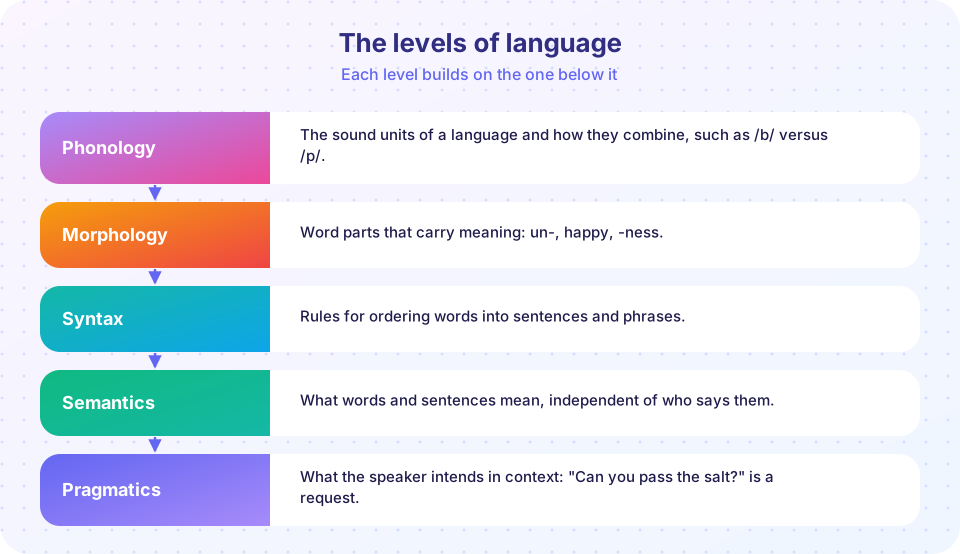
- The five levels at which language is analyzed.
- Which brain regions have long been linked to language, and why that picture is more complex than it first seemed.
- How people parse sentences incrementally, and what garden-path sentences reveal.
- The core disagreement between innate and usage-based accounts of acquisition.
- What evidence exists for linguistic relativity, and how modest it is.
Key terms
Phoneme: the smallest sound unit that distinguishes words in a language, such as /b/ and /p/ in "bat" and "pat".
Morpheme: the smallest unit of meaning, such as "un-" or "happy".
Parsing: assigning grammatical structure to a sentence.
Mental lexicon: your stored knowledge of words, their sounds, meanings and grammar.
Priming: faster processing of a word after a related word.
Levels of language
Linguists separate phonology (sound patterns), morphology (word structure), syntax (sentence structure), semantics (literal meaning) and pragmatics (meaning in context). These levels interact. "Can you pass the salt?" has a yes-or-no syntax and a literal meaning about ability, but pragmatically it is a request, and you reply by passing the salt.
The brain regions often linked to language include Broca's area in the left frontal lobe, named after Paul Broca, whose 1861 patient could say little more than "tan", and Wernicke's area in the left temporal lobe, linked by Carl Wernicke in 1874 to comprehension. Modern imaging shows language relies on wide networks, so these labels are a starting map, not a complete one.
Understanding words and sentences in real time
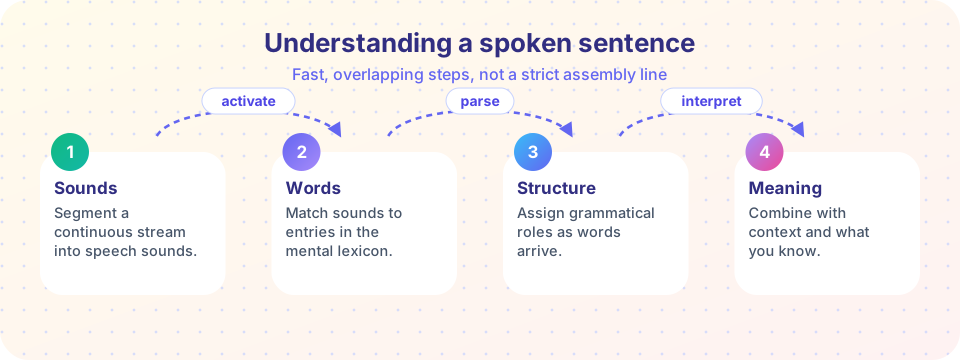
Lexical access is fast. In a famous 1971 study, David Meyer and Roger Schvaneveldt asked people to decide whether letter strings were words. People were quicker to say "nurse" is a word right after "doctor" than after an unrelated word, an early demonstration of semantic priming. Activation seems to spread among related words in the lexicon, which fits connectionist ideas.
Listeners also use the face. In 1976 Harry McGurk and John MacDonald showed that seeing a mouth say "ga" while hearing "ba" often leads people to perceive "da". Speech perception combines hearing and seeing, much like the cue combination of the last chapter.
Garden paths
People parse incrementally: they commit to a structure while words are still arriving. When the commitment turns out wrong you notice. Consider "The horse raced past the barn fell" (a famous example attributed to Thomas Bever in 1970). Most readers parse "raced" as the main verb and stumble at "fell". The intended reading is "the horse that was raced past the barn fell". Such sentences are called garden-path sentences because the reader is led down the wrong path. They show that parsing is fast, predictive and sometimes wrong, and different theories disagree about how much information, such as meaning and context, guides the first guess.
How do children acquire language?
Noam Chomsky argued in the 1950s and 60s that the input children hear is too limited to determine grammar, a poverty of the stimulus argument, so humans must have an innate language faculty, later called universal grammar. This view was transformative and remains influential.
Usage-based theories, such as Michael Tomasello's, argue instead that children learn constructions from the speech they hear using general abilities like pattern finding and understanding others' intentions. Evidence includes children's early reliance on specific word combinations before general rules. Computational models, including modern neural language models, are being used to test how much structure can be learned from data. The debate is lively, and most researchers accept some innate learning machinery while disagreeing about how language-specific it is.
Does language shape thought?
The linguistic relativity hypothesis, often called the Sapir-Whorf hypothesis, says the language you speak influences your thinking. The strong form, that language determines what you can think, is rejected. A weak form has some support.
- Color. Brent Berlin and Paul Kay (1969) reported that color terms across languages follow an ordered pattern, suggesting universal constraints. Yet Jonathan Winawer and colleagues (2007) found that Russian speakers, whose language has separate words for light blue and dark blue, discriminated blues across that boundary slightly faster than English speakers, and that effect vanished when people did a verbal task at the same time. This implies language can influence perception in subtle, task-dependent ways.
- Space and time. Studies by Lera Boroditsky and others suggest differences in how speakers conceptualize time or direction, though some effects have been debated or replicated unevenly.
A sober summary: language biases how quickly or easily some distinctions are made, but it does not lock minds into separate worlds. People can always learn new words and concepts.
Common misconceptions
"Eskimo languages have hundreds of words for snow, so Inuit people see snow differently." This popular claim is overstated and has been criticized by linguists. Many languages build words from smaller parts, so counting "words" is misleading.
"Broca's area is the speech center." It is one important region in a larger network.
Try it
Press Run (or Ctrl + Enter) to see the console output here.
No output.
Press Run (or Ctrl + Enter) to see the result here.
Program input · what you'd type while the program runs
Type the answers before you press Run, one per line. Each time the program reads a line (with input()), it gets the next line from this box.
Check your understanding
Quick check · 5 questions
of 5 answered You scored / 5 · perfect!
-
1. Which level of language concerns what a speaker intends in context?
Pragmatics covers meaning in context, such as treating 'Can you pass the salt?' as a request. -
2. What did Meyer and Schvaneveldt's 1971 study show?
People recognized a word faster after a semantically related word, a semantic priming effect. -
3. Why do garden-path sentences cause trouble?
Incremental parsing leads readers to a likely but incorrect structure. -
4. The poverty of the stimulus argument claims that:
Chomsky argued that input underdetermines grammar, motivating an innate faculty. -
5. Which statement about linguistic relativity best matches the evidence?
Studies like Winawer et al. (2007) show small, task-dependent effects, not strict determinism.
Summary
- Language is analyzed in levels from sound to intention, and the levels interact.
- Comprehension is fast and incremental, with priming and visual cues helping.
- Garden-path sentences expose commitments made before all the evidence arrives.
- Innate and usage-based theories disagree about how language-specific the learning machinery is.
- Language can nudge perception and thought in modest ways, not wall them off.
Next: Visual perception
Track your progress
Create a free account to tick off lessons and pick up where you left off on any device.
of Cognitive Science lessons completed