


















Lesson 3 of 43 · Getting Started
A short history of cognitive science
Follow the story from behaviorism to the cognitive revolution of the 1950s and 1960s, the key people and papers, and the debates that shaped the field.
Cognitive science feels like a natural idea today, but for decades it was almost unthinkable to talk scientifically about inner mental states. Understanding why helps you see what the field is reacting against, and why some of its old arguments are still alive. This lesson follows the story from behaviorism to the "cognitive revolution" and beyond.
What you will learn
- Why behaviorism dominated early twentieth-century psychology and what it got right.
- Which developments around 1950 to 1960 made mental talk respectable again.
- Who the main figures were and what each contributed.
- How the field developed its institutions and its later rivals, such as connectionism.
Key terms
Behaviorism: the view that psychology should study observable behavior and its relation to the environment, not inner mental states.
Cognitive revolution: the shift, centered on the 1950s and 1960s, toward explaining behavior through internal information processing.
Cognitive map: Edward Tolman's term for an internal representation of spatial layout.
Connectionism: modeling cognition with networks of simple units whose connection strengths are learned.
The behaviorist era
In 1913 John B. Watson published a paper, often called the behaviorist manifesto, arguing that psychology should become an objective science of behavior. Introspection (looking inward and reporting your thoughts) had produced disagreements that nobody could settle, so Watson dropped inner states altogether. Later, B. F. Skinner built on this with experiments on how rewards and punishments shape behavior.
Behaviorism was not foolish. It insisted on measurement and gave us robust laws of learning, and its techniques are still used in education and therapy. Its limit was the claim that inner states are unnecessary for explanation.
Even within the era, cracks appeared. Edward Tolman showed that rats do not merely learn chains of movements. In the well-known latent learning experiment by Tolman and Honzik (1930), rats allowed to wander a maze with no reward later ran it efficiently once food appeared, as if they had been building an internal layout all along. Tolman's 1948 paper described such an internal structure as a cognitive map. Karl Lashley argued in 1948 (published 1951) that complex sequences, like speech or piano playing, cannot be explained as chains of reflexes, because they require plans.
Three ingredients arrive
Around the middle of the century, three developments gave researchers new vocabulary for the mind.
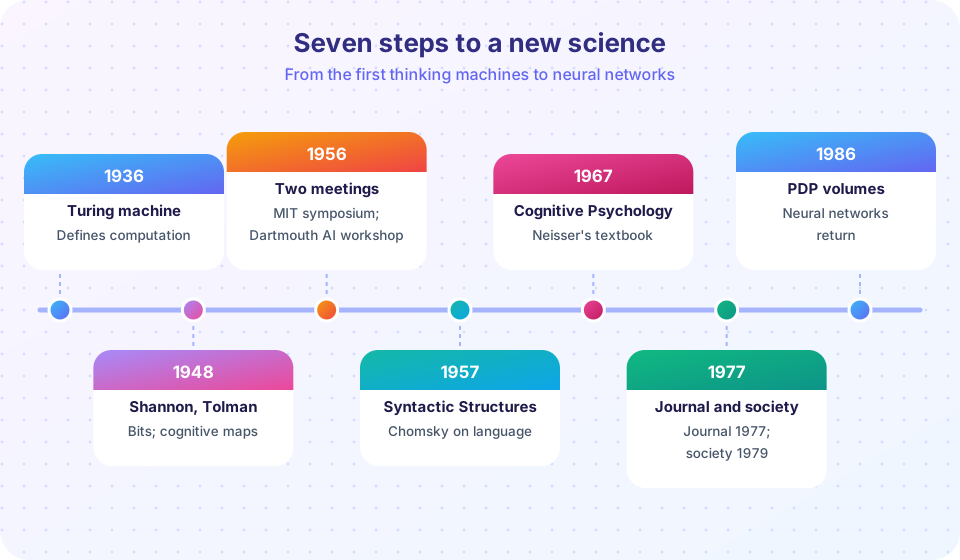
- Computation. Alan Turing described an abstract machine in 1936 that could carry out any well-defined procedure, and in his 1950 paper "Computing Machinery and Intelligence" he asked whether machines could think. Digital computers made it possible to test theories as running programs.
- Information theory. Claude Shannon's 1948 paper "A Mathematical Theory of Communication" defined information in bits and described communication channels with limited capacity. Psychologists quickly saw that people, too, are channels with limits. Donald Broadbent used this idea for attention (see attention and filtering), and George Miller wrote his 1956 paper on the limits of short-term memory in similar language.
- Linguistics. Noam Chomsky's Syntactic Structures (1957) argued that language has a rich structure that no simple stimulus-and-response chain could produce. His 1959 review of Skinner's Verbal Behavior criticized the idea that language could be explained by reinforcement alone. Historians still debate how fair the review was, but it became a symbol of the shift.
1956: a year of beginnings
Two events in 1956 are often used as birthdates. In September, a symposium on information theory at MIT featured Miller on memory, Chomsky on language, and Allen Newell and Herbert Simon on their Logic Theorist, a program that proved theorems from logic. Miller later remembered leaving with the conviction that experimental psychology, linguistics and computer modeling were parts of one larger enterprise.
Earlier that summer, John McCarthy, Marvin Minsky and colleagues held a workshop at Dartmouth College where the term artificial intelligence was coined. Newell and Simon went on to build the General Problem Solver, and they collected human thinking-aloud protocols to compare with the program's steps, an early example of testing a model against human data.
Naming and institutions
The word "cognitive" rose to prominence with Ulric Neisser's textbook Cognitive Psychology (1967), which defined cognition as all the processes by which sensory input is transformed, stored and used. The journal Cognitive Science started in 1977, a report commissioned by the Alfred P. Sloan Foundation in 1978 pictured the field as six disciplines linked in a ring, and the Cognitive Science Society held its first meeting in 1979.
Rival visions: symbols versus networks
Early cognitive science was dominated by the symbolic approach: the mind as a system that manipulates discrete symbols according to rules, much like a logic program. In the 1980s, a second approach grew. In 1986, David Rumelhart, James McClelland and the PDP Research Group published Parallel Distributed Processing, showing that networks of simple units, trained by adjusting connection strengths, could learn tasks such as pronouncing words. These connectionist models looked more brain-like and learned from examples. We will compare the two approaches carefully in chapter 5. Modern deep learning descends directly from this tradition.
Beyond the revolution
The cognitive revolution did not end the story. Later decades added cognitive neuroscience (linking mental functions to brain activity), evolutionary and developmental perspectives, Bayesian models of inference, and "embodied" views that stress the role of the body and environment. Some of these push back against the idea that the mind is only symbol manipulation. A good history is not a straight line, but a conversation among competing ideas.
Common misconceptions
"Behaviorism was simply wrong." It produced lasting methods and laws of learning. What failed was the claim that inner states have no place in explanation.
"Chomsky's review single-handedly killed behaviorism." It was influential, but behaviorism declined for many reasons, including new evidence on animals and humans and new tools from computing and information theory.
"The cognitive revolution happened on one day in 1956." 1956 is a convenient symbol. Changes accumulated over years, and participants themselves told the story differently.
Try it
Plot the milestones to see how quickly the pieces arrived. The dates are from this lesson; the plot is only a visual aid.
Press Run (or Ctrl + Enter) to see the result here.
Program input · what you'd type while the program runs
Type the answers before you press Run, one per line. Each time the program reads a line (with input()), it gets the next line from this box.
A toy version of Tolman's idea. An agent that memorized one chain of moves (stimulus to response) fails when a wall blocks the route. An agent with a map of the maze finds a detour. This is a simulation that illustrates the idea, not a reproduction of Tolman's experiments.
Press Run (or Ctrl + Enter) to see the result here.
Program input · what you'd type while the program runs
Type the answers before you press Run, one per line. Each time the program reads a line (with input()), it gets the next line from this box.
Check your understanding
Quick check · 5 questions
of 5 answered You scored / 5 · perfect!
-
1. What was the main claim of Watson's behaviorism?
Watson (1913) argued for an objective psychology of behavior and dropped introspection. -
2. What did Tolman and Honzik's latent learning study suggest?
Unrewarded rats later performed well once rewarded, suggesting they had learned the layout all along. -
3. Which contribution came from information theory?
Shannon's 1948 work inspired models of attention and memory limits, such as Broadbent's filter and Miller's 1956 paper. -
4. What is usually meant by the symbolic approach in early cognitive science?
Symbolic models treat cognition as rule-governed operations on discrete representations, like logic programs. -
5. Which book from 1986 helped launch the modern connectionist movement?
Rumelhart, McClelland and the PDP Research Group showed that learning in networks of simple units could explain many cognitive tasks.
Summary
- Behaviorism gave psychology objective methods but refused inner states; evidence from latent learning and complex sequences challenged that refusal.
- Computing, information theory and modern linguistics supplied the tools of the cognitive revolution.
- 1956 (the MIT symposium and the Dartmouth workshop) is used as a symbolic birth year; institutions followed in 1977 to 1979.
- Symbolic and connectionist approaches have been rivals and partners ever since.
Track your progress
Create a free account to tick off lessons and pick up where you left off on any device.
of Cognitive Science lessons completed