


















Lesson 4 of 43 · Getting Started
Methods of cognitive science
Learn the main research methods of cognitive science, from reaction-time experiments to brain imaging and computational models, and why converging evidence matters.
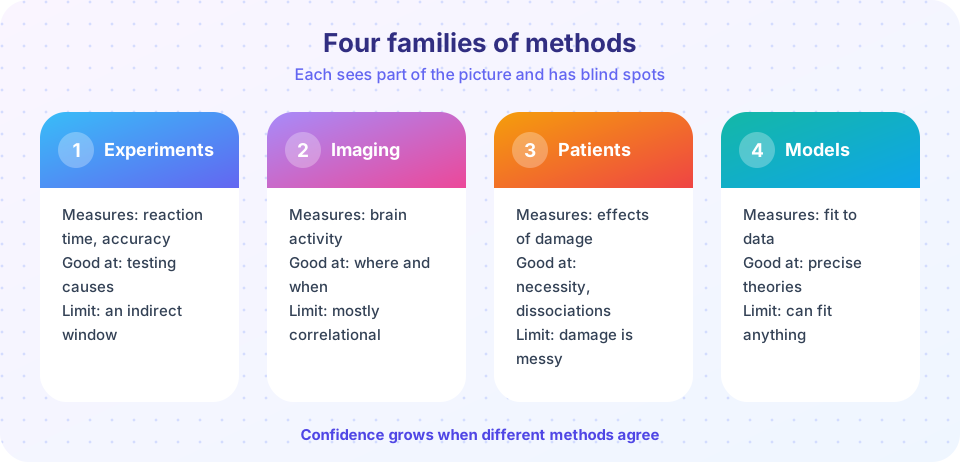
You cannot open a skull and read a thought. Cognitive scientists therefore study the mind indirectly, through behavior, through measurements of the brain, through people with unusual brain damage, and through models that must make testable predictions. Each method sees part of the picture and has blind spots. The trick is to combine them.
What you will learn
- The four main families of methods and what each can and cannot show.
- How a simple experiment isolates a cause: independent and dependent variables, control and randomization.
- Why replication matters and what the replication crisis taught the field.
- How converging evidence from different methods builds confidence.
Key terms
Independent variable: what the experimenter changes (for example, word type).
Dependent variable: what is measured (for example, reaction time or accuracy).
Within-subject design: every participant experiences every condition.
Replication: repeating a study to see whether the result holds.
Converging evidence: agreement among results from different methods.
Behavioral experiments
The workhorse method is the controlled experiment. You change one thing, measure an outcome, and keep everything else the same. In a classic example, participants decide as fast as they can whether a string of letters is a real word. Words that are common ("table") are recognized faster than rare ones ("pestle"). The independent variable is word frequency, the dependent variable is reaction time. Because the stimuli and procedure are otherwise matched, the difference is evidence about how word knowledge is stored or accessed.
Good experiments share a toolkit:
- Random assignment or counterbalancing so order effects do not masquerade as effects of the condition.
- Enough trials and participants, because individual reaction times vary a lot from trial to trial.
- Statistics to judge whether a difference is larger than chance variation.
- Pre-registration in modern practice: writing down the plan and analysis before seeing the data.
Behavior includes accuracy, reaction times (see reaction time and stages), eye movements, choices and verbal reports. Each is an indirect window into processing.
Neuropsychology: learning from damage
Some of the most dramatic evidence comes from patients with brain injuries or disease. Paul Broca's patient in 1861 could understand speech but produce almost none; Carl Wernicke later described patients with fluent but meaningless speech. Such cases suggest that a function depends on a particular region. The strongest inference is a double dissociation: patient A is impaired on task 1 but fine on task 2, patient B shows the reverse. That pattern suggests the two tasks rely on at least partly separate mechanisms. We return to this in brain organization.
The limits are real. Damage is rarely neat, patients differ, and a lesion shows that a region is necessary for something, not that it alone does the job.
Neuroimaging and recording
Tools such as EEG (electrodes on the scalp), MEG, fMRI and, in animals and some patients, direct recording from neurons let researchers watch the brain at work. They differ in how finely they locate activity in space and in time, a trade-off examined in methods in cognitive neuroscience. A common warning: activity in a region does not tell you which mental process is happening, because most regions are involved in many tasks.
Computational modeling
A model is a precise, runnable theory. You specify representations and rules, run the model, and compare its output with human data. A model forces you to be explicit: vague phrases like "attention filters information" become a mechanism with parameters that can fail. Models can be symbolic (rules), connectionist (networks), or probabilistic (Bayesian). Their danger is flexibility: with enough free parameters a model can fit anything, so good modelers test it on data it was not fitted to.
Other approaches
Cognitive science also uses developmental studies (how abilities emerge in infants and children), cross-cultural comparison, analysis of large text collections (corpora) in linguistics, observation in natural settings, and comparative studies with other species. Each adds variety so that findings do not depend on one narrow sample of people, which for decades meant university students in a few wealthy countries.
Replication and trust
In 2015 a large collaboration attempted to replicate 100 published psychology studies. The original studies had reported statistically significant results in 97 cases; in the replications, about 36 did. The exact interpretation is debated (the replications differed in details, and a failure is not proof of a false original), but the lesson was clear: single studies are fragile. The field responded with larger samples, open data and pre-registration. When you read about a surprising finding, ask whether it has been replicated, how big the sample was, and whether different methods agree.
Converging evidence
No method is decisive alone. Consider the claim that a region supports face recognition. Imaging shows it activates more for faces than for other objects. Patients with damage there struggle with faces. Recordings in animals find neurons that respond to faces. Models show how such a region could be learned. When these lines agree, confidence rises. When they disagree, the disagreement is an interesting puzzle.
Common misconceptions
"A significant result means the effect is real and large." Significance depends on sample size and says little about effect size or truth. Small samples and many analyses make false positives common.
"Brain imaging shows what a person is thinking." Current imaging shows patterns of activity that correlate with tasks. It cannot read arbitrary thoughts.
"Correlation shows that a region causes a behavior." Only manipulations (experiments, lesions, brain stimulation) support causal claims.
Try it
A reaction-time demonstration. Click the box as soon as it turns green. This is a classroom-style demonstration of how reaction times are collected; it is not a clinical or diagnostic test, and your own times depend on your device and browser.
A simulated within-subject experiment. We invent 24 participants whose reaction times are slightly slower for rare words, then use a paired t-test to see whether the difference stands out from noise. The data are simulated, not real.
Press Run (or Ctrl + Enter) to see the result here.
Program input · what you'd type while the program runs
Type the answers before you press Run, one per line. Each time the program reads a line (with input()), it gets the next line from this box.
Check your understanding
Quick check · 5 questions
of 5 answered You scored / 5 · perfect!
-
1. In the word-recognition example, what is the dependent variable?
The dependent variable is what is measured, here reaction time. Word frequency is the independent variable. -
2. What does a double dissociation suggest?
If patient A fails task 1 but passes task 2 and patient B shows the reverse, the tasks likely depend on separable processes. -
3. The 2015 replication project of 100 psychology studies found that
About 97 originals were significant and about 36 replications were, which prompted reforms such as pre-registration and larger samples. -
4. Which method best supports a causal claim about a brain region?
Activity is correlational. Disrupting or removing the region and seeing a deficit supports a causal role. -
5. Why is converging evidence valuable?
Different methods fail in different ways, so agreement among them is more convincing.
Summary
- Cognitive scientists combine behavioral experiments, neuropsychology, neuroimaging and recording, and computational modeling.
- Controlled experiments isolate causes by changing one variable and measuring another.
- Double dissociations are a strong form of evidence from patients.
- Single studies can fail to replicate; larger samples, open data and pre-registration help.
- Converging evidence across methods is the main route to trustworthy conclusions.
Next: Chapter 1 review
Track your progress
Create a free account to tick off lessons and pick up where you left off on any device.
of Cognitive Science lessons completed