


















Lesson 11 of 43 · Philosophy of Mind
Chapter 3 overview: Philosophy of mind
Preview the mind-body problem and the main positions in philosophy of mind: dualism, behaviorism, identity theory, functionalism and the Chinese room.
Everyone knows what it is like to feel a pain, taste coffee or think of a friend. Everyone also knows (or has been told) that a brain is a wet, gray organ made of cells. How can the feeling and the organ be the same story? This is the mind-body problem, one of the oldest puzzles in philosophy, and it frames everything cognitive science wants to explain.
What you will learn
- The central questions of philosophy of mind.
- A first map of the main positions.
- How each lesson in this chapter builds on the previous one.
Key terms
Mind-body problem: the question of how mental states and physical states are related.
Dualism: the view that mind and matter are fundamentally different kinds of thing.
Physicalism: the view that everything, including the mind, is ultimately physical.
Functionalism: the view that mental states are defined by what they do, not what they are made of.
Intentionality: the "aboutness" of mental states: thoughts are about things.
The questions
Philosophy of mind asks several connected questions.
- What is the mental? Beliefs, desires, sensations, emotions, intentions: do they form one natural category?
- How are mental states related to the brain? Are they the same thing, caused by it, or something else?
- Can a machine have a mind? If a program could mimic a person perfectly, would it understand?
- What is consciousness? Why does it feel like something to be you? (Chapter 8 returns to this.)
Philosophy does not run experiments, but it clarifies concepts, spots hidden assumptions and tests theories by thought experiments. Cognitive scientists need it because every empirical claim (this region "represents" faces, that model "understands" language) quietly relies on answers to these questions.
Mind and matter: separate?
The first split in the debate
Physicalist options
Three ways to be a physicalist
Hard cases
Where each view meets trouble
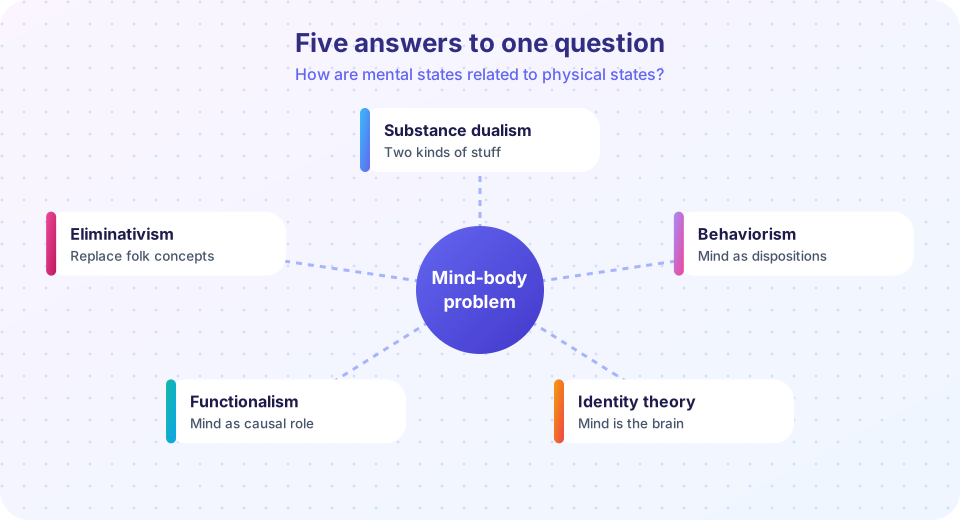
A first map
Substance dualism, associated with René Descartes (1596 to 1650), says that mind and body are distinct substances. Most scientists reject it, but it explains why the problem feels hard.
Behaviorism (as a philosophy, associated with Gilbert Ryle) says that talk of mental states is really talk of behavior and dispositions to behave.
Identity theory (U. T. Place, J. J. C. Smart) says that mental states are brain states, in the way that lightning is an electrical discharge.
Functionalism (Hilary Putnam, Jerry Fodor and others) says that a mental state is defined by its causal role among inputs, outputs and other states. This view fits the computational approach of chapter 1 best, because it allows the same mind to run on different hardware.
Eliminativism (Paul and Patricia Churchland) goes further: everyday mental concepts such as belief may turn out to be as mistaken as old theories of fire, and a mature neuroscience might replace them.
Lessons in this chapter
- Dualism, behaviorism and identity theory follows the story from Descartes to the 1950s brain-process theory.
- Functionalism and computation covers multiple realizability and Turing machines.
- The Chinese room and intentionality examines John Searle's famous challenge and the replies to it.
- Chapter 3 review compares the positions side by side.
How to read philosophy
Philosophical positions are not opinions to be matched with your personality. Each is an argument package: premises, a conclusion, objections and replies. Ask of each view what it explains, what it struggles with and what it predicts. A good habit is to state the strongest version of a view before criticizing it.
Common misconceptions
"Dualism is the religious view and physicalism the scientific one." The debate is more subtle. Some religious thinkers are physicalists, and some secular philosophers defend forms of property dualism. What counts is the quality of the arguments.
"Philosophy of mind is just opinion." It uses arguments that can be valid or invalid, and its debates have affected scientific practice, including the rejection of strict behaviorism.
Try it
A map of positions. Choose a question and see how each view answers it. This is a simplified summary for study, since real philosophers hold more nuanced versions.
The same idea in code: pick answers to four yes/no questions and list which of the positions agree with all of them. The table is a simplified teaching summary.
Press Run (or Ctrl + Enter) to see the result here.
Program input · what you'd type while the program runs
Type the answers before you press Run, one per line. Each time the program reads a line (with input()), it gets the next line from this box.
Check your understanding
Quick check · 5 questions
of 5 answered You scored / 5 · perfect!
-
1. The mind-body problem asks
It is the puzzle of how feelings and thoughts fit with a physical brain. -
2. Which view says mental states are defined by their causal roles, not their material?
Functionalism allows the same mental state to be realized in different materials. -
3. Who is the best-known defender of substance dualism?
Descartes argued that mind and body are distinct substances. -
4. Eliminativism claims that
Eliminativists compare folk psychology to discarded theories such as phlogiston. -
5. Why do cognitive scientists need philosophy of mind?
Philosophy clarifies concepts and assumptions that empirical work depends on.
Summary
- The mind-body problem asks how mental and physical states are related.
- Major positions: dualism, behaviorism, identity theory, functionalism and eliminativism.
- Functionalism is the view most compatible with the computational approach.
- Philosophy contributes arguments and conceptual clarity, not experiments.
Track your progress
Create a free account to tick off lessons and pick up where you left off on any device.
of Cognitive Science lessons completed