


















Lesson 25 of 43 · Models of Cognition
Models of Cognition: Chapter Review
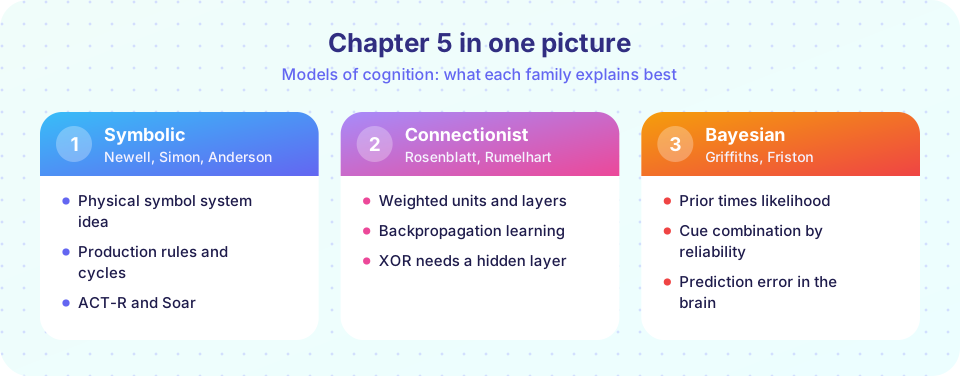
Review chapter 5: compare symbolic, connectionist and Bayesian models in one table, revisit key names and ideas, and test yourself with a ten-question quiz.
You have now met the three main families of cognitive models. This review puts them side by side, so you can see what each one explains best and where each struggles. Use it as a checkpoint before moving on to language, vision and the body.
What you will learn
- How to compare the three model families along the same dimensions.
- Which famous names and results belong to which approach.
- Which questions to ask when someone presents a new cognitive model.
Recap table
| Symbolic | Connectionist | Bayesian | |
|---|---|---|---|
| Knowledge is | Explicit rules and structures | Connection weights | Degrees of belief |
| Core operation | Match, select, fire | Spread activation, adjust weights | Update prior with likelihood |
| Learning | Hard; rules often hand-written | Central; gradient-based | Updating beliefs; priors may be learned |
| Strengths | Planning, reasoning, step traces | Pattern recognition, graceful errors | Uncertainty, cue combination |
| Typical weakness | Brittle, grounding problem | Opaque, systematicity debate | Flexible assumptions, intractable math |
| Key names | Newell, Simon, Anderson, Fodor | Rosenblatt, Rumelhart, McClelland, Hinton | Griffiths, Tenenbaum, Knill, Friston |
| Marr level | Algorithmic | Algorithmic / implementational | Computational |
How to evaluate any model
When you meet a new model, ask five questions:
- What does it assume is stored? Rules, weights or probabilities.
- What does it predict that other models do not? Precisely, and with numbers.
- How many free parameters does it have? More freedom makes a good fit less impressive.
- Where does it fail? Every model has failures. Hidden ones are a warning sign.
- At what level does it explain? A computational claim does not compete with an implementational one.
Hybrids and the road ahead
Modern work increasingly blends the families. Neural networks are trained to behave like Bayesian reasoners. Probabilistic programs describe structured, rule-like knowledge. Cognitive architectures add learned components. The rivalry of the 1980s has become a conversation about which tool fits which question.
Check your understanding
Quick check · 10 questions
of 10 answered You scored / 10 · perfect!
-
1. Which model family is most closely tied to the idea of a working memory and production rules?
Production systems keep facts in working memory and match IF-THEN rules against them. -
2. XOR is important in the history of connectionism because:
XOR is not linearly separable, so single-layer perceptrons fail on it, which Minsky and Papert highlighted. -
3. In a Bayesian model with a strong prior and a small amount of weak evidence, the posterior is:
A strong prior is hard to move with weak evidence. -
4. Who proposed the physical symbol system hypothesis?
Newell and Simon stated it in 1976. -
5. Graceful degradation is a feature mainly claimed for:
Because knowledge is spread over many units, damage causes gradual rather than total failure. -
6. Ernst and Banks (2002) showed people combining vision and touch by:
As the visual image got noisier, people relied more on touch, roughly as an optimal observer would. -
7. What does the frame problem ask?
It concerns specifying the non-effects of actions without listing every unchanged fact. -
8. Which statement about Marr's levels is best?
The levels are complementary: what is computed, how, and in which hardware. -
9. The criticism called Bayesian fundamentalism says that:
Jones and Love argued that flexible assumptions weaken a model's explanatory value. -
10. In predictive coding, which signal is passed up from lower to higher areas?
Higher areas send predictions down, lower areas send back the mismatch.
Summary
- Symbolic, connectionist and Bayesian models disagree about what knowledge is.
- Each family has landmark successes and well-known limits.
- Always ask what is stored, what is predicted, how many parameters are free and at which level the claim sits.
- Hybrids are now common.
Track your progress
Create a free account to tick off lessons and pick up where you left off on any device.
of Cognitive Science lessons completed