


















Lesson 22 of 43 · Models of Cognition
Symbolic Systems and Production Rules
Learn the physical symbol system idea, how production rules and the recognize-act cycle work, what ACT-R and Soar model, and Marr's three levels.
In 1956 a program called the Logic Theorist, written by Allen Newell, Herbert Simon and Cliff Shaw, proved theorems from Whitehead and Russell's Principia Mathematica. It did not look up the answers. It searched for proofs by manipulating logical symbols. To many people at the time, this looked like the beginning of an explanation of thinking itself: if a machine can reason by shuffling symbols, perhaps minds do the same.
That bet is the heart of the symbolic approach to cognition. This lesson explains the idea, shows how a production system works by building one, and then examines why many researchers moved beyond it.
What you will learn
- What the physical symbol system hypothesis claims.
- How a production system matches, selects and fires rules.
- What ACT-R and Soar are, and what they are used for.
- How Marr's three levels help you compare very different models.
- Where symbolic models struggle.
Key terms
Symbol: a physical token that stands for something else and can be combined with other tokens by rules.
Production rule: an IF-THEN pair. If the condition matches working memory, the action changes it.
Working memory: the small store of facts that rules currently match against.
Cognitive architecture: a fixed theory of the mind's structure, in which many tasks are modeled by adding knowledge.
Means-ends analysis: a strategy of reducing the difference between the current state and the goal.
The physical symbol system hypothesis
In 1976 Newell and Simon stated a bold claim. A physical symbol system is a machine that holds symbols, builds structures out of them and transforms those structures according to rules. They hypothesized that such a system has the necessary and sufficient means for general intelligent action. "Necessary" means anything intelligent must be one. "Sufficient" means a big enough one could be intelligent.
Jerry Fodor pushed a related idea in 1975 with his language of thought hypothesis: thinking involves sentence-like mental representations with a combinatorial syntax. Because the parts recombine, you can think "the dog chased the cat" and "the cat chased the dog" without learning them separately. This property is called systematicity, and symbolists consider it a core feature of human thought.
Production systems
A production system is the simplest symbolic architecture. It has two parts: a working memory of facts, and a set of rules. Each rule says: IF these facts are present, THEN do this (add a fact, delete one, or perform an action). The system runs a loop.
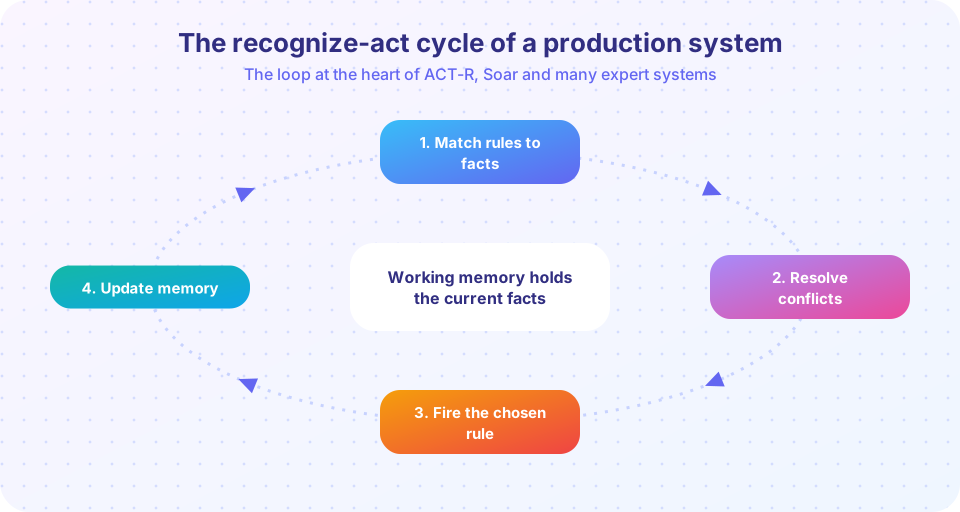
- Match: find every rule whose conditions fit working memory.
- Resolve conflicts: if several rules match, pick one using a policy such as most specific first.
- Fire: perform the action, which usually changes working memory.
- Repeat.
Here is a small example in words. Working memory holds goal: make-tea, have: kettle, have: tea-bag. One rule says: IF goal is make-tea AND no hot-water, THEN add subgoal boil-water. Another says: IF subgoal boil-water AND have kettle, THEN fill kettle, switch on. The behavior emerges from the cycle, not from a single plan.
Newell and Simon's General Problem Solver (late 1950s) used means-ends analysis: compare the current state with the goal, find the biggest difference and pick an operator that reduces it. Human think-aloud protocols showed that people often reason in similar ways on puzzles.
Cognitive architectures: ACT-R and Soar
Cognitive scientists extended these ideas into full cognitive architectures.
- ACT-R (Adaptive Control of Thought, Rational), developed by John Anderson, splits memory into a declarative store of facts and a procedural store of production rules. Modules for vision, motor control and memory exchange information through small buffers. Each production firing is modeled as lasting about 50 milliseconds, so the model's predicted reaction times can be compared with human data, and in some versions with brain imaging.
- Soar, from Newell, John Laird and Paul Rosenbloom, solves problems by searching problem spaces. When it hits an impasse it creates a subgoal, and when the subgoal is solved it stores the result as a new rule, a process called chunking. Soar has been used for both psychological modeling and AI agents.
Notice what these architectures claim. They do not say that people consciously follow rules. They say that, at some level of description, behavior is well captured by rules that match and fire, and that this level makes accurate timing predictions.
Marr's three levels
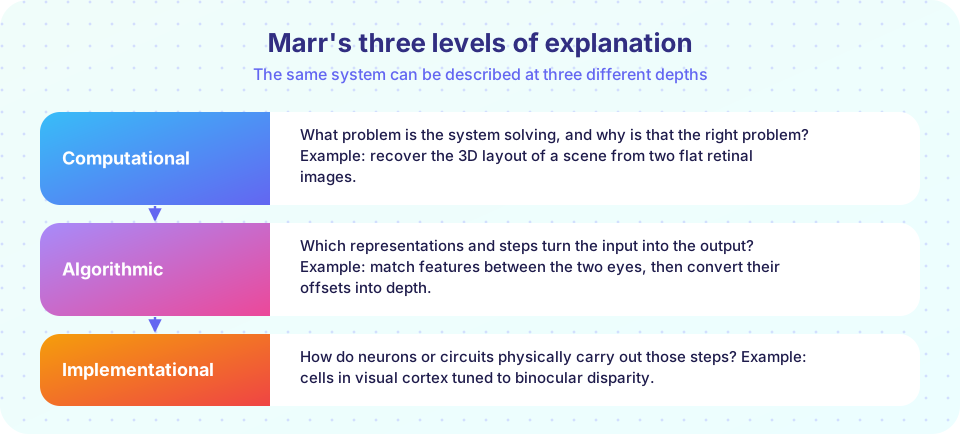
David Marr, in his 1982 book Vision, argued that a complete explanation of an information-processing system has three levels. The computational level asks what problem is solved and why. The algorithmic level asks which representations and steps are used. The implementational level asks how hardware carries it out. Symbolic models mostly target the algorithmic level. Neuroscientists work at the implementational level. Bayesian modelers often work at the computational level.
This framework helps you avoid false disputes. Two models that sit at different levels may both be right.
Strengths and limits
Strengths include explicit reasoning, clear step-by-step traces, planning with goals and subgoals, and the ability to explain how an answer was reached.
Limits, mostly noticed from the 1980s, include these:
- Brittleness. A rule base that is missing a case can fail completely, whereas people degrade gracefully.
- Learning. Hand-writing rules is slow. How do rules get acquired from raw experience?
- The frame problem. First named by John McCarthy and Patrick Hayes in 1969: how does a system know which facts stay the same after an action without listing them all?
- Symbol grounding. Stevan Harnad asked in 1990 how symbols get their meaning if they only point to other symbols.
These problems motivated the connectionist work in the next lesson, though symbolic ideas remain alive in planning, language and cognitive architectures.
Common misconceptions
"Symbolic models say people consciously follow rules." No. The rules are a theoretical description of unconscious processing, not a conscious checklist.
"Symbolic models are obsolete." Not so. Many cognitive architectures still use symbols, and modern AI systems often combine learned networks with symbolic planning or tools.
Try it
Press Run (or Ctrl + Enter) to see the console output here.
No output.
Check your understanding
Quick check · 5 questions
of 5 answered You scored / 5 · perfect!
-
1. What does the physical symbol system hypothesis claim?
Newell and Simon claimed that symbol systems are both necessary and sufficient for general intelligence. -
2. In a production system, what happens during conflict resolution?
When several rules match, a policy selects one. Then it fires and changes working memory. -
3. ACT-R splits long-term memory into which two stores?
ACT-R has a declarative store of facts and a procedural store of production rules. -
4. Which problem asks how a system knows what does NOT change when it acts?
The frame problem, named by McCarthy and Hayes, concerns specifying what stays the same after an action. -
5. Symbolic models mostly operate at which of Marr's levels?
They specify representations and the steps over them, which is the algorithmic level.
Summary
- Symbolic models treat thought as rule-governed manipulation of discrete symbols.
- Production systems run a match, select, fire cycle over a working memory.
- ACT-R and Soar are full architectures that make timing and learning predictions.
- Marr's three levels clarify what a model is explaining.
- Brittleness, learning and symbol grounding motivated alternatives.
Next: Connectionism
Track your progress
Create a free account to tick off lessons and pick up where you left off on any device.
of Cognitive Science lessons completed