


















Lesson 1 of 43 · Getting Started
Course map
Start here: who the Cognitive Science course is for, how its nine chapters fit together, and how to study it with interactive demos, quizzes and diagrams.
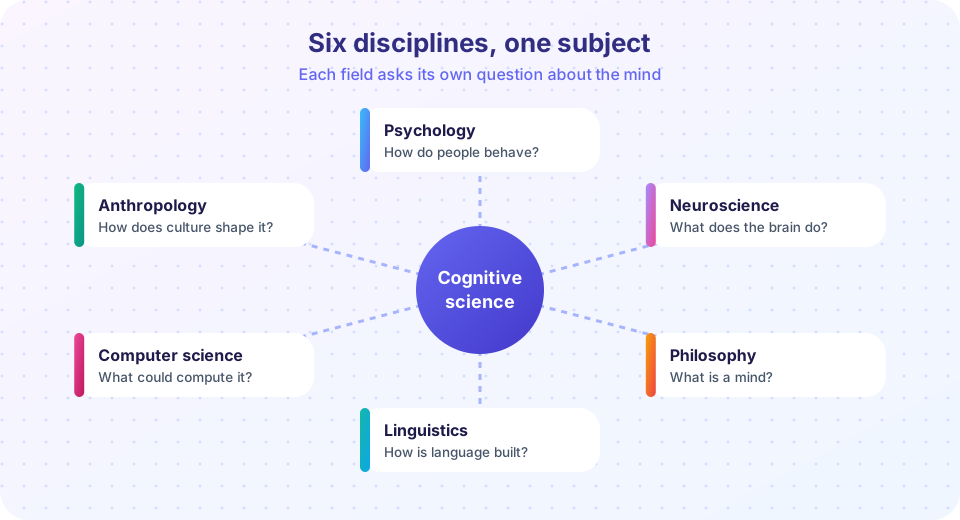
Cognitive science is the scientific study of the mind: how we perceive, remember, reason, speak, decide, and how a three-pound organ made of cells can do all of that. No single field can answer these questions alone, so cognitive science borrows from psychology, neuroscience, philosophy, linguistics, computer science and anthropology. This course is a guided tour through all of them.
You do not need any background. If you can read a graph and are curious about how thinking works, you are ready. The course is written for learners from about 16 upward, including adults who want a clear first map of the field.
Educational information only. This course explains research and ideas. It does not diagnose, treat or give advice about any mental or physical health condition. If you are worried about your own health or someone else's, talk to a qualified professional.
What you will learn
- What cognitive science is and which fields it combines.
- How to describe a mental process at different levels, from the task it solves to the cells that carry it out.
- The classic experiments on attention, memory and reaction time, and what they really showed.
- The main philosophical positions on mind and body, and the strongest arguments for and against them.
- Enough neuroscience to read a news story about a brain scan critically.
Key terms
Cognition: the mental processes of knowing, such as perceiving, remembering, reasoning and deciding.
Mind: what a brain does, described at the level of information and experience. How the mind relates to the brain is itself one of the big questions.
Representation: something inside a system that stands for something else, like a map standing for a place.
Computation: rule-governed transformation of representations.
The nine chapters at a glance
This first slice of the course covers chapters 1 to 4. Chapters 5 to 9 continue with models of cognition, language and vision, artificial intelligence, consciousness and projects.
Foundations
- Getting started
- Information processing
- Philosophy of mind
Part one: the questions and the vocabulary
Brain and models
- Neuroscience
- Models of cognition
- Language, vision, body
Part two: explaining cognition with mechanisms
Frontiers
- AI and cognition
- Consciousness
- Projects
Part three: the open edge of the science
Why one subject needs six fields
Imagine asking how a person recognizes a friend's face. A psychologist designs an experiment and measures how quickly people respond. A neuroscientist asks which brain regions become active. A computer scientist asks what program could do the same job. A linguist asks how the person then says the friend's name. A philosopher asks what it means to say the person "knows" the face at all. An anthropologist asks how culture shapes which faces and categories matter.
Each answer is partial. Together they are much stronger. A 1978 report written for the Sloan Foundation drew exactly this picture, with six fields linked in a ring, and helped give the new interdisciplinary field a name and an identity.
How to study this course
- Read actively. After each section, close your eyes and state the main idea in one sentence.
- Run the demos. The Try it blocks are small demonstrations and simulations. They are teaching models, not clinical tests, and each one says what it does and does not show.
- Take the quizzes seriously. Retrieving an answer from memory strengthens it much more than rereading. This is one of the most reliable findings in the psychology of learning.
- Space your study. Several short sessions beat one long one.
- Stay critical. Many famous results in this field have been challenged or refined. When a finding is shaky, the lessons say so.
Common misconceptions
"We only use 10% of our brains." This is false. Brain imaging and lesion studies show that nearly all regions are used and that damage almost anywhere has some effect.
"Left-brained and right-brained people exist." The two hemispheres do specialize in some functions, but healthy people use both together all the time. There is no good evidence for a stable "left-brain" or "right-brain" personality.
Try it
A discipline explorer. Click a field to see the central question it asks about the same everyday event. This is an illustration of the six-field idea, not a test.
A study planner. Change the numbers to see how the nine chapters fit your calendar.
Press Run (or Ctrl + Enter) to see the result here.
Program input · what you'd type while the program runs
Type the answers before you press Run, one per line. Each time the program reads a line (with input()), it gets the next line from this box.
Check your understanding
Quick check · 4 questions
of 4 answered You scored / 4 · perfect!
-
1. Which set of fields is usually named as the core of cognitive science?
The 1978 Sloan report drew a ring of six fields: philosophy, psychology, linguistics, anthropology, neuroscience and artificial intelligence. -
2. Why does the course use several fields to study face recognition?
Different fields ask different questions (behavior, mechanism, algorithm, meaning, culture). The full picture needs all of them. -
3. The claim that humans use only 10% of their brains is
Nearly all brain regions show activity over a day, and damage almost anywhere causes some deficit. -
4. Which study habit is best supported by research on learning?
Retrieval practice and spacing consistently beat rereading and highlighting.
Summary
- Cognitive science studies the mind by combining psychology, neuroscience, philosophy, linguistics, computer science and anthropology.
- One question (how do we recognize a face?) looks different from each field, and the answers complement each other.
- The course moves from foundations to the brain, to models, to language and AI, and finally to consciousness.
- The demos are teaching models, never diagnostic tools.
Track your progress
Create a free account to tick off lessons and pick up where you left off on any device.
of Cognitive Science lessons completed