


















Lesson 6 of 43 · The Mind as Information Processor
Chapter 2 overview: The mind as information processor
Preview chapter 2: how psychologists break a mental task into stages, measure them with reaction times, and study the limits of attention and working memory.
Chapter 1 told you that cognitive science treats the mind as an information-processing system. Chapter 2 shows what that looks like in practice. Instead of one mysterious "thinking", you will see a task broken into stages, each taking time, each with limits on how much it can handle. The surprising part is how much you can learn about those stages from simple experiments with a stopwatch.
What you will learn
- The "box and arrow" style of explanation and why it was so useful.
- A preview of reaction-time methods, attention and working memory.
- How the lessons of the chapter connect.
Key terms
Stage: a step of processing with an input and an output.
Capacity limit: the maximum amount of information a stage can handle at once.
Bottleneck: a stage that forces information to wait its turn.
Information-processing model: a theory that describes cognition as stages and flows of information.
The big picture
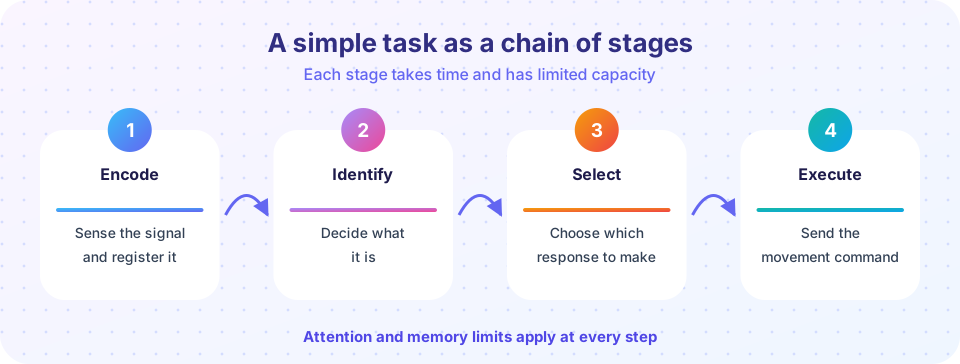
When a traffic light turns green and you press the pedal, something happens in between. The light must be sensed and encoded, identified as green rather than red, linked to the rule "green means go", and turned into a muscle command. Information-processing models put each of these steps in a box and draw arrows for the flow of information. The point is not that boxes exist in the brain. The point is that such a diagram makes predictions: if you make one stage harder, the total time should rise by a measurable amount, and the stage you changed should show it.
Stages take time
Reaction time is the sum
Attention is limited
Lesson 3 of this chapter
Memory has a workspace
Lesson 4 of this chapter
What each lesson covers
- Reaction time and stages shows how F. C. Donders and Saul Sternberg turned a stopwatch into a stage-measuring tool.
- Attention and filtering follows the cocktail party problem and the debate about where selection happens.
- Working memory and capacity covers Miller's limit, chunking and Baddeley's multi-part model.
- Chapter 2 review pulls everything together.
Why stage models have been so productive, and where they fall short
They are productive because they are testable. They gave psychology a shared language of limits, delays and flows, and they connected naturally to computer programs, where information also moves through steps. They fall short when the mind does several things at once, when processing is graded rather than all-or-nothing, and when top-down expectations change early stages. Later chapters (especially connectionist models in chapter 5) address those limitations. Think of stage models as a first map: very useful, but never the whole territory.
Common misconceptions
"Each box is a place in the brain." Boxes are functional components in a theory. A box may involve many regions, and one region may serve many boxes.
"Stages must run strictly one after another." Many tasks overlap stages. Whether stages are strictly serial is itself an empirical question.
Try it
Build your own stage chain. Drag the sliders to set how long each stage takes (these numbers are invented, for demonstration only) and watch the total reaction time.
The same idea as a stacked bar chart for three hypothetical tasks. The numbers are made up to show how extra stages lengthen total time.
Press Run (or Ctrl + Enter) to see the result here.
Program input · what you'd type while the program runs
Type the answers before you press Run, one per line. Each time the program reads a line (with input()), it gets the next line from this box.
Check your understanding
Quick check · 4 questions
of 4 answered You scored / 4 · perfect!
-
1. What is the main value of a box-and-arrow information-processing model?
Stage models predict, for example, that adding a stage lengthens reaction time. -
2. Which of the following is a bottleneck?
A bottleneck is a processing stage with limited capacity that makes other information wait. -
3. A weakness of strictly serial stage models is that
Many tasks involve parallel, overlapping processing, which later models address. -
4. Which lesson in this chapter introduces Baddeley's multi-part model?
Baddeley and Hitch's model of working memory is covered in the lesson on working memory and capacity.
Summary
- Information-processing models split a task into stages with limited capacity.
- Their strength is testable predictions, especially about timing.
- Boxes are theoretical components, not brain locations, and strict seriality is an assumption to be tested.
- Chapter 2 covers reaction time, attention and working memory.
Next: Reaction time and stages
Track your progress
Create a free account to tick off lessons and pick up where you left off on any device.
of Cognitive Science lessons completed